Palestinians launch postcodes in assertion of sovereignty

1 / 4
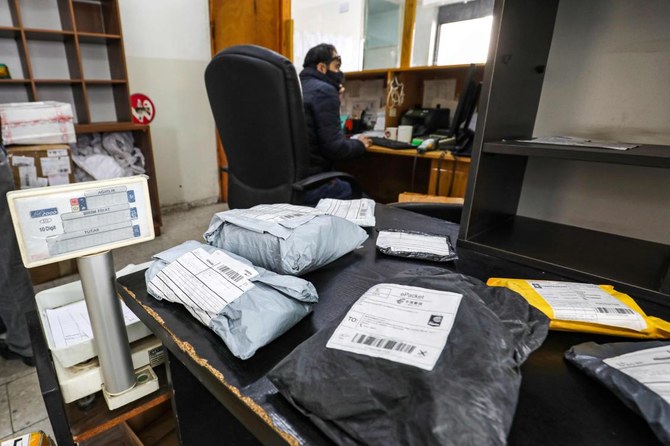
Mail packages are seen at a post office in the city of al-Bireh, about 15 kilometres north of Jerusalem in the occupied West Bank, on February 7, 2021. (AFP)
2 / 4
A man is assisted at a post office in the city of al-Bireh, about 15 kilometres north of Jerusalem in the occupied West Bank, on February 7, 2021. (AFP)
3 / 4
A man walks out of a post office in the city of al-Bireh, about 15 kilometres north of Jerusalem in the occupied West Bank, on February 7, 2021. (AFP)
4 / 4
Palestinian postal workers examine a mail package at a post office in the city of al-Bireh, about 15 kilometres north of Jerusalem in the occupied West Bank, on February 7, 2021. (AFP)
Short Url
Updated 08 February 2021
Follow

Palestinians launch postcodes in assertion of sovereignty

  • International mail sent to or from the occupied West Bank currently has to pass through Jordan or Israel
  • But the PA is now saying that Palestinian postal codes were coming into force

RAMALLAH: The Palestinian Authority announced Sunday it would begin using its own postal codes, a move at easing the delivery of parcels in the occupied territories as well as asserting sovereignty.
International mail sent to or from the occupied West Bank currently has to pass through Jordan or Israel.
But the PA said Sunday it had asked the Universal Postal Union to notify its member states that Palestinian postal codes were coming into force.
“From April, postal items that do not bear a Palestinian postal code will not be processed,” Palestinian Minister of Communications Ishaq Sidr told reporters in Ramallah, the West Bank headquarters of the Palestinian Authority.
“It is a question of asserting Palestinian rights,” he said.
Palestinian postal codes would also help put an end to the seizure of shipments from abroad, Sidr said.
He said six tons of packages had been held up in Jordan since 2018, and accused Israel of obstructing deliveries.
Using postcodes “will prevent Israel from seizing postal items that come to Palestine, and will help make the services more efficient,” Imad Al-Tumayzi, head of international relations at the Palestinian Post, told AFP.
“In 2020, we recorded more than 7,000 violations of postal equipment on the Israeli side, whether by opening packages, seizing them or summoning their owners for investigation,” he said.
Palestinians have complained that they are forced to use costly private courier services to send or receive parcels.
But it was not clear if the application of postal codes would cut mailing costs.
Official PA news agency Wafa said some half a million buildings in the West Bank had already been given postcodes.
It said the rollout would soon be extended to the Gaza Strip, under Israeli blockade and controlled by Islamists Hamas.
In the West Bank, a Palestinian postal worker who asked not to be named, said the new postcodes were “more symbolic than practical.”
“Postal coding can only truly be implemented when the Palestinian Authority controls ports or airports,” he said.
The West Bank, wedged between Israel and Jordan, has no operational civilian airport.


Fire from Iran, Lebanon triggers sirens across Israel

Updated 2 min 26 sec ago
Follow

Fire from Iran, Lebanon triggers sirens across Israel

  • Alerts were sounded in Jerusalem, Tel Aviv, Haifa and several other northern regions
  • The Israeli army had noticed a gradual decrease in the number of Iranian missiles launched at Israel since Saturday
JERUSALEM: The Israeli military said it had detected multiple missile barrages from Iran on Wednesday, as well as launches from Lebanon, but added that the number of missiles fired from the Islamic republic at Israel was declining.
AFP journalists heard several blasts and multiple rounds of sirens from Jerusalem, while alerts also sounded in Tel Aviv, central Israel, Haifa and several other northern regions.
“The IDF identified missiles launched from Iran toward the territory of the State of Israel. Defensive systems are operating to intercept the threat,” the military said four times throughout the afternoon and early evening.
In a statement shortly after the first salvo was announced, the military said that “several launches... from Lebanon toward Israeli territory were successfully intercepted” after sirens sounded in central Israel.
The new salvos came on the fifth day of the Middle East war, which began on Saturday with joint US-Israeli strikes on Iran.
Lebanon was dragged into the war on Monday when the Tehran-backed Hezbollah group launched an attack on Israel to “avenge” the killing of Iran’s supreme leader Ayatollah Ali Khamenei, prompting ongoing Israeli air strikes.
Israeli military spokesman Lt. Col. Nadav Shoshani told reporters Wednesday evening that the army had noticed a gradual decrease in the number of Iranian missiles launched at Israel since the start of the war.
“We are speaking about many dozens the first day going down gradually to a few dozen and very low amounts,” he said.
“The barrages are much smaller. Today, some of them weren’t even a barrage, they were just one missile,” he added.
Shoshani said that some projectiles were launched from Iraq too, where some militias act as Iran proxies.
“We’ve seen small amounts of fire coming from Iraq, mostly UAVs (drones), but the vast majority of fire is from Iran and now from Hezbollah,” he said.
Israel’s Magen David Adom (MDA) emergency services said they had evacuated to hospital two people in central Israel with mild injuries, including “a man of about 30 with shrapnel wounds and another casualty with blast injuries.”
Police said in a statement that officers were dispatched to five locations in the Jerusalem area “where various intercepted projectiles had fallen, causing only damage.”
The military said that the “majority of the launches” from Lebanon were intercepted.
Not including Wednesday’s figures, MDA said that since the start of the war its teams had provided medical treatment to 414 casualties including “10 fatalities, 2 seriously injured, 6 moderately injured and 396 lightly injured.”