

Pakistan’s first fashion week since pandemic brings wedding looks centre stage

Models display latest creations by designer Ali Xeeshan during Pakistan’s Bridal Couture Week in Lahore on Feb. 5, 2021. (Photo courtesy: PHBCW)
Short Url
Updated 06 February 2021
Follow

Pakistan’s first fashion week since pandemic brings wedding looks centre stage

  • Three nights dedicated to bridal fashion showcased the latest from Pakistani designers
  • Show organizers say event reflects return of normalcy to every day life

RAWALPINDI: Pakistan’s first fashion week since the start of the pandemic concluded in the eastern city of Lahore on Saturday at a luxury hotel, after three nights of wedding fashion.
For the last year, since Pakistan’s first coronavirus related lockdown in March 2020, fashion shows have taken place virtually or with designers opting for individual, socially distant presentations.
Sultana Siddiqui, president of entertainment conglomerate HUM Network which is the primary sponsor of the show, said in a press release that the show was being presented on schedule “to bring normalcy to everyday life.”
Bridal Couture Week’s fashion ramp is dedicated to showcasing bridal fashion, which highlights wedding centric trends usually consisting of heavily embellished outfits glittering under the stage lights.
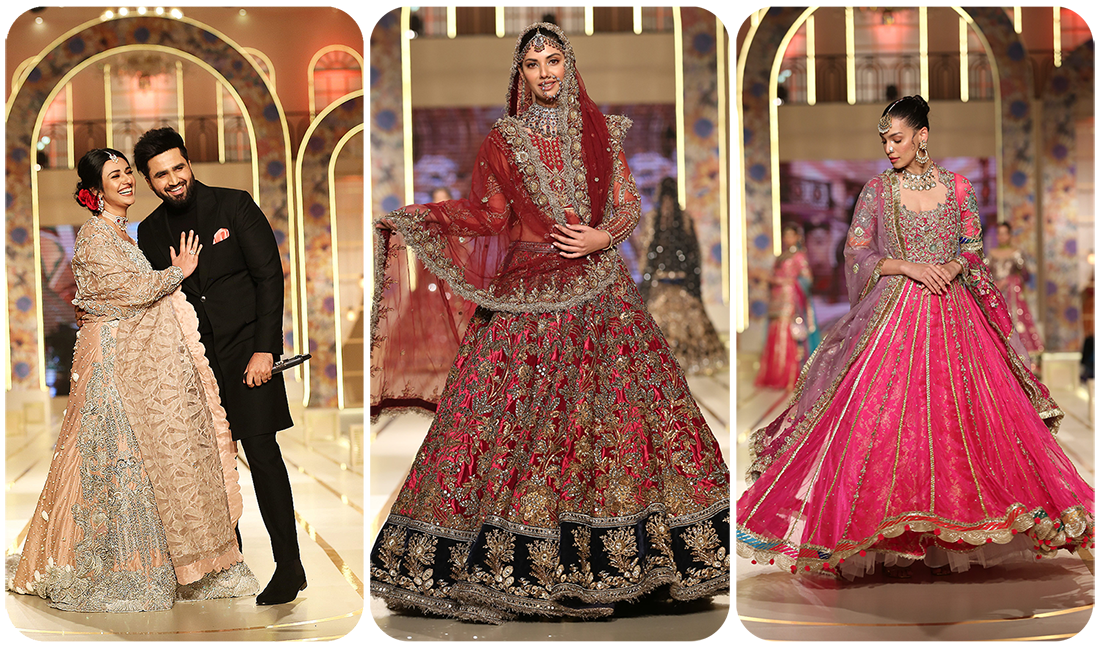


Models display latest creations by designers Madeeha Shoaib, Kashee’s and Tabya during Pakistan’s Bridal Couture Week in Lahore on Feb. 5, 2021. (Photo courtesy: PHBCW)


The organizers have said they pride bridal couture week as a place for fashion but also for business, where designers-- both emerging and established-- bring their most sought after designs to the limelight for buyers in Pakistan and abroad.
Designers have been sharing their own behind-the-scenes coverage of the return to fashion week, including menswear designer, Munib Nawaz, who told Arab News on Friday that his collection was in alignment with fashion week taking place-- one that wanted to represent "life."


"I wanted to create and show a collection that represented how I felt, wanting to feel happy, and welcoming a state where we could celebrate again," Nawaz said.
"Fashion is a celebration of life and being back on the ramp feels great, it feels important for us to show that the show must go on, the show being life itself."


Pakistan PM expresses solidarity with Morrocco as building collapse kills 22

Updated 7 sec ago
Follow

Pakistan PM expresses solidarity with Morrocco as building collapse kills 22

  • Two adjacent four-story buildings, housing eight families, collapsed in Morocco’s Fez city on Wednesday
  • Such building collapses are not uncommon in Moroccan cities that are undergoing rapid population growth

ISLAMABAD: Prime Minister Shehbaz Sharif expressed solidarity with Morocco and prayed for rescue efforts on Thursday as 22 people were reported dead after two buildings collapsed in the country’s Fez city. 

Morocco’s state news agency, MAP, reported on Wednesday that two adjacent four-story buildings, which housed eight families, collapsed overnight in Fez. Sixteen people were injured and taken to the hospital as authorities said the neighborhood had been evacuated, and search and rescue efforts were ongoing. 

Moroccan authorities said they had opened an investigation into the incident, while MAP reported that the structures were built in 2006 during an initiative called “City Without Slums.”

“My heartfelt condolences to the bereaved families and prayers for the swift recovery of the wounded,” Sharif wrote on social media platform X. “We stand in solidarity with the Government and people of Morocco in this hour of grief, and pray for the success of the ongoing rescue efforts.”

https://x.com/CMShehbaz/status/1998940192879911417

Such building collapses are not uncommon in Moroccan cities undergoing rapid population growth. A collapse in May in Fez killed 10 people and injured seven in a building that had been slated for evacuation, according to Moroccan outlet Le360.

Building codes are often not enforced in Morocco, especially in ancient cities where aging, multifamily homes of cinderblock are common. 

Infrastructure inequality was a focus of protests that swept the country earlier this year, with demonstrators criticizing the government for investing in new stadiums instead of addressing inequality in health care, education and other public services.

With additional input from AP