

India to lift lengthy Internet clampdown in Kashmir: official

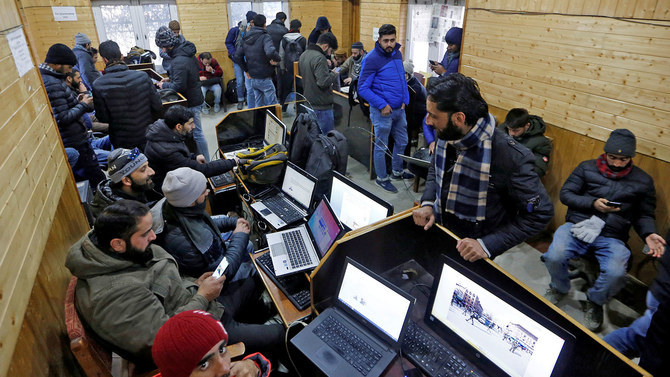
In this file photo, journalists use the internet as they work inside a government-run media centre in Srinagar on Jan. 10, 2020. (REUTERS)
Short Url
Updated 06 February 2021
Follow

India to lift lengthy Internet clampdown in Kashmir: official

  • New Delhi imposed communications shutdown on August 5, 2019, making this one of the world’s longest web clampdowns
  • India restricted Internet access more often than any other country in 2020

Authorities in Indian-administered Kashmir said Friday they would restore high-speed web access in the region, bringing to an end what rights groups have called one of the world’s longest Internet clampdowns.
New Delhi imposed a communications shutdown on August 5, 2019 in restive Kashmir to quell unrest after it revoked the region’s semi-autonomy and brought it under direct rule.

Access to slow, 2G Internet for mobile and fixed-line subscribers was restored in March 2020, but high-speed 4G access remained blocked.
Authorities then issued fortnightly orders restricting mobile data speeds, with the latest rolling ban due to expire on Saturday.
“4G mobile Internet services being restored in entire J&K,” Rohit Kansal, a spokesman for the Jammu & Kashmir territory, tweeted late Friday.
No further details were released, but an AFP journalist in Kashmir’s main city of Srinagar reported a jump in mobile Internet speeds just before midnight local time.
The 4G announcement follows international scrutiny on Internet blackouts around India’s capital New Delhi, where farmers protesting new agriculture laws have been camping out for more than two months.
Pop superstar Rihanna and climate activist Greta Thunberg tweeted a link to a news story about the blackouts and commented on the protests Tuesday, triggering a furious response from the foreign ministry which slammed the “sensationalist” social media comments.
In Kashmir, officials had said Internet restrictions were needed to clamp down on protests and prevent armed rebels — who have been challenging Indian rule since 1989 in fighting that has killed tens of thousands of people, mostly civilians — from launching attacks on government forces.
Apart from the shutdown, authorities often cut access to mobile Internet services in parts of the region, fearing unrest or during gunbattles between rebels and Indian soldiers.
India — the world’s biggest democracy — restricted Internet access more often than any other country in 2020, imposing over 75 blackouts, many in Kashmir, according to British virtual private networks review site Top10VPN.com.
Human Rights Watch last year called for full Internet access to be restored in Kashmir, saying it had badly affected businesses, students’ access to education and medical services during the coronavirus pandemic.


Colorado funeral home owner who abused nearly 200 corpses gets 40 years

Updated 4 sec ago
Follow

Colorado funeral home owner who abused nearly 200 corpses gets 40 years

  • Hallford’s attorney unsuccessfully sought a 30 year sentence, arguing that it was not a crime of violence

COLORADO SPRINGS: A Colorado funeral home owner who stashed 189 decomposing bodies in a building over four years and gave grieving families fake ashes was sentenced to 40 years in state prison on Friday.

During the sentencing hearing, family members told Judge Eric Bentley they have had recurring nightmares about decomposing flesh and maggots since learning what happened to their loved ones.

They called defendant Jon Hallford a “monster” and urged the judge to give him the maximum sentence of 50 years.

Bentley told Hallford he caused “unspeakable and incomprehensible” harm. “It is my personal belief that every one of us, every human being, is basically good at the core, but we live in a world that tests that belief every day, and Mr. Hallford your crimes are testing that belief,” Bentley said.

Hallford apologized before his sentencing and said he would regret his actions for the rest of his life. “I had so many chances to put a stop to everything and walk away, but I did not,” he said. “My mistakes will echo for a generation. Everything I did was wrong.”

Hallford’s attorney unsuccessfully sought a 30 year sentence, arguing that it was not a crime of violence and he had no prior criminal record.

His former wife, Carie Hallford, who co-owned the Return to Nature Funeral Home, is due to be sentenced April 24. She faces 25 to 35 years in prison.

Both pleaded guilty in December to nearly 200 counts of corpse abuse under an agreement with prosecutors.

During the years they were stashing bodies, the Hallfords spent lavishly. That included purchasing a GMC Yukon and an Infiniti worth over $120,000 combined, along with $31,000 in cryptocurrency, pricey goods from stores like Gucci and Tiffany & Co. and laser body sculpting.