

IAEA inspectors find new evidence of Iran’s undeclared nuclear work — WSJ

Short Url
Updated 06 February 2021
Follow

IAEA inspectors find new evidence of Iran’s undeclared nuclear work — WSJ

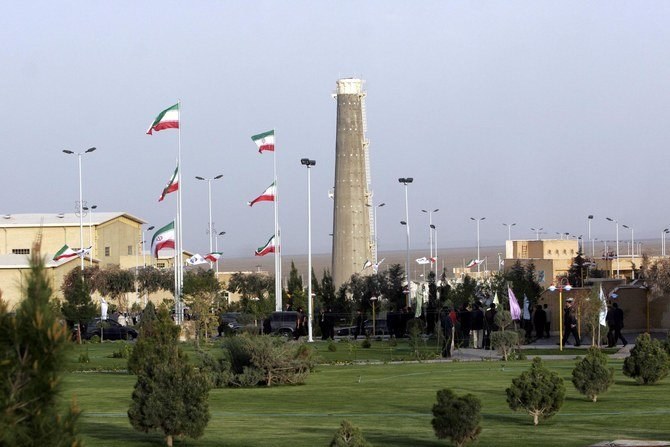
RIYADH: UN inspectors have unearthed fresh evidence that Iran had undertaken work on nuclear weapons without declaring such activities, the Wall Street Journal reported on Saturday.

"Samples taken from two sites during inspections in the fall by the U.N.’s International Atomic Energy Agency (IAEA) contained traces of radioactive material," the report said, quoting diplomats briefed on the discovery.

While the diplomats said they didn’t know the exact nature of what was found, the discovery raises new questions about the scope of Iran’s nuclear ambitions, it added.

Tehran has repeatedly asserted that its nuclear program was for peaceful purposes such as generating energy, but it has blocked IAEA inspectors from checking suspected sites. 

It has increased its nuclear activities after former US President Donald Trump pulled his country out of the 2015 nuclear deal Iran signed with the US, European Union, Russia and China. 

Iran's nuclear ambitions is being opposed by its Arab neighbors as well as by Israel, citing its record as a trouble-maker. Iran's mullah regime has been accused of supporting militias such as the Houthis in Yemen, the Hezbollah in Lebanon and others in Iraq and the Palestinian territories.


Sudanese trek through mountains to escape Kordofan fighting

Updated 3 sec ago
Follow

Sudanese trek through mountains to escape Kordofan fighting

  • For eight days, Sudanese farmer Ibrahim Hussein led his family through treacherous terrain to flee the fighting in southern Kordofan — the latest and most volatile front in the country’s 31-month-old
PORT SUDAN: For eight days, Sudanese farmer Ibrahim Hussein led his family through treacherous terrain to flee the fighting in southern Kordofan — the latest and most volatile front in the country’s 31-month-old conflict.
“We left everything behind,” said the 47-year-old, who escaped with his family of seven from Keiklek, near the South Sudanese border.
“Our animals and our unharvested crops — all of it.”
Hussein spoke to AFP from Kosti, an army-controlled city in White Nile state, around 300 kilometers (186 miles) south of Khartoum.
The city has become a refuge for hundreds of families fleeing violence in oil-rich Kordofan, where the Sudanese army and the Rapid Support Forces (RSF) — locked in a brutal war since April 2023 — are vying for control.
Emboldened by their October capture of the army’s last stronghold in Darfur, the RSF and their allies have in recent weeks descended in full force on Kordofan, forcing nearly 53,000 people to flee, according to the United Nations.
“For most of the war, we lived in peace and looked after our animals,” Hussein said.
“But when the RSF came close, we were afraid fighting would break out. So we left, most of the way on foot.”
He took his family through the rocky spine of the Nuba Mountains and the surrounding valley, passing through both paramilitary and army checkpoints.
This month, the RSF consolidated its grip on West Kordofan — one of three regional states — and seized Heglig, which lies on Sudan’s largest oil field.
With their local allies, they have also tightened their siege on the army-held cities of Kadugli and Dilling, where hundreds of thousands face mass starvation.

- Running for their lives -

In just two days this week, nearly 4,000 people arrived in Kosti, hungry and terrified, said Mohamed Refaat, Sudan chief of mission for the UN’s International Organization for Migration.
“Most of those arriving are women and children. Very few adult men are with them,” he told AFP, adding that many men stay behind “out of fear of being killed or abducted.”
The main roads are unsafe, so families are taking “long and uncertain journeys and sleeping wherever they can,” according to Mercy Corps, one of the few aid agencies operating in Kordofan.
“Journeys that once took four hours now force people to walk for 15 to 30 days through isolated areas and mine-littered terrain,” said Miji Park, interim country director for Sudan.
This month, drones hit a kindergarten and a hospital in Kalogi in South Kordofan, killing 114 people, including 63 children, according to the World Health Organization.
Adam Eissa, a 53-year-old farmer, knew it was time to run. He took his wife, four daughters and elderly mother — all crammed into a pickup truck with 30 others — and drove for three days through “backroads to avoid RSF checkpoints,” he told AFP from Kosti.
They are now sheltering in a school-turned-shelter housing around 500 displaced people.
“We receive some help, but it is not enough,” said Eissa, who is trying to find work in the market.
According to the IOM’s Refaat, Kosti — a relatively small city — is already under strain. It hosts thousands of South Sudanese refugees, themselves fleeing violence across the border.
It cost Eissa $400 to get his family to safety. Anyone who does not have that kind of money — most Sudanese, after close to three years of war — has to walk, or stay behind.
Those left behind
According to Refaat, transport prices from El-Obeid in North Kordofan have increased more than tenfold in two months, severely “limiting who can flee.”
In besieged Kadugli, 56-year-old market trader Hamdan is desperate for a way out, “terrified” that the RSF will seize the city.
“I sent my family away a while ago with my eldest son,” he told AFP via satellite Internet connection, asking to be identified only by his first name. “Now I am looking for a way to leave.”
Every day brings “the sound of shelling and sometimes gunfire,” said Kassem Eissa, a civil servant and head of a family of eight.
“I have three daughters, the youngest is 14,” he told AFP, laying out an impossible choice: “Getting out is expensive and the road is unsafe” but “we’re struggling to get enough food and medicine.”
The UN has issued repeated warnings of the violence in Kordofan, raising fears of atrocities similar to those reported in the last captured city in Darfur, including summary executions, abductions and rape.
“If a ceasefire is not reached around Kadugli,” Refaat said, “the scale of violence we saw in El-Fasher could be repeated.”