

Amnesty, UN raise alarm over Iran minority executions

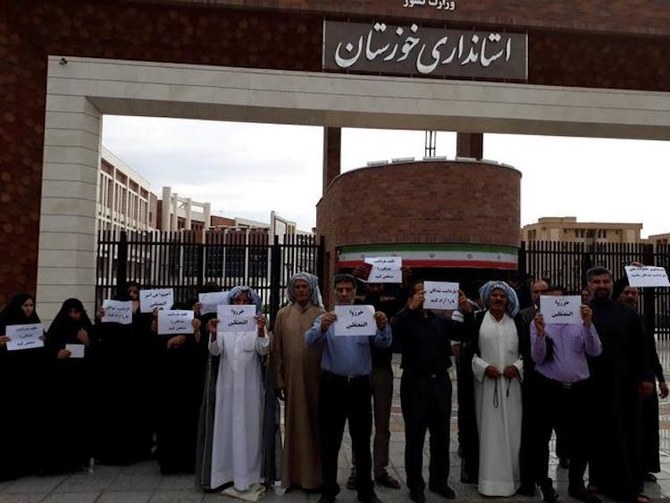
Families of prisoners protest in front of the governor’s office in Ahvaz, Iran, April 16, 2018. (Reuters)
Short Url
Updated 05 February 2021
Follow

Amnesty, UN raise alarm over Iran minority executions

  • Rights groups increasingly concerned at treatment of country’s ethnic minorities
  • Amnesty slams ‘recent escalation in executions of Baluchis and Ahwazi Arabs’

LONDON: Amnesty International has urged Tehran to “immediately halt” plans to execute eight people, including four Ahwazi Arabs, and condemned the country’s “alarming rise” in executions of ethnic minority prisoners.

“The recent escalation in executions of Baluchis and Ahwazi Arabs raises serious concerns that the authorities are using the death penalty to sow fear among disadvantaged ethnic minorities, as well as the wider population,” said Diana Eltahawy, deputy director for the Middle East and North Africa at Amnesty. 

“The disproportionate use of the death penalty against Iran’s ethnic minorities epitomizes the entrenched discrimination and repression they have faced for decades.”

Among those minorities regularly targeted by Tehran are the Ahwazi Arabs, four of which are currently facing execution. 

Three of them — Ali Khasraji, Hossein Silawi and Jassem Heidari — have sewn their lips shut and are currently on hunger strike, Amnesty said.

The fourth, Naser Khafajian, has been forcibly disappeared and is at risk of torture or summary execution.

At least four Balochis are also facing imminent execution, just days after the hanging of Balochi Javid Dehghan.

Javaid Rehman, UN special rapporteur on the situation of human rights in Iran, said Dehghan was executed despite “serious violations of his fair trial rights, including claims he was tortured.”

Rehman and other UN experts slammed the decision to execute Dehghan despite serious miscarriages of justice during his trial.

“International human rights law is clear,” they said. “A state that has not abolished the death penalty can only implement it for a ‘most serious crime’ involving intentional killing and following a judicial process that strictly adheres to fair trial and due process guarantees.

“The concerns raised in this case of serious fair trial violations, including lack of an effective right of appeal and a torture-induced forced confession, mean that the Iranian Government’s implementation of his death sentence amounts to an arbitrary execution.”

Thursday’s statements from Amnesty and the UN followed a joint letter sent on Wednesday by a coalition of rights groups denouncing Iran’s treatment and arbitrary arrests of members of its Kurdish minority population. 

The signatories said “based on past patterns of documented human rights violations by the Iranian authorities,” they were seriously concerned that detained Kurdish citizens could be “at risk of torture or other ill-treatment aimed at extracting forced ‘confessions,’ and that these may be later used in grossly unfair trials for spurious national security related offenses.”

Soleimani’s shadow
Qassem Soleimani left a trail of death and destruction in his wake as head of Iran’s Quds Force … until his assassination on Jan. 3, 2020. Yet still, his legacy of murderous interference continues to haunt the region

Enter


keywords

MSF calls Israeli ban a ‘grave blow’ to Gaza aid

Updated 10 sec ago
Follow

MSF calls Israeli ban a ‘grave blow’ to Gaza aid

  • Doctors Without Borders is among 37 foreign humanitarian organizations banned from the territory
  • The group, which has hundreds of staff in Gaza, says: 'Denying medical assistance to civilians is unacceptable'
JERUSALEM: International charity Doctors Without Borders Friday condemned a “grave blow to humanitarian aid” after Israel revoked the status it needs to operate in Gaza for refusing to share Palestinian staff lists.
Israel on Thursday confirmed it had banned access to the Gaza Strip to 37 foreign humanitarian organizations for refusing to share lists of their Palestinian employees.
Doctors Without Borders (MSF), which has 1,200 staff members in the Palestinian territories, the majority of them in Gaza, said in a statement that “denying medical assistance to civilians is unacceptable under any circumstances.”
The medical organization argued that it had “legitimate concerns” over new Israeli requirements for foreign NGO registration, specifically the disclosing of personal information about Palestinian staff.
It pointed to the fact that 15 MSF staff had been “killed by Israeli forces,” and that access to any given territory should not be conditional on staff list disclosure.
“Demanding staff lists as a condition for access to territory is an outrageous overreach,” the charity said.
MSF also denounced “the absence of any clarity about how such sensitive data will be used, stored, or shared,” charging that Israeli forces “have killed and wounded hundreds of thousands of civilians” in Gaza during the course of the war.
It also charged that Israel had “manufactured shortages of basic necessities by blocking and delaying the entry of essential goods, including medical supplies.”
Israel controls and regulates all entry points into Gaza, which is surrounded by a wall that began to be built in 2005.
Felipe Ribero, MSF head of mission in the Palestinian territories, told AFP that all of its operations were still ongoing in Gaza.
“We are supposed to leave under 60 days, but we don’t know whether it will be three or 60 days” before Israeli authorities force MSF to leave, he said.
Prominent humanitarian organizations hit by the Israeli ban include the Norwegian Refugee Council (NRC), World Vision International and Oxfam, according to an Israeli ministry list.
The ban, which came into effect on December 31, 2025 at midnight, has triggered widespread international condemnation.
Israel says the new regulation aims to prevent bodies it accuses of supporting terrorism from operating in the Palestinian territories.
MSF says it currently supports one in five hospital beds in Gaza and assists one in three mothers in the territory, and urged the Israeli authorities to meet to discuss the ban.
