

Archaeologists make new discoveries in Egypt

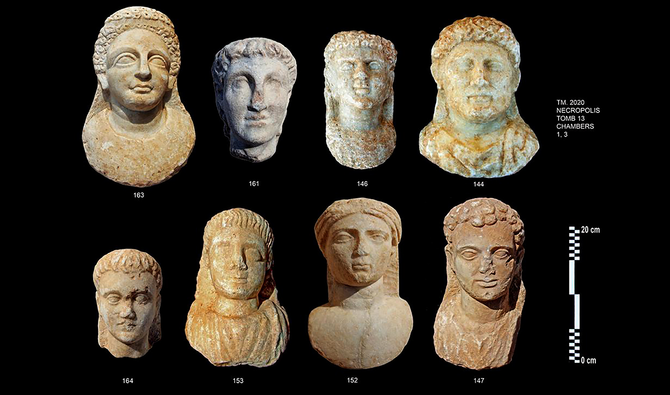
A handout picture released by the Egyptian Ministry of Tourism and Antiquities on January 29, 2021 shows marble masks dating back to the Greek and Roman eras uncovered at the Taposiris Magna Temple in western Alexandria. (AFP)
Short Url
Updated 03 February 2021
Follow

Archaeologists make new discoveries in Egypt

  • Egypt’s Ministry of Tourism and Antiquities announced last June the new archaeological find in the coastal city

CAIRO: Archaeologists have discovered 16 new tombs at the ancient Egyptian Taposiris Magna Temple in Alexandria, one of which contains a mummy bearing a gold tongue. Researchers say ancient Egyptians believed that such an accessory enabled the deceased to speak in the afterlife. Both the tongue and the mummy’s skeleton were found to be in good condition.

The Egyptian-Dominican mission of the Santo Domingo University, headed by Kathleen Martinez, contributed to the discovery. The university has been working on the site for nearly a decade.

Egypt’s Ministry of Tourism and Antiquities announced last June the new archaeological find in the coastal city. The 16 burials are in the Lockley stone-carved tombs, which were popular in Greco-Roman antiquity.

The ministry said that several of the mummies are in a poor state of preservation but nonetheless serve to highlight the characteristics of mummification in classical antiquity. The stone funerary masks are still intact, allowing the team to see what each person looked like.

Burial corridors, dating back 2,000 years and containing the remains of the deceased within a mountain or natural rock formation, were common in the Greco-Roman period.

The other 15 tombs also date back about 2,000 years. One contains a female mummy wearing a death mask, which covers most of her body and portrays her smiling and donning a head covering. 

Two more mummies were found with the remains of scrolls, which scientists are currently analyzing and deciphering.

Inside the temple, the team of archaeologists had previously discovered several coins engraved with the face of Queen Cleopatra VII, indicating that she ruled at the time when several individuals were buried in the tombs.

Statues and temple grounds reveal that King Ptolemy IV built the temple.


‘One in a Million’: Syrian refugee tale wows Sundance

Updated 24 January 2026
Follow

‘One in a Million’: Syrian refugee tale wows Sundance

PARK CITY: As a million Syrians fled their country's devastating civil war in 2015, directors Itab Azzam and Jack MacInnes headed to Turkey where they would meet a young girl who encapsulated the contradictions of this enormous migration.

In Ismir, they met Isra'a, a then-11-year-old girl whose family had left Aleppo as bombs rained down on the city, and who would become the subject of their documentary "One In A Million," which premiered at the Sundance Film Festival on Friday.

For the next ten years, they followed her and her family's travels through Europe, towards Germany and a new life, where the opportunities and the challenges would almost tear her family apart.

The film is by directors Itab Azzam and Jack MacInnes. (Supplied)

There was "something about Isra'a that sort of felt to us like it encapsulated everything about what was happening there," MacInnes told an audience at the Sundance Film Festival in Park City, Utah on Friday.

"The obvious vulnerability of her situation, especially as being a child going through this, but that at the same time, she was an agent.

"She wasn't sitting back, waiting for other people to save her. She was trying to fight, make her own way there."

The documentary mixes fly-on-the-wall footage with sit-down interviews that reveal Isra'a's changing relationship with Germany, with her religion, and with her father.

It is this evolution between father and daughter that provides the emotional backbone to the film, and through which tensions play out over their new-found freedoms in Europe -- something her father struggles to adjust to.

Isra'a, who by the end of the film is a married mother living in Germany, said watching her life on film in the Park City theatre was "beautiful."

And having documentarists follow her every step of the way as she grew had its upsides.

"I felt like this was something very special," she told the audience after the screening. "My friends thought I was famous; it made making friends easier and faster."