

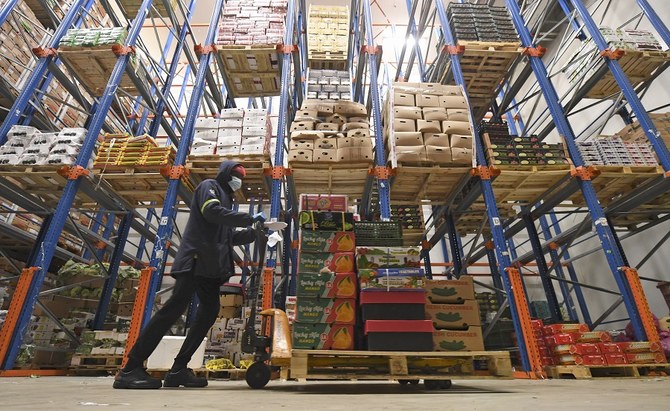
UAE’s surge in e-commerce boosts demand for warehouse space

The report said the arrival of online retail giants such as Amazon and Noon has seen increased demand for next-day or same-delivery options from customers. (File/AFP)
Short Url
Updated 02 February 2021
Follow

UAE’s surge in e-commerce boosts demand for warehouse space

  • Deloitte predicts that this will create a need for local delivery hubs close to major residential and business districts

The surge in growth in the e-commerce sector in the region has seen increased demand for warehousing space in Dubai, but owners are witnessing a tightened market as tenants push for lower rents and better contract terms, according to a new industry report.

“Growth in the e-commerce segment has increased the requirement for storage and fulfilment centres, boosting the demand for warehouses,” global consultancy firm Deloitte said in its latest Dubai real estate report.

“Further expansion in the e-commerce and cargo sectors is expected in the short to medium term, with more design and build for specific end users, as opposed to speculative build.”

The report said the arrival of online retail giants such as Amazon and Noon has seen increased demand for next-day or same-delivery options from customers.

Deloitte predicts that this will create a need for local delivery hubs close to major residential and business districts.

While demand is growing, the report found that warehouse rents for newly built facilities developed to international standards ranged from 22 UAE dirhams ($5.99) to 35 dirhams per square feet in 2020. This compared to 28-40 dirhams in 2019.

Deloitte observed that “liquidity considerations due to the constrained business environment during 2020 has meant that a number of small and medium enterprises are now seeking annual lease contracts.”

Previously, landlords were able to demand three- or five-year contracts as standard for warehouse and industrial contracts.

The increased demand for warehouse space is a direct result of continued growth in the UAE’s e-commerce sector.

According to figures by research website Statista, revenue in the sector is projected to reach $7.456 billion in 2021 and grow at a compound annual rate of 10.3 percent to reach $11.034 billion by 2025.

In November, a survey by payment company Visa and Dubai Economy found that 49 percent of respondents in the UAE said they have been shopping more online during the pandemic.

The survey also found that consumers in the country have the biggest annual spend per online shopper, at $1,648.

Additionally, UAE online shoppers spend an average of $122 per transaction, compared to $76 in mature markets and $22 in emerging markets.


Saudi POS spending jumps 28% in final week of Jan: SAMA

Updated 06 February 2026
Follow

Saudi POS spending jumps 28% in final week of Jan: SAMA

RIYADH: Saudi Arabia’s point-of-sale spending climbed sharply in the final week of January, rising nearly 28 percent from the previous week as consumer outlays increased across almost all sectors. 

POS transactions reached SR16 billion ($4.27 billion) in the week ending Jan. 31, up 27.8 percent week on week, according to the Saudi Central Bank. Transaction volumes rose 16.5 percent to 248.8 million, reflecting stronger retail and service activity. 

Spending on jewelry saw the biggest uptick at 55.5 percent to SR613.69 million, followed by laundry services which saw a 44.4 percent increase to SR62.83 million. 

Expenditure on personal care rose 29.1 percent, while outlays on books and stationery increased 5.1 percent. Hotel spending climbed 7.4 percent to SR377.1 million. 

Further gains were recorded across other categories. Spending in pharmacies and medical supplies rose 33.4 percent to SR259.19 million, while medical services increased 13.7 percent to SR515.44 million. 

Food and beverage spending surged 38.6 percent to SR2.6 billion, accounting for the largest share of total POS value. Restaurants and cafes followed with a 20.4 percent increase to SR1.81 billion. Apparel and clothing spending rose 35.4 percent to SR1.33 billion, representing the third-largest share during the week. 

The Kingdom’s key urban centers mirrored the national surge. Riyadh, which accounted for the largest share of total POS spending, saw a 22 percent rise to SR5.44 billion from SR4.46 billion the previous week. The number of transactions in the capital reached 78.6 million, up 13.8 percent week on week. 

In Jeddah, transaction values increased 23.7 percent to SR2.16 billion, while Dammam reported a 22.2 percent rise to SR783.06 million. 

POS data, tracked weekly by SAMA, provides an indicator of consumer spending trends and the ongoing growth of digital payments in Saudi Arabia.  

The data also highlights the expanding reach of POS infrastructure, extending beyond major retail hubs to smaller cities and service sectors, supporting broader digital inclusion initiatives.  

The growth of digital payment technologies aligns with Saudi Arabia’s Vision 2030 objectives, promoting electronic transactions and contributing to the Kingdom’s broader digital economy.