Senate approves bill making Arabic classes compulsory at Islamabad schools

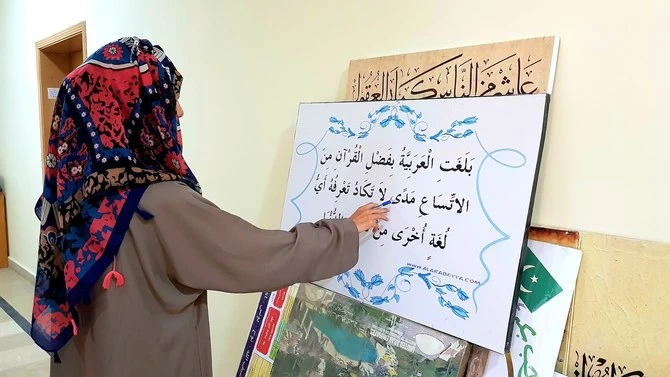
A student learns Arabic at the NUML University’s Arabic department in Islamabad, Pakistan, on September 19, 2019. (AN photo by Sana Jamal)
Short Url
Updated 02 February 2021
Follow

Senate approves bill making Arabic classes compulsory at Islamabad schools

  • Senators argue teaching of Arabic would open up more job opportunities for Pakistanis in the Middle East and more remittances
  • Bill approved by all members of Senate except Raza Rabbani from the opposition Pakistan People’s Party who gave a dissenting note

ISLAMABAD: Pakistan’s upper house of parliament on Monday approved the Compulsory Teaching of the Arabic Language Bill 2020 which makes Arabic classes mandatory at all primary and secondary schools in the capital, Islamabad, Pakistani media reported. 

The bill, which is to be implemented within a period of six months, was presented by opposition senator Javed Abbasi and approved by all members of the Senate, except Raza Rabbani from the opposition Pakistan People’s Party who gave a dissenting note. 

The bill next requires approval by the National Assembly Standing Committee on Education and then by both the Senate and National Assembly to become law. 

“We would not go through the problems we are currently facing if we understood the Holy Qur’an,” Abbasi said on the floor of the house while arguing for the bill. 

Arabic, the official language of over 25 countries, would open up more job opportunities for Pakistanis in the Middle East and lead to lower unemployment and increased remittances, the senator said.

Minister of State for Parliamentary Affairs, Ali Muhammad Khan, concurred with Abbasi, saying that the government “categorically supported” the bill. He added that according to Article 31 of the constitution, “measures should be taken to spend our lives according to the Holy Qur’an and Sunnah.”

Rabbani, however, said the legislation was the state’s attempt to use “Islam for achieving a political agenda,” adding that such moves would eliminate Pakistan’s multicultural and multilingual diversity.

Imran Khan not a ‘national security threat,’ ex-PM’s party responds to Pakistan military

Updated 06 December 2025
Follow

Imran Khan not a ‘national security threat,’ ex-PM’s party responds to Pakistan military

  • Pakistan’s military spokesperson on Friday described Khan’s anti-army narrative as a “national security threat”
  • PTI Chairman Gohar Ali Khan says words used by military spokesperson for Khan were “not appropriate”

ISLAMABAD: Former prime minister Imran Khan’s Pakistan Tehreek-e-Insaf (PTI) party on Saturday responded to allegations by Pakistan military spokesperson Lt. Gen. Ahmed Sharif Chaudhry from a day earlier, saying that he was not a “national security threat.”

Chaudhry, who heads the military’s media wing as director general of the Inter-Services Public Relations (ISPR), spoke to journalists on Friday, in which he referred to Khan as a “mentally ill” person several times during the press interaction. Chaudhry described Khan’s anti-army narrative as a “national security threat.”

The military spokesperson was responding to Khan’s social media post this week in which he accused Chief of Defense Forces Field Marshal Asim Munir of being responsible for “the complete collapse of the constitution and rule of law in Pakistan.” 

“The people of Pakistan stand with Imran Khan, they stand with PTI,” the party’s secretary-general, Salman Akram Raja, told reporters during a news conference. 

“Imran Khan is not a national security threat. Imran Khan has kept the people of this country united.”

Raja said there were several narratives in the country, including those that created tensions along ethnic and sectarian lines, but Khan had rejected all of them and stood with one that the people of Pakistan supported. 

PTI Chairman Gohar Ali Khan, flanked by Raja, criticized the military spokesperson as well, saying his press talk on Thursday had “severely disappointed” him. 

“The words that were used [by the military spokesperson] were not appropriate,” Gohar said. “Those words were wrong.”

NATURAL OUTCOME’

Speaking to reporters earlier on Saturday, Pakistan’s Defense Minister Khawaja Asif defended the military spokesperson’s remarks against Khan.

“When this kind of language is used for individuals as well as for institutions, then a reaction is a natural outcome,” he said. 

“The same thing is happening on the Twitter accounts being run in his [Khan’s] name. If the DG ISPR has given any reaction to it, then I believe it was a very measured reaction.”

Khan, who was ousted after a parliamentary vote of confidence in April 2022, blames the country’s powerful military for removing him from power by colluding with his political opponents. Both deny the allegations. 

The former prime minister, who has been in prison since August 2023 on a slew of charges he says are politically motivated, also alleges his party was denied victory by the army and his political rivals in the 2024 general election through rigging. 

The army and the government both deny his allegations.