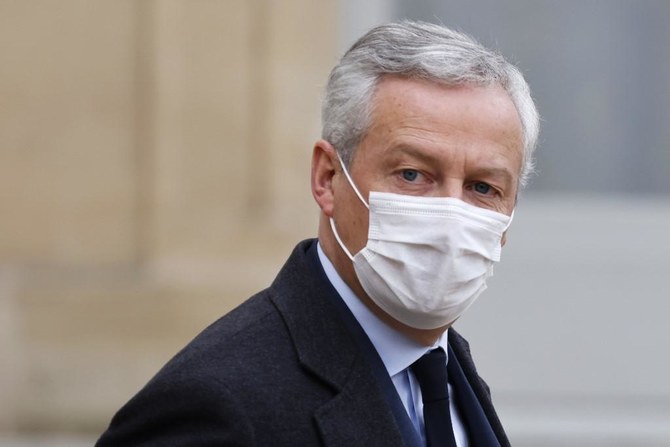
PARIS A new lockdown to curb the COVID-19 virus in France can only be a last resort, said French Finance Minister Bruno Le Maire on Monday, who added that the country’s current curfew measures were delivering results in terms of trying to contain the virus.
Le Maire told RTL radio that France’s current curfew from 6 p.m. to 6 a.m. cost the economy around $7.3 billion a month whereas a full lockdown would cost it around 15 billion euros a month.
France decided against imposing a third nationwide coronavirus lockdown on Friday.

French finance minister: New COVID lockdown can only be last resort
https://arab.news/6bejs
French finance minister: New COVID lockdown can only be last resort
Japan restarts world’s biggest nuclear plant
- Japan wants to revive atomic energy to reduce its reliance on fossil fuels
KARIWA: The world’s biggest nuclear power plant was restarted Wednesday for the first time since the 2011 Fukushima disaster, its Japanese operator said, despite persistent safety concerns among residents.
The plant was “started at 19:02” (1002 GMT), Tokyo Electric Power Company spokesman Tatsuya Matoba said of the Kashiwazaki-Kariwa plant in Niigata prefecture.
The regional governor approved the resumption last month, although public opinion remains sharply divided.
On Tuesday, a few dozen protesters — mostly elderly — braved freezing temperatures to demonstrate in the snow near the plant’s entrance, whose buildings line the Sea of Japan coast.
“It’s Tokyo’s electricity that is produced in Kashiwazaki, so why should the people here be put at risk? That makes no sense,” Yumiko Abe, a 73-year-old resident, told AFP.
Around 60 percent of residents oppose the restart, while 37 percent support it, according to a survey conducted in September.
TEPCO said Wednesday it would “proceed with careful verification of each plant facility’s integrity” and address any issues appropriately and transparently.
Kashiwazaki-Kariwa is the world’s biggest nuclear power plant by potential capacity, although just one reactor of seven was restarted.
The facility was taken offline when Japan pulled the plug on nuclear power after a colossal earthquake and tsunami sent three reactors at the Fukushima atomic plant into meltdown in 2011.
However, resource-poor Japan now wants to revive atomic energy to reduce its reliance on fossil fuels, achieve carbon neutrality by 2050 and meet growing energy needs from artificial intelligence.
Prime Minister Sanae Takaichi has voiced support for the energy source.
Fourteen reactors, mostly in western and southern Japan, have resumed operation since the post-Fukushima shutdown under strict safety rules, with 13 running as of mid-January. The vast Kashiwazaki-Kariwa complex has been fitted with a 15-meter-high (50-foot) tsunami wall, elevated emergency power systems and other safety upgrades.
However, residents raised concerns about the risk of a serious accident, citing frequent cover-up scandals, minor accidents and evacuation plans they say are inadequate.


