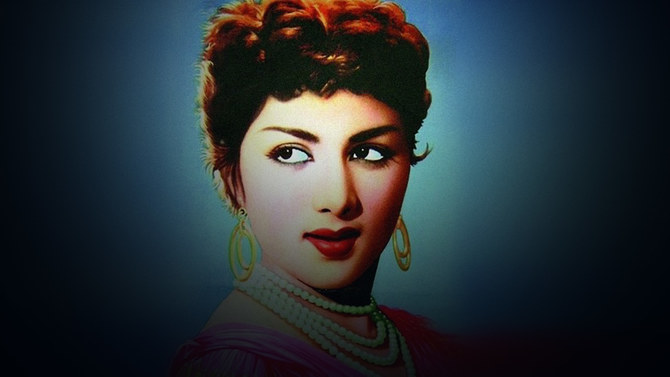
RAWALPINDI: Legendary Pakistani actress Neelo Begum, who most notably played a Palestinian fighter in the 1969 film Zarqa, died in Lahore on Saturday at the age of 80.
Born Cynthia Alexander Fernandes in 1940 in Sargodha, Pakistan, Neelo got her lucky break in a small role for a Hollywood film called Bhowani Junction, alongside Ava Gardner, when she was just 16 years old.
Neelo’s son, Pakistani actor Shaan Shahid, tweeted about his mother’s death on Saturday.
“It is with the saddest of heart I share the departure of my mother as she has gone to her creator,” the actor wrote.
In 1964, Neelo became a symbol of resistance to military rule in Pakistan in an incident involving the Shah of Iran. During the era of General Ayub Khan, as one of Pakistan’s most sought-after film stars, Neelo was ordered to perform on stage for the then Shah of Iran, Mohammad Reza Pahlavi, who was on an official state visit.
But the artist refused to dance, and subsequently was forcibly grabbed from her home and presented at the event hosted by Nawab Malik Amir Mohammad Khan, the then governor of West Pakistan.
In protest, the popular story goes, Neelo tried to take her own life and had to be rushed to the hospital. The incident launched the actress into some of Pakistan’s most heroic chapters of resistance, inspiring pop culture, poetry and film, most notably by the likes of poet Habib Jalib.
Jalib’s poem, Raqs-e-Zanjeer (Dance in Chains) was used in ‘Zarqa,’ catapulting Neelo to further fame.
Condolences poured in from all over Pakistan at the news of her death, including from Prime Minister Imran Khan on Twitter.


Legendary Pakistani actress who played role of Palestinian fighter dies at 80
https://arab.news/yanf4
Legendary Pakistani actress who played role of Palestinian fighter dies at 80

- Neelo Begum was Pakistan’s top film star in the 1960’s
- Her story of resistance inspired pop culture including poetry and film

Pakistan urges diplomacy on Iran nuclear issue, warns sanctions would hurt civilians
- Pakistan warns the situation has become more complex since Israel’s attack on Iran and US bombing of nuclear sites
- It cautions against invoking the snapback mechanism, saying sanctions will further deepen mistrust, derail diplomacy
ISLAMABAD: Pakistan demanded on Tuesday that diplomacy be given a chance in addressing all issues related to Iran’s nuclear program, warning the United Nations Security Council that sanctions would hurt ordinary Iranians, as tensions remain heightened following this year’s war between Israel and Iran.
Pakistan’s comments came amid renewed debate at the Security Council over Iran’s nuclear program and the future of the Joint Comprehensive Plan of Action (JCPOA), which sought to limit Tehran’s nuclear activities in exchange for sanctions relief.
The conflict in June was dubbed the Twelve-Day War and erupted after Israel carried out a surprise attack on Iranian military and nuclear facilities while international diplomacy was still underway. The strikes derailed negotiations, with the United States later bombing Iranian nuclear sites and declaring that the attacks had substantially degraded Iran’s nuclear capabilities.
Addressing the Security Council, Pakistan’s Acting Permanent Representative Ambassador Usman Jadoon said Islamabad believed that “diplomacy and dialogue should be the guiding principles for the resolution of all outstanding issues concerning Iran’s nuclear program in accordance with the rights, obligations and responsibilities of the parties concerned.”
“Coercive measures would not help in bringing the parties closer and only exacerbate the trust deficit,” he said. “Sanctions directly hurt ordinary people the most, impact trade, affect economic development and diminish the prospects of regional connectivity.”
Jadoon said the council last met on the issue in September following developments related to the JCPOA’s “snapback” mechanism — a provision that allows the automatic re-imposition of UN sanctions on Iran in cases of alleged non-compliance — adding that Pakistan opposed what it viewed as a rushed move and cautioned against hasty action.
He said Pakistan’s stance was grounded in the belief that disputes over Iran’s nuclear program should be resolved through dialogue, with more time allowed for diplomacy to succeed, while preserving the JCPOA framework until a successor arrangement is reached.
The ambassador said divisions within the council had widened in recent months, further complicating efforts to resolve the issue.
While acknowledging that the JCPOA was not implemented as intended, Jadoon said the agreement had nonetheless provided an essential framework rooted in international law and mutual respect, and could still prove useful if there was a shared willingness to move forward in a spirit of compromise.
He stressed the need to revive the agreement’s underlying principles and restore trust in diplomatic engagement that had been damaged in recent months, urging all parties to avoid confrontation and work toward a solution-oriented approach.


