New archeological finds made in Egypt

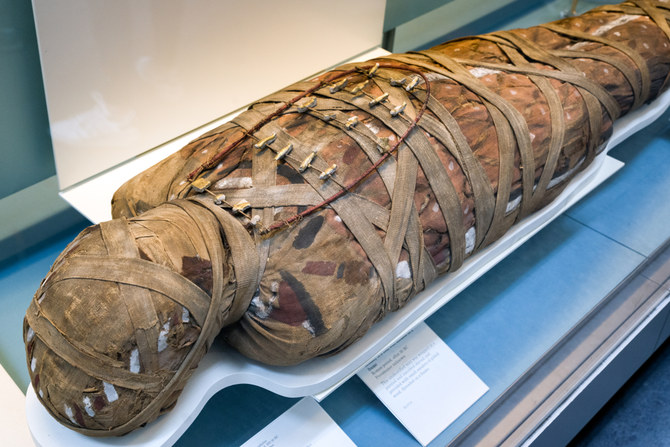
The archaeological team said the most important finds were two mummies that preserved the remains of scrolls and parts of the cartonnage layer. (Shutterstock/File Photo/Illustrative purposes only)
Short Url
Updated 30 January 2021
Follow

New archeological finds made in Egypt

  • Team said most important finds were two mummies that preserved remains of scrolls and parts of cartonnage layer

CAIRO: The Egyptian-Dominican mission of the Santo Domingo University, headed by Kathleen Martinez and which has been working at the Tabosiris Magna Temple in western Alexandria, has uncovered 16 stone-carved burials.

The mission has revealed several mummies in a poor state of preservation but that nonetheless highlight the characteristics of mummification in Greco-Roman antiquity.

Amulets of gold foil in the form of tongues were placed in the mouths of the mummies as part of a special ritual to ensure the ability of the dead to speak in the other world.

Martinez said the most important finds were two mummies that preserved the remains of scrolls and parts of the cartonnage layer.

The first has remnants of gilding that depict Osiris, god of the other world, while the other wears the Atef crown, decorated with horns and a cobra on the forehead. On the chest is a wide necklace bearing a falcon head, symbol of the deity Horus.

Khaled Abu Al-Hamd, director-general of Alexandria Antiquities, said that during this season, the mission has come across several archaeological finds, the most important of which is a funeral mask for a woman, eight golden flakes, and eight marble masks dating back to classical antiquity.

The items found by the mission in the last 10 years have changed popular perception of the Temple of Tabosiris Magna, where coins bearing the name and image of Queen Cleopatra VII were found.

The foundation panels of the temple suggested it was built by King Ptolemy IV.


Israeli airstrikes pound areas north of Litani River as tensions with Hezbollah escalate

Updated 5 sec ago
Follow

Israeli airstrikes pound areas north of Litani River as tensions with Hezbollah escalate

  • Raids day after Tel Aviv signaled possible resumption of strikes, accusing Lebanon of ‘not moving fast enough’
  • US President Donald Trump says Hezbollah ‘must be completely disarmed’

BEIRUT: Israeli airstrikes on Friday hit several areas north of the Litani River, a day after Israel signaled it could resume its attacks on Hezbollah after claiming the Lebanese army was “not moving fast enough” and that the Iran-backed group was “rebuilding its military system.”

The raids struck multiple locations across the Iqlim Al-Tuffah region, the heights of Jabal Al-Rihane, and the towns of Mlikh and Aaramta in the Jezzine District, as well as the area around Qal’at Meiss between Ansar and Al-Zrariyah. Strikes on the Tabna area, on the outskirts of Al-Baisariyah in the Sidon–Zahrani district, cut the road linking nearby villages.

Airstrikes also hit the valley between Kafroue and Aazze in the Nabatieh District, the outskirts of Ain Al-Tineh, and Jabal Machghara in Western Bekaa, while Israeli warplanes flew at low altitude over the south, reaching the airspace of Baalbek, northern Bekaa, and the surrounding villages.

Israeli army spokesperson Avichay Adraee claimed that Israel’s forces had targeted a “training compound” of the Radwan Force of Hezbollah allegedly used to conduct training for its members “in order to plan and carry out terrorist plots against army forces and the citizens of the state of Israel. The terrorist operatives were undergoing shooting training and qualification in the use of various combat means.”

Adraee added that the Israeli army struck “buildings and military facilities (used) for storing weapons” belonging to Hezbollah, and suggested that attacks were likely to continue.

Political writer Ali Al-Amin told Arab News: “The areas targeted by the Israeli airstrikes on Friday had previously been targeted repeatedly, but these areas are valleys and closed spaces belonging to the party, extending from the south to the Western Bekaa, and everyone knows that they contain bases and armament centers.”

Al-Amin added that Hezbollah “is currently living (in) an unprecedented moment of weakness. Iran, on the other hand, is facing a renewed predicament, confronting internal protests at a moment of external pullback, which means that whether Hezbollah hands over its weapons or does not hand them over, it is in a state of exposure at a time of a major imbalance.”

The end of 2025 marked the deadline Lebanon committed to for the state’s monopoly of arms south of the Litani River. On Jan. 8, its first session of the year, the Cabinet is expected to hear the Lebanese army’s report announcing the completion of its mission, preceding the second phase which covers the southern area up to the Awali River. Prime Minister Nawaf Salam said the country remained committed to meeting the deadline.

An official political source confirmed to Arab News: “The army commander will present his report and the military institution will continue its mission. There will be no postponement.”

Hezbollah’s Secretary-General Naim Qassem said in a statement: “Hezbollah’s disarmament is a US-Israeli project targeting Lebanon and its sovereignty and independence, even if it is marketed under the banner of exclusive state control of arms.”

He added that the demand for control of weapons amid “continued Israeli attacks means that you are not working in Lebanon’s interest, but in Israel’s interest.”

On Thursday, following his meeting with Israeli Prime Minister Benjamin Netanyahu, US President Donald Trump said that Hezbollah “has been behaving badly” and “must be completely disarmed,” adding that “the Lebanese government is at a little bit of a disadvantage” with the group.

Asked whether Israel should strike Hezbollah in Lebanon due to the group’s refusal to disarm, Trump replied: “We’re going to see about that.”

Sirens sounded in Baram in Western Galilee in Israel on Friday morning, and a missile was launched toward a target in Upper Galilee, exploding in the north near the Lebanese towns of Maroun Al-Ras and Yaroun. Israeli Army Radio later reported that it had been a false alarm and the “suspect was a flock of birds.”