Toyota beats Volkswagen to become World’s No. 1 car seller in 2020

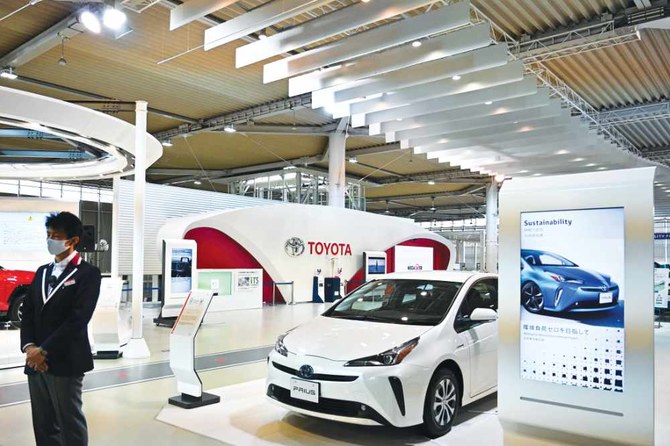
In this file photo taken on November 6, 2020, a staff member stands in a Toyota showroom in Tokyo. Japan’s Toyota reclaimed the title of world’s top-selling automaker in 2020, according to data released by the firm on January 28, 2021, pushing Volkswagen into second place for the first time in five years. (AFP file photo)
Short Url
Updated 28 January 2021
Follow

Toyota beats Volkswagen to become World’s No. 1 car seller in 2020

TOKYO: Japan’s Toyota Motor Corp. overtook Germany’s Volkswagen in vehicle sales last year, regaining pole position as the world’s top selling automaker for the first time in five years as the pandemic demand slump hit its German rival harder.

Toyota said on Thursday its group-wide global sales fell 11.3 percent to 9.528 million vehicles in 2020. That compared with a 15.2 percent drop at Volkswagen to 9.305 million vehicles.

Automakers have suffered as coronavirus lockdowns have stopped people from visiting car showrooms and forced manufacturing plants to reduce or halt production.

Toyota, however, has weathered the pandemic better in part because its home market Japan, and the Asian region in general, have been less affected by the outbreak than Europe and the United States.

“Our focus is not on what our ranking may be, but on serving our customers” a Toyota spokeswoman said.

As demand for cars rebounds, particularly in China, Toyota, Volkswagen and other manufacturers are scrambling to tap growing demand for electric cars. Toyota said that the ratio of electric vehicle it sold last year grew to 23 percent of total sales from 20 percent in 2019.


Talks underway with Saudi Arabia on higher oil flows: Pakistani oil minister 

Updated 8 sec ago
Follow

Talks underway with Saudi Arabia on higher oil flows: Pakistani oil minister 

RIYADH: Pakistan is in talks with Saudi Arabia to increase the flow of petroleum products to the country in order to serve shared economic interests and secure Islamabad’s growing energy needs, Pakistani Oil Minister Ali Pervaiz told Al-Eqtisadiah. 

Pervaiz said that Pakistan, as a net energy importer with a bill ranging between $15 billion and $20 billion, seeks to strengthen its strategic partnership with Saudi Arabia in the energy and mining sectors and looks forward to benefiting from the Kingdom’s vast hydrocarbon potential. 

Speaking on the sidelines of his participation in the Future Minerals Forum hosted in Riyadh, the minister said the timing of the event is ideal given the pivotal stage the world is going through and the rising demand for vital minerals amid ongoing technological development.  

He noted that the conference represents a vital platform for discussing opportunities to establish new mines and mobilize the capital needed to operate them, particularly as production from existing mines declines and price volatility increases due to global conflicts, making international cooperation an urgent necessity for the stability of this vital sector. 

Regarding bilateral relations, Pervaiz stressed that ties between Riyadh and Islamabad have reached unprecedented levels of strength and depth, citing the numerous meetings between Prime Minister Shehbaz Sharif and Crown Prince Mohammed bin Salman, which he said have exceeded 12 since Sharif took office three years ago. 

He added that there is a clear governmental mandate for working groups in both countries to build a comprehensive framework for economic cooperation, with a particular focus on the mining sector, which he described as one of the main pillars of future projects currently under review. 

The minister said Pakistan is expecting to host a high-level Saudi delegation at the Pakistan Minerals Investment Forum 2026, scheduled for April, noting that the event is expected to see the signing of several agreements and memoranda of understanding aimed at advancing cooperation in geological studies and mining sector development.  

He added that work is underway with the Saudi side to implement tangible projects on the ground, strengthening the existing partnership, which spans multiple areas, including ongoing defense cooperation, further consolidating the two countries’ position as strategic partners in the region.