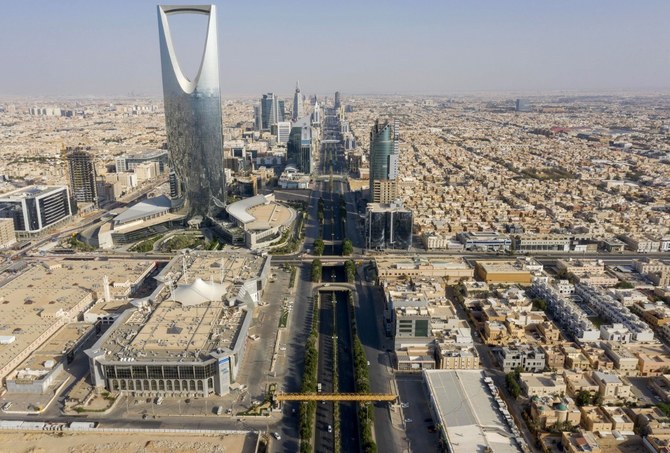

DUBAI: The growing attraction of Riyadh as an economic, financial and investment hub has been underlined by the decision of 24 multinational companies to establish regional headquarters in the Saudi capital.
The companies - including such heavyweights as PepsiCo, Schlumberger, Bechtel and Boston Scientific - announced their plans on the second day of the Future Investment Initiative (FII). In a sign of the growing appeal of Riyadh as a consumer hub, Canadian fast food chain Tim Hortons will also set up there.
The news came after Crown Prince Mohammed Bin Salman announced ambitious plans to accelerate the city’s growth to join the ranks of the top 10 city economies in the world and double the size of its population by 2030.
Fahd Al-Rasheed, president of the Royal Commission for Riyadh City, told the FII: “A key focus is to make it easier for global businesses to operate in the Kingdom. Creating the King Abdullah Financial District special economic zone opens the door for multinational companies to relocate to Riyadh. Now they can maximize first-mover advantage and take total control at the heart of their largest regional market.”
He also highlighted Riyadh’s plans to make the city more livable, with plans for big green spaces, more sports and leisure facilities as well as arts and cultural activities.
“If you provide those facilities, they will come,” Al-Rasheed told Arab News.
Khalid Al-Falih, minister for investment, said that a number of key reforms relating to the establishment and governance of special economic zones, labour and education laws would be ratified in the first half of this year.
Companies operating in the zones will enjoy a range of tax exemptions, incentives, labor law improvements and relevant labor law exemptions for ten years, as well as fast and simple commercial licensing.
“The government enables us, gives us our vision, and drives us hard. But these projects are going to be achieved mainly by the private sector, and they are going to be profitable,” he added.
Al-Rasheed said that some $220 billion had already been spent or earmarked as government investment for projects in and around Riyadh, but that most of the rest of the required investment would come from the private sector.
“The government is working with the private sector as partners, it will not crowd out the private sector,” he said.
Full detailed plans for the expansion of the city would be ready by the second quarter, Al-Rasheed added, when more details of financing would also be available.
He said Riyadh’s ambitious plans for expansion would benefit the whole region, including other cities that act as hubs for global businesses in the Middle East.
“Cities work best when they work together, and they are all better off with a stronger Riyadh. It is not just a regional, but a global appeal,” he said.
Business leaders explained the attractions of Riyadh. Olivier Le Peuch, chief executive officer of oil services giant Schlumberger, said: “Riyadh is transforming rapidly to become a world class economic capital. The MoU we are signing today is aligned with our vision for the Kingdom. We look forward to an exciting future for our industry and for the world.”
Neeraj Techchandani, director at Tim Hortons Middle East, said: “We have big plans and ambitions for our growth in the Kingdom and the wider Middle East.”