

Pakistan, Kuwait call for stronger ties in trade, manpower export, food security

Pakistan’s Foreign Minister Makhdoom Shah Mahmood Qureshi received Assistant Foreign Minister of Kuwait on Asian Affairs, Ambassador Ali Suleman Al-Saeed, at Ministry of Foreign Affairs, Islamabad on 27th January 2021. (Photo courtesy: PID)
Short Url
Updated 28 January 2021
Follow

Pakistan, Kuwait call for stronger ties in trade, manpower export, food security

  • Pakistani Foreign Minister Shah Mahmood Qureshi meets Kuwait’s assistant foreign minister of Asian affairs
  • Chairman Joint Chief of Staff of the Jordanian army calls on Pakistani army chief separately

ISLAMABAD: Pakistani Foreign Minister Shah Mahmood Qureshi met Kuwait’s assistant foreign minister of Asian affairs on Wednesday and called for stronger ties, particularly in the areas of trade, manpower export and food security, the foreign office said.
Kuwait’s Ali Suleman Al-Saeed is on an official visit to Pakistan to hold a third round of bilateral political consultations. The last round was held in Kuwait in May 2016.
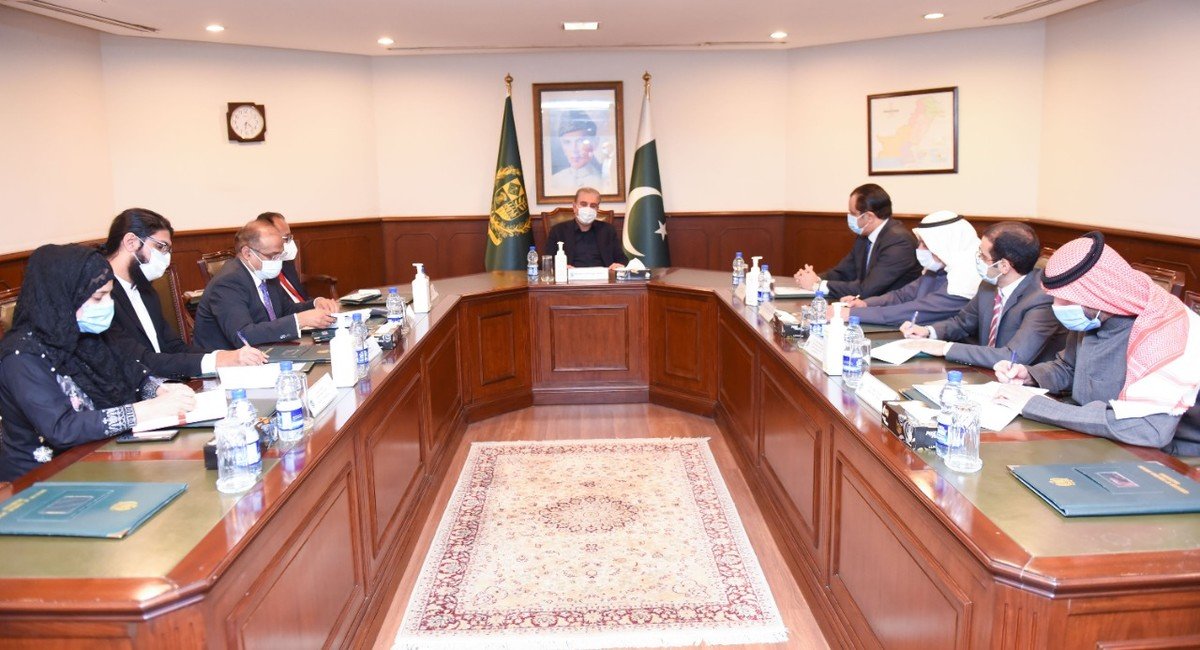


Pakistan’s Foreign Minister Makhdoom Shah Mahmood Qureshi and Assistant Foreign Minister of Kuwait on Asian Affairs, Ambassador Ali Suleman Al-Saeed, held bilateral political consultations at Ministry of Foreign Affairs, Islamabad, on 27th January 2021. (Photo courtesy: Foreign Ministry of Pakistan)

Qureshi reaffirmed Pakistan’s desire to forge stronger bilateral relations with Kuwait, particularly in the areas of trade, investment, manpower export, and food security. He also discussed the importance of facilitating travel between the two countries, the foreign office said.
Al-Saeed said his visit reflected the “keenness of the leadership of Kuwait to enhance cooperation and collaboration with Pakistan in diverse arenas.”
“During the meeting, the two sides expressed satisfaction at mutual collaboration in multilateral organizations, in particular the United Nations and the Organization of Islamic Cooperation,” the Pakistani foreign office said. “Views were also exchanged on regional developments, including stability in the Gulf/Middle East and CPEC.”
Qureshi also lauded the role of Kuwait in helping reach a breakthrough in Qatar’s three-year-old dispute with Saudi Arabia and three other Arab countries.
“Foreign Minister Qureshi lauded the positive and constructive role played by the Kuwaiti leadership toward the resolution of differences among the Gulf Cooperation Council (GCC) countries,” the statement said.
Separately, Major General Yousef Ahmed Al-Hnaity, Chairman Joint Chief of Staff of Jordan, called on the Pakistani army chief General Qamar Javed Bajwa, Chief of Army Staff (COAS), on Tuesday.
“During the meeting matters of mutual & professional interest and regional security situation were discussed,” the Pakistani military said in a statement. “COAS said that Pakistan values its brotherly relations with Jordan and Pakistan Army looks forward for enhanced defense and security cooperation with Jordan Armed Forces.”


Pakistan to raise special force to guard Balochistan minerals as Barrick reviews Reko Diq project — official

Updated 07 February 2026
Follow

Pakistan to raise special force to guard Balochistan minerals as Barrick reviews Reko Diq project — official

  • Barrick decision follows coordinated separatist attacks in several districts across Balochistan last Saturday that killed over 50 civilians and security personnel
  • Balochistan, which borders Iran and Afghanistan, is the site of a decades-long insurgency by Baloch separatist groups who often attack security forces, foreigners

KARACHI: Pakistan has decided to boost intelligence network and raise a special force to guard the mineral-rich Balochistan province and its borders with Iran and Afghanistan, a provincial government official said on Saturday.

The development comes days after Canadian giant Barrick Mining Corporation said it planned to “immediately” begin a comprehensive review of all aspects of the multibillion-dollar Reko Diq copper-gold project in Balochistan.

Barrick decision followed coordinated separatist attacks by the Baloch Liberation Army (BLA) group in several districts across Balochistan last Saturday that killed 36 civilians and 22 security personnel. Authorities said they had killed 216 militants in follow-up operations.

Mineral-rich Balochistan, which borders Iran and Afghanistan, is the site of a decades-long insurgency waged by Baloch separatist groups who often attack security forces, foreigners and non-local Pakistanis and kidnap government officials.

“In light of the terrorists events, the provincial government in tandem with security forces is redesigning the entire security architecture,” Shahid Rind, an aide to Chief Minister Sarfraz Bugti for media and political affairs, told Arab News.

“This includes raising of dedicated Frontier Corps for the mineral-bearing area, securing both borders i.e. Iran and Afghanistan.”

Arab News reached out to Pakistan’s information minister, Attaullah Tarar, but he did not respond to questions seeking comment on the matter.

The Balochistan government will also beef up intelligence network and work closely with mining companies in the region.

“The Balochistan government is extremely serious about foreign investment in the province and considers Reko Diq as the flag-bearer of foreign investment,” Rind said.

“The provincial government will do whatever is necessary to maintain that.”

The recent attacks have apparently alarmed international investors, especially Barrick, which is developing one of the world’s largest copper and gold mines in Balochistan.

“As we stated in our public documents, Barrick is undertaking a review of all aspects of the Reko Diq project, including with respect to the project’s security arrangements, development timetable and capital budget,” a Barrick spokesperson said in response to an Arab News email.

In a Feb. 5 statement issued with its fourth-quarter financial results, Barrick said the Reko Diq project “continued to advance site works in Q4, although in light of a recent increase in security incidents, management is currently reviewing all aspects of the project.”

“The review will begin immediately,” the Barrick spokesperson said. “An update will be provided when the review has been completed.”

Barrick owns 50 percent share in Reko Diq, along with three Pakistani federal state-owned enterprises that own 25 percent, while the Balochistan government has the remaining 25 percent share in the project.

The project is expected to begin production in 2028 and is central to Pakistan’s hopes of boosting mineral exports and attracting foreign investment into its underdeveloped mining sector. Despite heightened threats in Balochistan, development linked to the project continues in other parts of the country.

Barrick is expected to start investing in Pakistan’s port infrastructure soon as it prepares for exports.

Pakistan International Bulk Terminal Ltd. (PIBT), the country’s first dirty bulk terminal located at Port Qasim in Karachi, will host dedicated facilities to ship Reko Diq’s output.

PIBT CEO Sharique Azim Siddiqui told Arab News this week that Barrick would invest $150 million to build a shed and upgrade other dedicated facilities to handle shipments of copper-gold concentrate once Reko Diq production begins in 2028.

Barrick’s Pakistani subsidiary, Reko Diq Mining Company, last week signed an export agreement with PIBT under which the miner will export 800,000 tons of copper and gold concentrate through the terminal in the first phase, doubling the volume in the second phase, according to Siddiqui.

Revived in 2022 after years of legal disputes, the Reko Diq project is billed by the government as a transformative investment for Balochistan, Pakistan’s largest but least developed province.

But persistent militant activity and rising attacks targeting security forces, state institutions and infrastructure have raised concerns among investors.

The latest separatist attacks, one of the deadliest flare-ups in Balochistan in recent years, have prompted large-scale security operations across the province as authorities continue their hunt for militant facilitators.

Siddiqui said the recent surge in militancy in Balochistan remains a concern for them.

“Security challenges have always been there in Pakistan. The investors do realize that, and we take it in our stride, and we hope for the best,” Siddiqui said.

“If there is no security for the cargo movement, then that’s going to hurt that (Reko Diq) project and hurt everyone.”