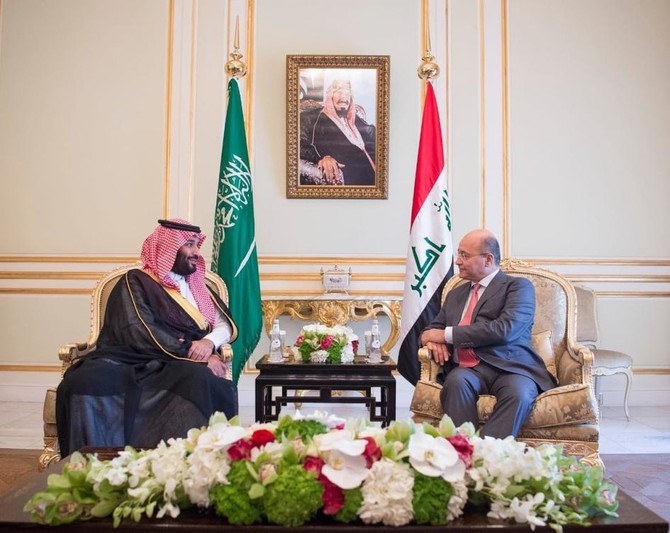
RIYADH: Saudi Arabia’s Crown Prince Mohammed bin Salman received a phone call from Iraqi President Barham Salih, Saudi Press Agency reported on Tuesday.
During the call, they reviewed relations between the two countries, in addition to discussing ways of enhancing bilateral cooperation in a way that serves the interests of the two countries in various fields, within the framework of the Saudi-Iraqi Coordination Council.
Saudi Arabia and Iraq opened the Arar border crossing for trade for the first time in three decades in November last year. The crossing had been closed since 1990 after the two countries cut ties following Saddam Hussein’s invasion of Kuwait.
Also in November, a Saudi delegation led by the Kingdom’s commerce and industry and agricultural ministers visited Baghdad as part of the framework of the Saudi-Iraqi Coordination Council and the Economic, Trade, Investment, Development and Joint Relief Committee.
A Saudi-Iraqi businessmen forum was also launched on the side-lines of the visit, under the auspices of the Iraqi Prime Minister Mustafa Al-Kadhimi.
The Saudi-Iraqi rapprochement extends back to 2015, when Saudi Arabia reopened its embassy in Baghdad following a 25-year break.
In July Saudi Arabia and Iraq signed investment agreements on energy and sports.

Saudi Arabia’s crown prince, Iraqi president discuss cooperation
https://arab.news/yss52
Saudi Arabia’s crown prince, Iraqi president discuss cooperation
- They discussed relations and ways of enhancing them in all fields
Red Sea Global unveils scientific model for regenerative tourism worldwide
- The report details the model’s rollout at “The Red Sea” and “AMAALA” destinations, backed by studies covering 8 marine habitats
TABUK: Red Sea Global (RSG) has unveiled a science-based model aimed at achieving a 30% net positive conservation benefit across its tourism destinations by 2040.
The framework is now available for global adoption, according to a statement released by RSG.
Owned by Saudi Arabia’s Public Investment Fund (PIF), Red Sea Global is the multi-project developer behind ambitious regenerative tourism destinations like “The Red Sea” and “AMAALA.”
As a cornerstone of the Kingdom’s Vision 2030, the company aims to diversify the national economy while setting new global benchmarks for sustainable, nature-positive development.
CEO John Pagano stated that openly sharing this detailed approach will help elevate the global tourism sector and secure a healthier environment for future generations.
The cornerstone of this initiative is the proprietary SIIG Model, a four-step framework:
• Survey: Establish biodiversity baselines and monitor long-term changes.
• Identify: Assess risks to priority habitats and species.
• Intervene: Execute evidence-based actions, such as regulating fishing and enhancing natural habitats.
• Gain: Measure and verify biodiversity improvements.
The report details the model’s rollout at “The Red Sea” and “AMAALA” destinations, backed by extensive 2022–2023 environmental baseline studies covering eight marine habitats and priority species groups during 2022 and 2023.

A major intervention is the 5,015-square-kilometer Fishery Management Area in Al-Wajh Lagoon. The plan reserves 38% of the area for priority conservation—protecting 62% of local coral reefs—while allocating 61% for sustainable fishing.
According to scientific modeling, eliminating fishing in high-protection zones could increase reef fish populations by 113%, sharks and rays by 72%, and marine mammals by 24%. These measures are expected to boost coral resilience, support ecosystem recovery, and protect vulnerable species like sea turtles and seabirds.
Ihab Kindi, RSG’s Red Sea Destination Executive Director, called the data-driven model a practical roadmap for large-scale marine recovery. The complete methodology is available in the new report, “The SIIG Model: A Roadmap Toward Achieving Measurable Conservation Gains.”


