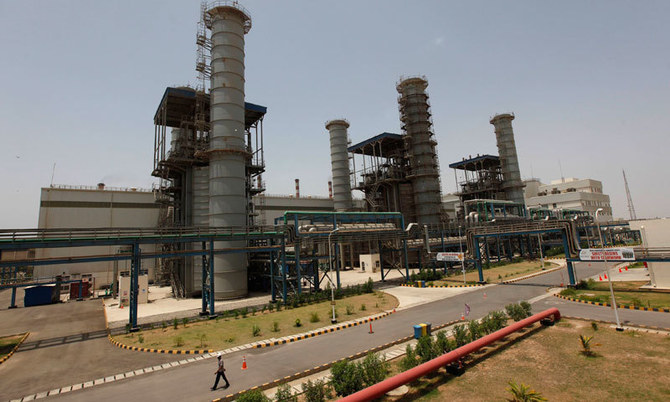

KARACHI: In a rare move, Pakistani industrialists’ bodies have joined hands this week to oppose the federal government’s decision to discontinue gas supplies to captive power plants (CPPs) from next month.
A CPP is an electricity generation facility used and managed by an industrial or commercial energy user for its own energy consumption needs. Captive power plants can operate off-grid or be connected to the national electric grid to exchange excess generation.
Since the start of the winter, Pakistanis using natural gas for cooking and heating, as well as factories and power plants that rely on the fuel, have experienced significant inconvenience due to low gas pressure or no supply at all. Factories and business have been badly affected, threatening jobs and the livelihoods of workers.
Indeed, December and January see the largest spike in demand for gas in Pakistan, but this year authorities have said the demand-supply shortfall is greater on the back of higher consumption and diminishing indigenous supply.
Pakistan’s federal Cabinet Committee on Energy (CCoE) last week said it had decided to ban fresh gas connections and disconnect gas supplies for captive power plants. The policy only applies to industries that are connected to the power grid and therefore have an alternative electricity source, and the decision is based on the fact that cheaper domestic gas supplies were declining and their consumption by inefficient CPPs was a national loss, the government has said.
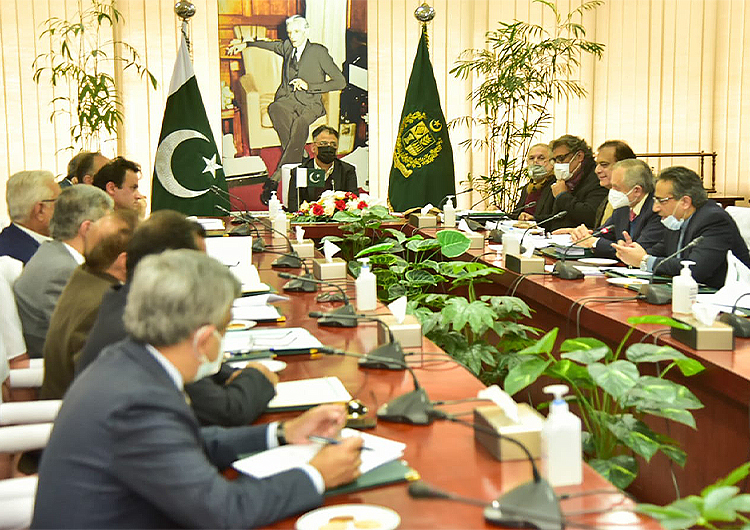
Pakistan's Federal Minister for Planning, Development, Reforms and Special Initiatives Asad Umar chairing a meeting of the Cabinet Committee on Energy at the Cabinet Division in Islamabad on January 21, 2020. (Photo courtesy: Ministry of Planning Development & Special Initiatives)
The CCoE’s decision is to be implemented from February 01, 2021 for the general industry and would be applicable to export-oriented industries from March 2021.
The government’s decision will impact all industries, including those declared as zero-rated, which are on natural gas and regasified liquefied natural gas (RLNG). The total number of captive power plants operational on gas is around 1,200 and use around 400 million standard cubic feet per day of gas.
On Monday, Pakistan industries and traders bodies gathered at the Federation of the Pakistan Chamber of Commerce and Industries (FPCCI) and called for a retraction of the government’s decision.

Mian Nasser Hyatt Maggo, President of FPCCI along with officials and representatives of trade bodies holding a press conference on January 25, 2021, against the government's decision to stop gas supplies to Captive Power Plants from February 01, 2021. (AN photo)
“The government has decided to stop the supply of gas to captive power plants that generate electricity for industries and they want us to obtain electricity from existing power utilities,” Mian Nasser Hyatt Maggo, President of FPCCI, told Arab News after a press conference. “The first problem is that they [power suppliers] don’t have systems and the second issue is that the industries should have systems in place to receive such power. If the gas is stopped the industry will collapse.”
“We are very surprised that without any homework, without any due diligence and without any thought process applied, they [government] have announced to stop supply of gas to the industries,” Zubair Motiwala, Chairman of the Businessmen Group (BMG), said.
“It is technically impossible that surplus electricity from WAPDA [Pakistan Water and Power Development Authority] territory is brought into KE [Karachi Electric] without putting in place grids, pylons, high transmission lines,” Motiwala said adding that “in order to supply electricity to the doorsteps of industries there are so many requirements and it is huge task.”
Industrialists said cutting supplies to CPPs would upset export orders and affect millions of people associated with these industries.
“The announcement has disturbed us, disturbed the industry because we are running on gas and our buyers are confused whether the commitments we made would be fulfilled or not,” Motiwala said. “Huge number of people working in the industry including vendors and womenfolk who would get unemployed.. it is millions of people who will be affected by this.”
A huge gap between the cost of the power generation through gas-fired captive power plants and the supply by power utilities is a main reason industrialists are opposing the government’s move, industrialists said.
“Own captive power cost of producing electricity would be Rs 11-12 per unit; if you buy from KE or WAPDA it is like Rs 19/20 per unit,” said Ismail Suttar, president of the Employers’ Federation(EFP) and Lasbela Chamber of Commerce and Industry. “If the cost is out we just can’t survive.”
Shariq Vohra, president of the Karachi Chamber of Commerce and Industry, said Prime Minister Imran Khan should immediately intervene and reject the cabinet’s decision in the interest of the country’s industries and economy.