



LAHORE – Winter expeditions to Pakistan by Gulf falconers to hunt the rare houbara bustard every year have helped uplift impoverished hunting towns, some locals say, though conservationists have raised alarm about continued hunting in the absence of annual population surveys of the birds.
The International Union for Conservation of Nature lists the bustard — a shy, rare bird, the size of a chicken — as a vulnerable species with a global population of between 50,000 and 100,000. The bird has nearly vanished on the Arabian Peninsula.
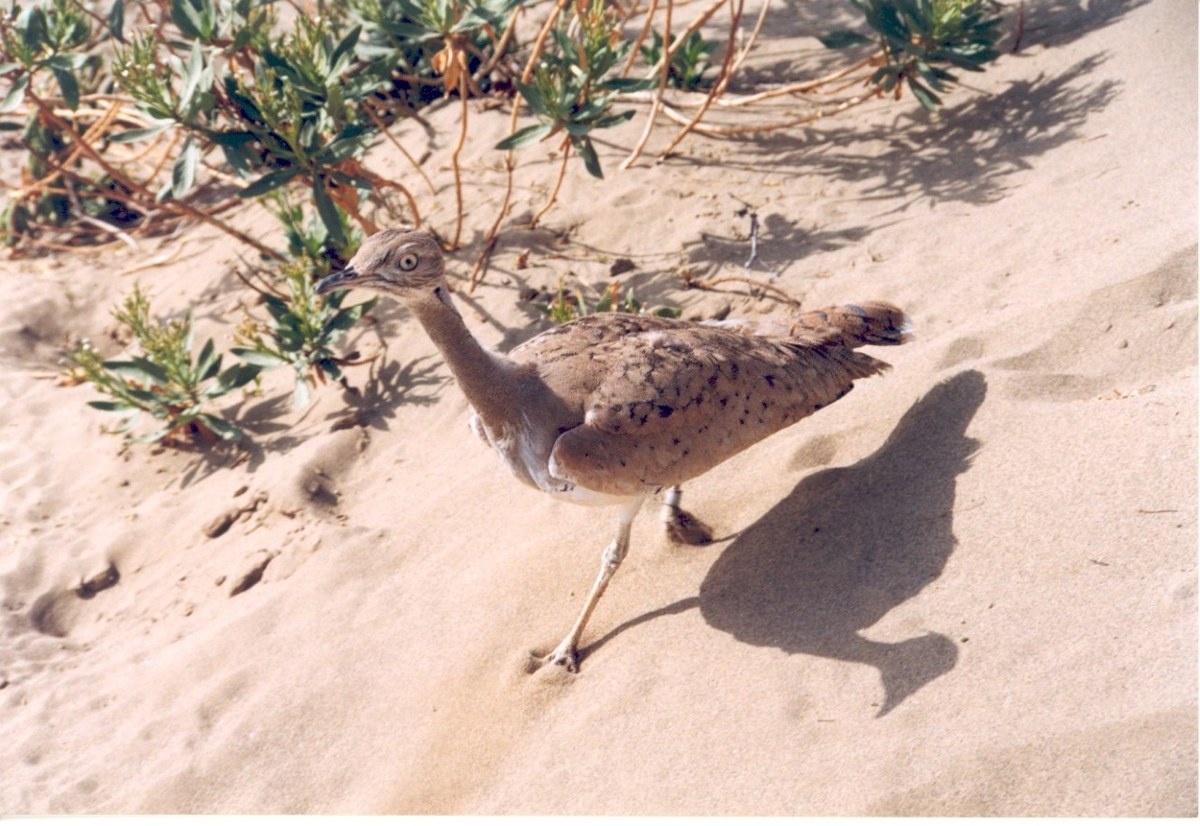
A released houbara bustard bird is seen in this undated photo after being released from poachers. (Photo courtesy: Houbara Foundation International Pakistan)
The World Wildlife Fund has recommended that the Pakistan government stop issuing hunting permits for the bustard and completely ban hunting “with immediate effect,” saying controlled hunting should be allowed only after carrying out population surveys on an annual basis “with the involvement of relevant stakeholders to determine the population status and trends of the species in the country.”
For now, between the months of December and February, royals from Saudi Arabia, UAE, Qatar and Bahrain arrive in Pakistan and partake in falconry — the hunting of wild animals in their natural state and habitat by means of a trained bird of prey. Each hunting party pays $100,000 to be assigned a territory, another $100,000 for a ten-day permit to hunt 100 birds, and $1,000 for each falcon used in the hunt, according to a 2019 report published in The Economist.
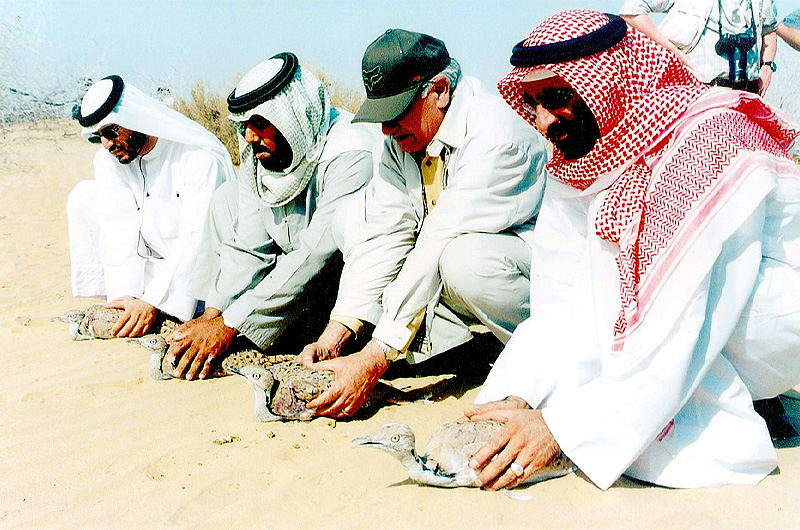
In this undated photo, Mohamed Ahmed Al Bowardi, managing director of the Environment Agency in Abu Dhabi, and Pakistani Brigadier Mukhtar Ahmed, President of the Houbara Foundation International Pakistan, release houbara bustard birds. (Photo courtesy: Houbara Foundation International Pakistan)
Locals say the visitors have helped develop the remote towns across Pakistan where the hunts take place, setting up health, education, water supply and infrastructural projects worth millions of dollars. Officials at the Houbara Foundation International Pakistan (HFIP) argue sustainable hunting of the bustard is the best means of conservation.
“Not a single person from the last three generations of my family saw a school but my children are going to school. We spent our lives in mud huts, in the freezing cold and the blistering heat; now, we are living in a colony with all of life’s facilities,” Ali Ahmad, 32, who lives in Punjab’s Rahim Yar Khan, told Arab News.
He said this was because of “Sheikhs from the UAE” who had come to his hometown to hunt.
“They’ve done a lot of development projects here, and made our lives livable,” Ahmad added.
Another local, Nina Kumari, said her 12-year-old daughter was admitted at Sheikh Zayed Medical Complex Rahim Yar Khan, a facility built by the UAE government and named after the founder of the Emirates.
“Medicine is free and attendants get free meals,” Kumari said in a phone interview.
Other locals said hunting permit fees and jobs created around the hunting business had helped improve their lives.
In 2014, the government had imposed a “temporary moratorium” on hunting the bustard. In August 2015, the Supreme Court ordered a blanket ban, lifting it the following year after the government argued houbara hunting was a “cornerstone” of Pakistan’s relations with the Middle Eastern rulers and sustainable hunting was a means of conserving the vulnerable bird.
Officials at the Houbara Foundation International Pakistan (HFIP) concurred, telling Arab News the hunts by Arab dignitaries in designated areas had contributed toward the protection and conservation of the otherwise threatened species.
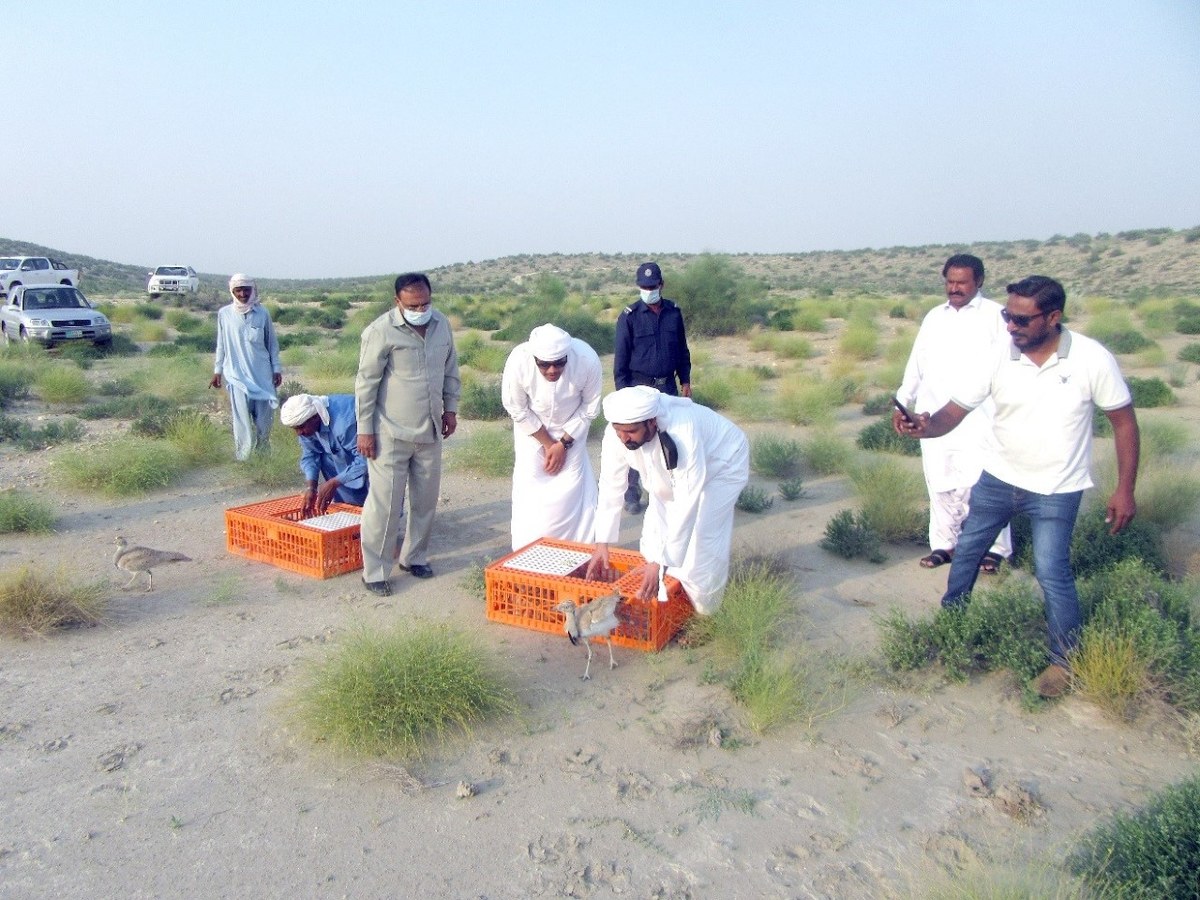
Officials from the International Fund for Houbara Conservation (IFHC) UAE, along with the Houbara Foundation International Pakistan release 250 houbara bustard birds in Kot Digi, Sindh, Pakistan on October 21, 2020. (Photo courtesy: Houbara Foundation International Pakistan)
“The Arab dignitaries release houbara in the deserts of Pakistan in the month of February and March every year,” an official at the Lahore-based HFIP, who declined to be named, said. “Last year, 3,200 houbara were released. The number of released houbara is bigger than the number hunted.”
He said Arab hunters had also initiated several projects to develop areas marked as protected for the houbara.
“Several health, educational, water supply and infrastructural projects worth millions of dollars have been completed with the financial help of UAE governments,” the HFIP official said. “The UAE government also provides funds for the protection and conservation of houbara on Pakistani soil.”


