



RIYADH: Saudi Arabia’s National Water Company (NWC) this month signed a $5.36 million two-year contract with a French utilities company to reduce the amount of water lost during the Kingdom’s water production process, known as non-revenue water in the industry.
This is a positive step forward, as a report released late last year by global consultancy firm Oliver Wyman found that while water usage is rising, supply is diminishing. The study estimated that 25 percent of the world’s population lives in areas that suffer extremely high water stress, and by 2050 that portion of the population will more than double.
“With water resources becoming increasingly scarce globally, the Middle East region is addressing the critical issues, with governments increasingly adopting new strategies for balancing their scarce water resources and growing demand for fresh water,” said Bruno Sousa, a partner in the Energy Practice at Oliver Wyman.
“This has led some countries in the Middle East to turn to options such as desalination and treatment, and reuse of wastewater,” he added.
Saudi Arabia is the third biggest consumer of water per capita in the world, after the US and Canada. The Kingdom has implemented a series of measures to rationalize water consumption as part of its Vision 2030 program, with the aim of reducing consumption by 24 percent in 2021 and by up to 43 percent by the end of the decade.
Saudi chemical company SABIC in 2019 committed to reducing its energy consumption, greenhouse gas emissions and water usage intensity by 25 percent by 2025, from 2010 levels.
As part of this drive to address this issue, the Saudi Ministry of Environment, Water and Agriculture has developed a unified water sector reference framework that includes a comprehensive water strategy that integrates national water sector trends, policies, legislation and practices with the main objective of addressing these key challenges and restructuring the sector.
Dr. Ibrahim Aref, director of the rehabilitation of agricultural terraces initiative at the ministry, told Arab News that most of the Arabian Peninsula’s water resources comes from rainfall. Yet, rainfall in the Kingdom, especially in the center of the Arabian Peninsula, is very weak compared to any other place in the world, thus causing water scarcity.
New technology has been developed over the years to minimize the environmental impact of desalination.
Bruno Sousa
Aref pointed out that even though the Arabian Peninsula in general experiences dry seasons that last for two, four or up to seven years, the Kingdom has been blessed with a strong economy and therefore has been able to work on many solutions that might be unusual elsewhere in the world, such as desalination.
According to Oliver Wyman’s Sousa, desalination can be achieved through two main technologies: Thermal and electric.
He told Arab News that thermal technology consists of heating water and collecting the resulting evaporated pure water. “This is a very energy-intensive process, requiring both electricity and thermal energy to heat the water. As part of the process, electricity is also generated that can be injected into the electric grid.
“Electric consists mainly in reverse osmosis, where water is forced through membranes that remove salt ... it is also an energy-intensive process, but only requires electricity to run,” he said.
“Although thermal desalination is still used, reverse osmosis is the mainstream technology, adopted mainly because of lower costs (including with energy) and a higher rate of potable water conversion from seawater,” he added.
Independent of the technology used, Sousa said that the desalination process will result in potable water and a high-concentrated saline effluent (brine), that requires disposal.
“Brine is commonly discharged back to the ocean, in case of seawater desalination, but other applications can be applied, such as use in agriculture in saline-tolerant crops, making building materials, or further treatment can be done to recover valuable products in the brine, including sodium, lithium and bromine.”
Sousa said that new technology has been developed over the years to minimize the environmental impact of desalination.
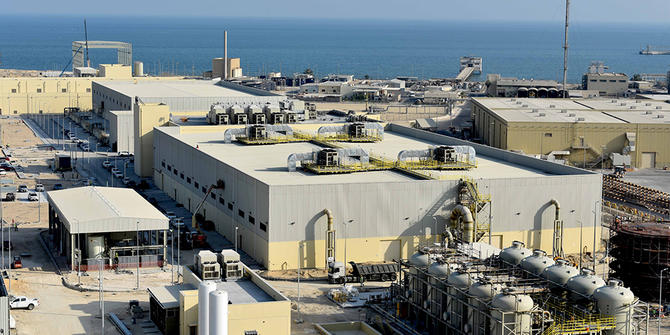
Spanish firm Acciona last year completed the construction of the Al-Khobar I desalination plant in Saudi Arabia, and since Dec. 26, it has produced 210,000 cubic meters of drinking water per day, which will supply a population of 350,000. It is one of the biggest desalination plants in Saudi Arabia in terms of capacity.
Acciona completed the testing program and the commissioning of the plant remotely through a team in Madrid, using digital twin technology.
According to Julio de la Rosa, Acciona Middle East director for water solutions, a digital twin is a full virtual model of a process, product or service with the capacity to replicate with accuracy what outcome will be obtained under certain conditions.
“This pairing of the virtual and physical worlds allows analysis of data and monitoring of systems to head off problems before they even occur, prevent downtime, develop new opportunities and even plan for the future by using simulations,” he added.
He said that the technology allowed the commissioning of the plant to remain on schedule in spite of the travel restrictions in force because of the pandemic.
“Using advanced machine learning and artificial intelligence, the desalination plant’s start-up equipment, control system programs, water and electrical circuits were tested and put into operation with remote supervision,” la Rosa said.
He believes that artificial intelligence and robotics has a lot of potential applications within the desalination sector. “Perhaps repetitive, checkup or inspection tasks can be developed by robots designed for industrial environments,” he said.
Desalination is not the only way the Kingdom is looking to address the issue of water shortages. One of the largest programs being undertaken by the Ministry of Environment, Water and Agriculture is the rehabilitation of agricultural terraces in the southwest of the Kingdom.
The project aims to increase the efficiency of water use for agricultural purposes and to rely on renewable sources that contribute to food security, rural development and increased productivity of strategic crops.
Aref, who is in charge of the project, said rainfall was the focus of attention. “This is one of the important means in the field of agriculture and water security. We take advantage of every drop that falls from the sky … to make sure that farmers continue to farm and families can live.”
The Oliver Wyman report said that addressing this issue has direct economic benefits and can impact gross domestic product by up to 6 percent, making initiatives such as the Suez and Acciona deals ever more important.