Iran to begin vaccination in coming weeks, says Rouhani

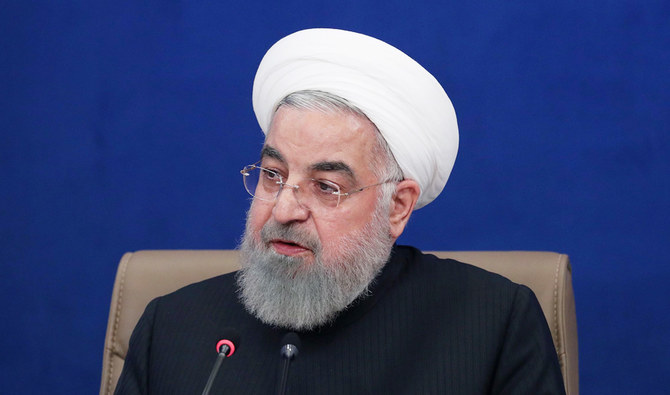
A handout picture provided by the Iranian presidency on January 20, 2021, shows Iranian President Hassan Rouhani charing a cabinet meeting in the capital Tehran. (AFP)
Short Url
Updated 24 January 2021
Follow

Iran to begin vaccination in coming weeks, says Rouhani

  • Tehran and Havana are under tough US sanctions that while they exempt medicine often deter foreign pharmaceutical companies from trading with them

DUBAI: President Hassan Rouhani said on Saturday that COVID-19 vaccinations will begin in the coming weeks in Iran, the Middle East’s worst-hit country.
“Foreign vaccines are a necessity until local vaccines are available,” Rouhani said in televised remarks, without giving details of what foreign vaccines would be used.
Earlier this month Supreme Leader Ayatollah Ali Khamenei, Iran’s highest authority, banned the government from importing vaccines from the US and Britain, which he said were possibly seeking to spread the infection to other countries.
Rouhani himself, in compliance with Khamenei’s ban, said at the time that his government would purchase “safe foreign vaccines.”
Iran launched human trials of its first domestic vaccine candidate late last month, saying this could help it defeat the pandemic despite US sanctions that affect its ability to import vaccines.
“There have been good movements in the field of local and foreign vaccines,” Rouhani said, adding that three domestic vaccines — Barekat, Pasteur and Razi, some of which have been developed with foreign collaboration — could begin in the spring and summer.

BACKGROUND

The country has recorded 1,150,000 cases and 57,000 deaths. There has been a decline in recent weeks of new infections and deaths.

Cuba said earlier this month that it had signed an accord with Tehran to transfer the technology for its most advanced coronavirus vaccine candidate and carry out last-stage clinical trials of the shot in Iran.
Tehran and Havana are under tough US sanctions that while they exempt medicine often deter foreign pharmaceutical companies from trading with them.
In addition to developing its own vaccine, Iran is participating in the COVAX scheme which aims to secure fair access to COVID-19 vaccines for poorer countries.



Abbas reiterates opposition to displacement of Palestinians

Russian President Vladimir Putin with Palestinian President Mahmoud Abbas at the Senate Palace of the Kremlin in Moscow. (AP)
Updated 23 January 2026
Follow

Abbas reiterates opposition to displacement of Palestinians

  • During Moscow talks, president calls for immediate halt to Israeli acts of terror
  • Historically, Russia has supported and stood by the Palestinian people at political and diplomatic levels

MOSCOW: The Palestinian National Authority’s President Mahmoud Abbas has reiterated his opposition to all attempts to displace Palestinian people from their land.

Speaking with Russian President Vladimir Putin at the presidential palace in Moscow, Abbas was reported by the Kremlin’s official website as saying that “the Palestinian people are holding on to their land, and we categorically oppose attempts by the Americans and Israelis to expatriate Palestinians beyond Palestinian territory.” 
He said the Palestinian people “will not abandon their land, whatever the cost.” Abbas stressed the need to fully implement US President Donald Trump’s peace plan, leading to the withdrawal of occupation forces and the launch of the reconstruction process.
He emphasized that the Palestinian Authority would assume a central role in administering the Gaza Strip, and that the enclave and the West Bank constituted two parts of a single territorial unit, with a unified and undifferentiated system of civilian institutions.
He stressed the need for an immediate halt to “Israeli settler colonialism and Israeli acts of terror in the West Bank, including Jerusalem, along with the release of withheld Palestinian funds and the cessation of all measures that undermined the Palestinian Authority and the two-state solution.”
He reaffirmed his commitment to continue the struggle for the realization of the Palestinian people’s right to self-determination and of their right to a fully sovereign, independent state based on the borders of June 4, 1967, with East Jerusalem as its capital, while living in security and peace with neighbors.
He told Putin: “What we need is peace, and we hope that with your help and support, we can achieve it — a peace built on the basis of international legal resolutions, decisions of the United Nations, and the principles established following the wars of 1967 and 1973.
“East Jerusalem remains the capital of Palestine, and we know that Russia has always supported — indeed, was the first to support — Palestine, maintaining a firm stance in support of our people.”
Abbas thanked his Russian counterpart for Moscow’s support and commended the bilateral “bonds of friendship” between both countries. He added: “We are friends of Russia and the Russian people. For over 50 years our nations have been bound by a strong friendship that has developed over the decades and continues on the correct path. Russia is a great friend and a nation upon which we rely in many spheres.
“Historically, Russia has supported and stood by the Palestinian people at political and diplomatic levels. Your economic and financial support is both significant in scale and crucial in importance.”
Abbas emphasized moving forward with the implementation of a comprehensive national reform program aimed at consolidating the rule of law, strengthening the principles of good governance, transparency, and accountability, and ensuring the separation of powers.
Putin affirmed Moscow’s “principled and consistent approach” to the Palestinian question.
He said: “We believe that only the establishment and full functioning of the Palestinian state can lead to a lasting settlement of the Middle East conflict.”