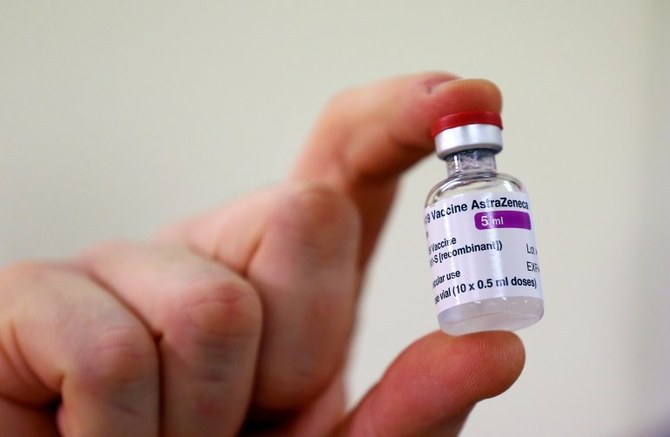
Morocco gets 2m AstraZeneca vaccine doses, first big shipment to Africa

Dose of the Oxford University/AstraZeneca COVID-19 vaccine is displayed at the Princess Royal Hospital in Haywards Heath, West Sussex, Britain. (File/Reuters)
Short Url
Updated 23 January 2021
Follow

Morocco gets 2m AstraZeneca vaccine doses, first big shipment to Africa

RABAT: Morocco received 2 million doses of AstraZeneca’s COVID-19 vaccine on Friday, becoming the first African country to get a large enough shipment to start rolling out a nationwide free immunization program.
The consignment arrived on a Royal Air Maroc flight from India, which began exporting the vaccine, developed in conjunction with Oxford University, to mid- and lower-income countries this week.
The vast majority of the production of the three most widely approved COVID vaccines, including the AstraZeneca drug, has so far been hoovered up by developed nations.
World Health Organization Director-General Tedros Adhanom Ghebreyesus has described the unequal access poor countries had to COVID-19 vaccines as a “catastrophic moral failure.”
Morocco’s free vaccination campain will start next week targeting at an initial stage health workers, public authorities, teachers and the elderly, in areas with higher infections, the health ministry said in a statement.
Some 3,000 vaccine locations have been prepared as well as mobile units to deliver doses in hard-to-reach areas.
Rabat has placed orders for 66 million doses, comprising 25 million of the AstraZeneca vaccine — for which it has deals with both Serum Institute of India (SII) and Russia’s R-Pharm — and the remainder with China’s Sinopharm.
Morocco expects to receive its first vaccine batch from China’s Sinopharm on Jan 27, the health ministry said without offering further details,
By Friday, Morocco had reported 464,844 coronavirus infections, including 8,105 deaths.
Although Egypt received 50,000 vaccine doses in December from its close ally the United Arab Emirates, no African country had up to now received enough supply to start mass inoculations.
India, the world’s largest vaccine manufacturer, began exporting the AstraZeneca/Oxford vaccine to neighboring Asian countries on Wednesday. The SII also planned to ship doses to Brazil on Friday, Reuters reported.
The AstraZeneca vaccine requires two doses, but unlike some other vaccines it does not need ultra-cold storage, making it easier to roll out in hot countries and remote locations.


How rats, sewage and winter rains are compounding Gaza’s public health emergency

Updated 7 sec ago
Follow

How rats, sewage and winter rains are compounding Gaza’s public health emergency

  • Flooding, sewage collapse and blocked pest control supplies are driving rodent infestations across displacement camps
  • Aid agencies warn of preventable rat-borne diseases as sanitation systems fail and winter conditions worsen

DUBAI: Rats are spreading rapidly through Gaza’s flooded displacement camps, thriving amid sewage overflow, garbage accumulation and overcrowded shelters, and heightening fears of rodent-borne disease as winter rains worsen living conditions for thousands of Palestinians.
Aid agencies warn that the collapse of sanitation systems, combined with restricted access to pest control materials, has created ideal conditions for infestations across camps and damaged neighborhoods, turning already precarious shelters into vectors of serious public health risk.
“Much of Gaza’s sewage infrastructure was destroyed during the war, leading to sewage flooding streets and areas between tents,” a spokesperson for the UN Relief and Works Agency, UNRWA, told Arab News.
In agricultural displacement areas such as Al-Mawasi, families are reverting to rudimentary sewage disposal methods, UNRWA said, further accelerating the spread of rodents and increasing exposure to contaminated water and waste.
These conditions have already triggered suspected cases of leptospirosis, a potentially serious zoonotic disease commonly spread through water contaminated with rodent urine.
“Last year, three suspected leptospirosis cases were reported in Khan Younis and Gaza City,” Christian Lindmeier, a spokesperson for the World Health Organization, told Arab News.
Leptospirosis has epidemic potential, particularly after heavy rainfall. It is caused by the Leptospira bacterium and is usually transmitted through contact with urine from infected animals — most commonly rodents — or environments contaminated by that urine.
Human-to-human transmission is considered extremely rare.
Dr. Hamdan Abdullah Hamed, a UAE-based, US board-certified dermatologist, said flooding and overcrowding were driving risk by forcing people into prolonged contact with contaminated water and animals.
“When sewage mixes with floodwater and clean water is scarce, the risk of exposure to contaminated water, food and surrounding surfaces rises sharply — particularly for leptospirosis, which spreads through water contaminated with urine from infected animals such as rodents,” he told Arab News.
He warned that even minor skin damage significantly increases vulnerability.
“Even microscopic tears are often enough for infection, and constant exposure to contaminated water can rapidly heighten the risk in flood-affected areas,” Hamed said.
While no preventive human vaccine exists for leptospirosis, early treatment can be effective.
“The good news is that leptospirosis can be treated with antibiotics such as doxycycline and amoxicillin if caught early,” he said.
Hamed added that even limited protective measures could reduce risk in extreme conditions.
“Wearing closed footwear, long sleeves and full-length trousers can reduce direct skin exposure,” he said. “Even basic wound cleansing with boiled or treated water can lower bacterial load when resources are extremely limited.”
The growing rodent problem is unfolding against the backdrop of near-total displacement and a broader winter health crisis.
Nearly the entire population of Gaza remains displaced, many repeatedly, with more than one million people in need of emergency shelter assistance, according to the WHO.
Winter rains have turned camps into waterlogged landscapes, flooding tents and collapsing makeshift structures as cold, damp conditions persist.
“Winter conditions are placing an increasing burden on Gaza’s population, particularly those living in overcrowded and poorly insulated makeshift shelters that offer little protection from cold temperatures and rainwater infiltration,” Lindmeier said.
According to Gaza’s Ministry of Health, 33 storm-related deaths have been reported, including nine children who died due to hypothermia, while a further 24 people were killed by collapsing structures.
Health officials say these overlapping pressures — flooding, overcrowding, malnutrition and limited access to care — are compounding disease risks across the population.
“Winter conditions act as a multiplier of acute respiratory infections risk in Gaza by combining environmental exposure, overcrowding, malnutrition and constrained access to healthcare,” Lindmeier said.
He added that a rise in severe cases requiring admission to intensive care units has also been observed.
WHO data shows that acute respiratory infections and acute watery diarrhoea remain the most frequently reported illnesses in Gaza, accounting for 60 percent and 39 percent of reported morbidities respectively. In December alone, 88,300 cases were reported.
Children are facing particularly acute risks, Philippe Lazzarini, commissioner-general of UNRWA, warned in a statement.
“After more than two years of war in Gaza, children have repeatedly missed out on the vaccines they need to stay safe,” he said, underscoring gaps in routine immunisations amid the collapse of health services.
“Vaccination in such conditions matters more than ever,” Lazzarini added.
The war, triggered by the Hamas-led attack on southern Israel on Oct. 7, 2023, and Israel’s subsequent military assault on Gaza, has left much of the territory’s civilian infrastructure severely damaged.
Although a ceasefire and hostages-for-prisoners deal was reached last October, sporadic violence and humanitarian pressures persist.
Environmental health specialists say the destruction of waste management systems is now directly fuelling rodent infestations.
UN humanitarian assessments show that solid waste collection has been severely disrupted due to fuel shortages, damaged roads and access constraints, leaving piles of garbage near shelters and displacement sites.
At the same time, water service disruptions now affect around 60 percent of Gaza City, as key pipelines remain damaged and access for repairs is limited.
While water, sanitation and hygiene partners have distributed hundreds of thousands of hygiene items and thousands of latrines, pesticides used for vector control have been denied entry.
“Restrictions on access to official sanitary landfills and the limited entry of essential pest control materials, including insecticides and rodenticides, are severely undermining efforts to control rodent infestations across shelters and camps,” said the UNRWA spokesperson.
Hospitals, meanwhile, continue to operate under intermittent fuel and medical supply shortages, according to the UN Office for the Coordination of Humanitarian Affairs.
The WHO said it is working to strengthen disease detection and surveillance despite severe operational constraints, including rehabilitating Gaza’s central laboratory and expanding its Early Warning Alert and Response System.
The system, which tracks 16 reportable diseases and conditions, was piloted in 10 UNRWA facilities before being scaled up to 276 health facilities across 39 health partners, said Lindmeier.
Since its establishment in January 2024, more than 1.47 million cases of acute respiratory infections and over 670,000 cases of acute diarrhoeal diseases have been reported through the system.
But detection remains limited by shortages of diagnostic supplies.
“Diagnostics and testing in Gaza remain severely limited due to lack of laboratory reagents, which have been denied entry,” Lindmeier said.
“We need these supplies to enter Gaza urgently,” he added.
With sanitation systems shattered, pest control materials blocked and families exposed to cold, damp and contaminated environments, aid agencies warn that Gaza’s rat-driven health risks are escalating — and that many of the dangers remain preventable if access and resources are restored.