

Pakistan’s central bank rules out 'sudden and higher' interest rate changes in foreseeable future

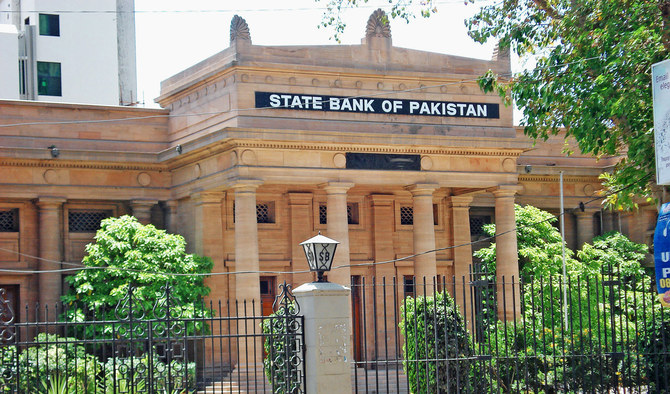
This undated file photo shows premises of the State Bank of Pakistan. (Shutterstock)
Short Url
Updated 02 March 2021
Follow

Pakistan’s central bank rules out 'sudden and higher' interest rate changes in foreseeable future

  • The State Bank of Pakistan has given forward guidance on monetary policy for the first time to address concerns of investors
  • The central bank maintains policy rate at 7 percent for the next two months as domestic recovery gains traction

KARACHI: Pakistan’s central bank on Friday ruled out any “sudden and higher” interest rate movements in the foreseeable future amid speculations that the International Monetary Fund (IMF) was likely to resume its $6 billion loan program for the country. 

The bank decided to maintain the policy rate at 7 percent for the next two months, saying that domestic economic recovery had gained further traction. 

“In the absence of unforeseen developments, the Monetary Policy Committee (MPC) expects monetary policy settings to remain unchanged in the near term,” Governor State Bank of Pakistan (SBP) Dr Reza Baqir told a news conference in Karachi. 

“As the recovery becomes more durable and the economy returns to full capacity, the MPC expects any adjustments in the policy rate to be ‘measured and gradual’ to achieve mildly positive real interest rates,” he said while reading a document, adding that the MPC considered it appropriate to provide some forward guidance on monetary policy to facilitate policy predictability and decision-making by economic agents. 

Last week, Baqir said the country was hoping for good news following talks with the IMF on the revival of fiscal stabilization program where concerns about future interest rates were also raised. The central bank’s forward guidance is meant to assuage such concerns of investors and business community. 

Pakistan signed $6 billion, three-year Extended Fund Facility (EFF) with the IMF and has so far secured $1.44 billion under the loan program since July 2019. The country was expecting another tranche of about $450 million before the second review was put on hold about a year ago. 

“We were in touch with the IMF at the technical level and the IMF also wanted fast economic recovery,” the SBP governor said, adding: “Now talks are going on with the IMF and when announcement would be made that our agreement on the review has been done its basic purpose would be to maintain the economic growth so that recovery could be stabilized.” 

Despite recent electricity tariff hikes, the central bank said that inflation was expected to fall within the previously announced range of 7-9 percent during FY21, hoping that the trend would move toward the 5-7 percent target range over the medium-term. 

Pakistan on Thursday increased the electricity tariff by Rs1.95 per unit, or 15 percent, which will also affect the base tariff for lifeline consumers using up to 50 units per month for the first time in almost two decades.

The SBP governor said, however, that the impact of these measures on inflation would be temporary. 

“The rates have been increased in the past as well,” he added, “but we witnessed that their impact was temporary.” 

He said the country had come out of the difficult stabilization phase and the economic activity data and indicators of consumer and business sentiment were reflecting continued improvement. 

However, the MPC stressed in its report that considerable uncertainty remained part of the general economic outlook. 

“The trajectory of the COVID pandemic is difficult to predict, given still-elevated global cases, the emergence of new strains, and lingering uncertainties about the roll out of vaccines worldwide,” the SBP statement read. “Such external shocks could slow the recovery.” 


Pakistan party calls Sindh resolution against new provinces ‘unconstitutional’

Updated 5 sec ago
Follow

Pakistan party calls Sindh resolution against new provinces ‘unconstitutional’

  • The development follows calls to separate Karachi from Sindh amid governance concerns intensified by a deadly mall fire last month
  • Muttahida Qaumi Movement-Pakistan calls for a referendum in urban areas of Sindh for the establishment of a new administrative unit

ISLAMABAD: The Muttahida Qaumi Movement-Pakistan (MQM-P) political party on Sunday criticized the Sindh provincial government for adopting a resolution in the provincial assembly against the creation of new provinces, describing it as “illegal, unconstitutional.”

The resolution was adopted on Saturday after fresh demands by the MQM-P and other voices to grant Karachi a provincial or federal status following governance challenges highlighted by a deadly mall fire earlier this year that killed 80 people.

Karachi, Pakistan’s largest city that is home to more than 20 million, is the country’s main commercial hub and contributes a significant share to the national economy.

Speaking at a press conference, MQM-P’s Khalid Maqbool Siddiqui said the Constitution of Pakistan provided procedure for establishing new provinces, but a province had “carried itself as if it were a separate country,” referring to Saturday’s resolution.

“Anything in contrast with the constitution cannot be adopted. This is illegal, unconstitutional, undemocratic,” he said, calling for a referendum in urban areas of Sindh for the establishment of a new administrative unit in the region.

Sindh Chief Minister Syed Murad Ali Shah had tabled the resolution in the assembly on Saturday, condemning what he described as “divisive statements” about breaking up Sindh or detaching Karachi.

“The province that played a foundational role in the creation of Pakistan cannot allow the fragmentation of its own historic homeland,” Shah told lawmakers, citing Article 239 of Pakistan’s 1973 Constitution, which requires the consent of not less than two-thirds of a provincial assembly to alter provincial boundaries.

“If any such move is attempted, it is this Assembly — by a two-thirds majority — that will decide,” he said.

The resolution reaffirmed that Karachi would “forever remain” an integral part of Sindh and directed the provincial government to forward the motion to the president, prime minister and parliamentary leadership for record.

Calls to alter Karachi’s status have periodically surfaced amid longstanding complaints over governance, infrastructure and administrative control in the megacity, though no formal proposal to redraw provincial boundaries has been introduced at the federal level.

Taha Ahmed Khan, a senior MQM-P member, acknowledged that his party had “presented its demand openly on television channels with clear and logical arguments” to separate Karachi from Sindh.

“It is a purely constitutional debate,” he told Arab News on Saturday. “We are aware that the Pakistan Peoples Party, which rules the province, holds a two-thirds majority and that a new province cannot be created at this stage. But that does not mean new provinces can never be formed.”