

Pakistani journalists blame 'nexus' between government, media owners for censorship, layoffs

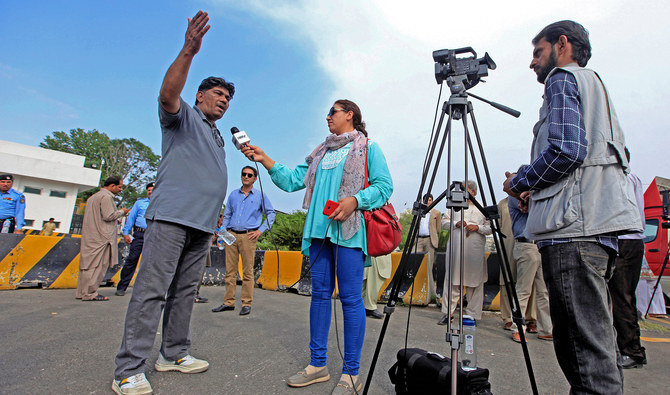
Journalists work during a demonstration to mark World Press Freedom Day in Islamabad on May 3, 2018. (REUTERS/File)
Short Url
Updated 23 January 2021
Follow

Pakistani journalists blame 'nexus' between government, media owners for censorship, layoffs

  • The government has denied allegations of any 'unholy alliance' with media owners
  • Media owners say the layoffs are part of ‘cost cutting’ decisions in the face of dwindling advertisement revenues

ISLAMABAD: An association of Pakistani journalists has announced a protest march on Islamabad in the first week of April to “force the government and media owners” to protect the rights of media workers and respect their freedom of expression. 

Journalists and rights groups say the government’s relations with the press have become strained since Prime Minister Imran Khan took office in 2018. The ruling Pakistan Tehreek-e-Insaf (PTI) administration denies that it censors the media. 

Journalists complain that editors and producers are not only forced to suppress opposition voices but also prevented from running critical content against the country's civil and military leadership. 

Many of them accuse the authorities of hindering the transmission and circulation of recalcitrant news channels and publications, saying the media outlets that refuse to play the official game begin to face problems with their advertisement revenues. 

The Pakistan Federal Union of Journalists (PFUJ) said in a statement on Sunday that newspapers and channels across the country had sacked more than 8,000 media workers in the last three years. Media owners defend such measures as “cost cutting” measures in response to a reduction in their revenues. 

“The anti-worker alliance and nexus between the government and the media industry owners is causing censorship and mass layoffs,” Shahzada Zulfiqar, PFUJ president, told Arab News on Thursday. 

He said that journalists would press the government to ensure full implementation of the country’s labor laws to protect their rights by staging a sit-in in front of the Parliament House in April. 

“The media owners have surrendered their independence to the government as part of an unholy alliance to violate labor laws and sack journalists with impunity,” he added. 

However, media owners reject the allegations, saying that the news industry works independently and follow all relevant laws of the country. 

“No such nexus exists between the government and media owners,” Shakeel Masud Hussain, secretary-general of Pakistan Broadcasters Association, told Arab News. 

He continued that the revenue of media organizations had significantly declined due to the COVID-19 pandemic and about Rs3 billion of advertisement revenue was pending with the government. 

“Journalists aren’t laid off under any specific plan,” he said. “This is a cost cutting measure as our revenues have shrunk due to the pandemic." 

Pakistan ranked 145th out of 180 countries on the World Press Freedom Index released by Reporters Sans Frontières (RSF) in April last year. 

Arif Nizami, president of the Council of Pakistan Newspapers Editors, endorsed the PFUJ demand of timely disbursement of salaries to journalists and protection of their rights under the country’s labor laws. 

“The government has devised a centralized media policy which means that it gives ads to its favorite news organizations, and this often leads to undeclared censorship as well,” he told Arab News. 

However, he maintained that only those media organizations were complicit “who have other businesses to protect.” 

“We fully support the genuine demands of working journalists and are ready to sit with them to resolve their issues,” Nizami said. 

However, the government said it was already “cognizant of the problems of working journalists” and blamed them on “the coercive policies of some media houses.” 

“The PTI administration does not have an ‘unholy alliance’ with media owners,” Faisal Javed Khan, who heads Senate Standing Committee on Information and Broadcasting, told Arab News. “This can be judged by the fact that our government initiated the process of bringing much needed changes in the media policies after coming into power to ensure safety of journalists and their job protection.” 

He added that he had personally tabled a bill in the Senate to improve the working of the local media industry. 

Meanwhile, the PFUJ president said that journalists would present a charter of demand to the government to ensure press freedom and job security for workers. 

“We are responsible and accountable [for our work], but we aren’t ready to compromise on freedom of press and freedom of expression,” Zulfiqar said. 


Islamabad dismisses claims about paying up to 8 percent interest on foreign loans as ‘misleading’

Updated 22 February 2026
Follow

Islamabad dismisses claims about paying up to 8 percent interest on foreign loans as ‘misleading’

  • Pakistan has long relied on external loans to help bridge persistent gaps in public finances and foreign exchange reserves
  • Pakistan’s total external debt, liabilities stand at $138 billion at an overall average cost of around 4 percent, ministry says

KARACHI: Pakistan’s finance ministry on Sunday dismissed as “misleading” claims that the country is paying up to 8 percent interest on external loans, saying the overall average cost of external public debt is approximately 4 percent.

Pakistan has long relied on external loans to help bridge persistent gaps in public finances and foreign exchange reserves, driven largely by a narrow tax base, chronic trade deficits, rising debt-servicing costs and repeated balance-of-payments pressures.

Over the decades, successive governments have turned to multilateral and bilateral lenders, including the International Monetary Fund, the World Bank and the Asian Development Bank, to support budgetary needs and shore up foreign exchange reserves.

The finance ministry on Sunday issued a clarification in response to a “recent press commentary” regarding the country’s external debt position and associated interest payments, and said the figures required contextual explanation to ensure accurate understanding of Pakistan’s external debt profile.

“Pakistan’s total external debt and liabilities currently stand at $138 billion. This figure, however, encompasses a broad range of obligations, including public and publicly guaranteed debt, debt of Public Sector Enterprises (both guaranteed and non-guaranteed), bank borrowings, private-sector external debt, and intercompany liabilities to direct investors. It is therefore important to distinguish this aggregate figure from External Public (Government) Debt, which amounts to approximately $92 billion,” it said.

“Of the total External Public Debt, nearly 75 percent comprises concessional and long-term financing obtained from multilateral institutions (excluding the IMF) and bilateral development partners. Only about 7 percent of this debt consists of commercial loans, while another 7 percent relates to long-term Eurobonds. In light of this composition, the claim that Pakistan is paying interest on external loans ‘up to 8 percent’ is misleading.

The overall average cost of External Public Debt is approximately 4 percent, reflecting the predominantly concessional nature of the borrowing portfolio.”

With respect to interest payments, public external debt interest outflows increased from $1.99 billion in Fiscal Year (FY) 2022 to $3.59 billion in FY2025, representing an increase of 80.4 percent, not 84 percent as reported. In absolute terms, interest payments rose by $1.60 billion over this period, not $1.67 billion, it said.

According to the State Bank of Pakistan’s records, Pakistan’s total debt servicing payments to specific creditors during the period under reference were as follows: the IMF received $1.50 billion, of which $580 million constituted interest; Naya Pakistan Certificates payments totaled $1.56 billion, including $94 million in interest; the Asian Development Bank received $1.54 billion, including $615 million in interest; the World Bank received $1.25 billion, including $419 million in interest; and external commercial loans amounted to nearly $3 billion, of which $327 million represented interest payments.

“While interest payments have increased in absolute terms, this rise cannot be attributed solely to an expansion in the debt stock,” the ministry said. “Although the overall debt stock has increased slightly since FY2022, the additional inflows have primarily originated from concessional multilateral sources and the IMF’s Extended Fund Facility (EFF) under the ongoing IMF-supported program.”

Pakistan secured a $7 billion IMF bailout in Sept. 2024 as part of Prime Minister Shehbaz Sharif’s efforts to stabilize the South Asian economy that narrowly averted a default in 2023. The government has since been making efforts to boost trade and bring in foreign investment to consolidate recovery.

“It is also important to note that the increase in interest payments reflects prevailing global interest rate dynamics. In response to the inflation surge of 2021–22, the US Federal Reserve raised the federal funds rate from 0.75-1.00 percent in May 2022 to 5.25–5.50 percent by July 2023. Although rates have since moderated to around 3.75 percent, they remain significantly higher than 2022 levels,” the finance ministry said.

“The government remains committed to prudent debt management, transparency, and the continued strengthening of Pakistan’s macroeconomic stability,” it added.