

Israeli warplanes strike Syria, kill 4, including children

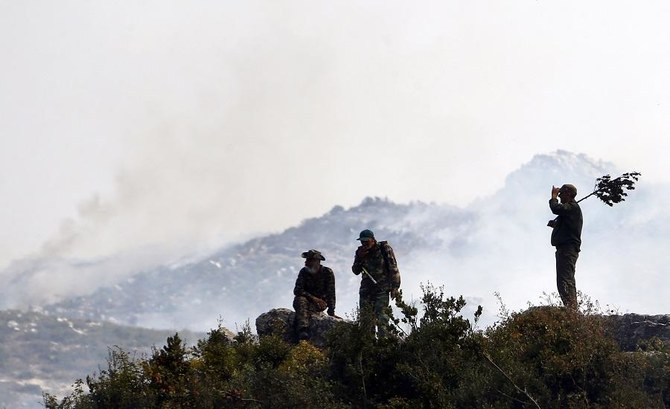
Syrian soldiers take a break as they battle a forest fire in the Ain Shams area, in the west of Hama province, on Sept. 10, 2020. (File/AFP)
Short Url
Updated 22 January 2021
Follow

Israeli warplanes strike Syria, kill 4, including children

  • At about four o’clock in the morning today, the Israeli enemy launched an aerial aggression with a barrage of missiles, state media has reported

DAMASCUS: Israeli warplanes fired several missiles toward central Syria early on Friday, killing a family of four — including two children — and wounding four other people, state media reported.
Separately, the Israeli military said it downed a drone that had crossed into Israel from Lebanon. It did not say how the aircraft was brought down. There was no immediate word from the Lebanese side but the militant Hezbollah group has sent drones into Israel’s airspace in the past.
Syria’s state news agency SANA quoted an unnamed military official as saying the missile attack took place shortly before dawn when Israeli warplanes flew over neighboring Lebanon.
Israeli Prime Minister Benjamin Netanyahu’s office refused to comment on the reports on Friday. Israel has launched hundreds of strikes against Iran-linked military targets in Syria over the years. But it rarely acknowledges or discusses such operations.

SPEEDREAD

The Israeli military said it downed a drone that had crossed into Israel from Lebanon.

The Syrian military official said the attack was aimed at several targets in and near the central province of Hama. It added that Syrian air defense units shot down most of the missiles. The official said the strike killed a family of four, including the parents and two children.
The strike also wounded four others, including two children, and destroyed three homes on the western edge of the provincial capital of Hama, SANA quoted the official as saying.
State TV said the family that was killed had been displaced by Syria’s nearly 10-year conflict.
The Britain-based Syrian Observatory for Human Rights, an opposition war monitoring group that tracks Syria’s civil war, said the strikes targeted five posts for Iran-backed fighters based within Syrian army positions.
It said the posts were destroyed, adding that parts of one of the air defense missiles fell on a residential area, causing casualties among civilians.
The observatory said it recorded 39 Israeli strikes inside Syria in 2020 that hit 135 targets, including military posts, warehouses and vehicles.


Turkiye’s foreign minister says the US and Iran showing flexibility on nuclear deal, FT reports

Updated 4 sec ago
Follow

Turkiye’s foreign minister says the US and Iran showing flexibility on nuclear deal, FT reports

  • Hakan Fidan: “It is positive that the Americans appear willing to tolerate Iranian enrichment within clearly set boundaries”
  • Washington has until now demanded Iran relinquish its stockpile of uranium enriched to up to 60 percent fissile purity
The United States and Iran are showing flexibility on a nuclear deal, with Washington appearing “willing” to tolerate some nuclear enrichment, Turkish Foreign Minister Hakan Fidan told the Financial Times in an interview published Thursday.
“It is positive that the Americans appear willing to tolerate Iranian enrichment within clearly set boundaries,” Fidan, who has been involved in talks with both Washington and Tehran, told the FT.
“The Iranians now recognize ‌that they ‌need to reach a deal with the ‌Americans, ⁠and the Americans ⁠understand that the Iranians have certain limits. It’s pointless to try to force them.”
Washington has until now demanded Iran relinquish its stockpile of uranium enriched to up to 60 percent fissile purity, a small step away from the 90 percent that is considered weapons grade.
Iranian ⁠President Masoud Pezeshkian has said Iran would continue ‌to demand the ‌lifting of financial sanctions and insist on its nuclear rights including ‌enrichment.
Fidan told the FT he believed Tehran “genuinely ‌wants to reach a real agreement” and would accept restrictions on enrichment levels and a strict inspection regime, as it did in the 2015 agreement with the US and others. US ‌and Iranian diplomats held talks through Omani mediators in Oman last week in ⁠an effort ⁠to revive diplomacy, after President Donald Trump positioned a naval flotilla in the region, raising fears of new military action. Trump on Tuesday said he was considering sending a second aircraft carrier to the Middle East, even as Washington and Tehran prepared to resume negotiations.
The Turkish foreign minister, however, cautioned that broadening the Iran-US talks to ballistic missiles would bring “nothing but another war.”
The US State Department and the White House did not respond to a request for comment outside regular business hours.