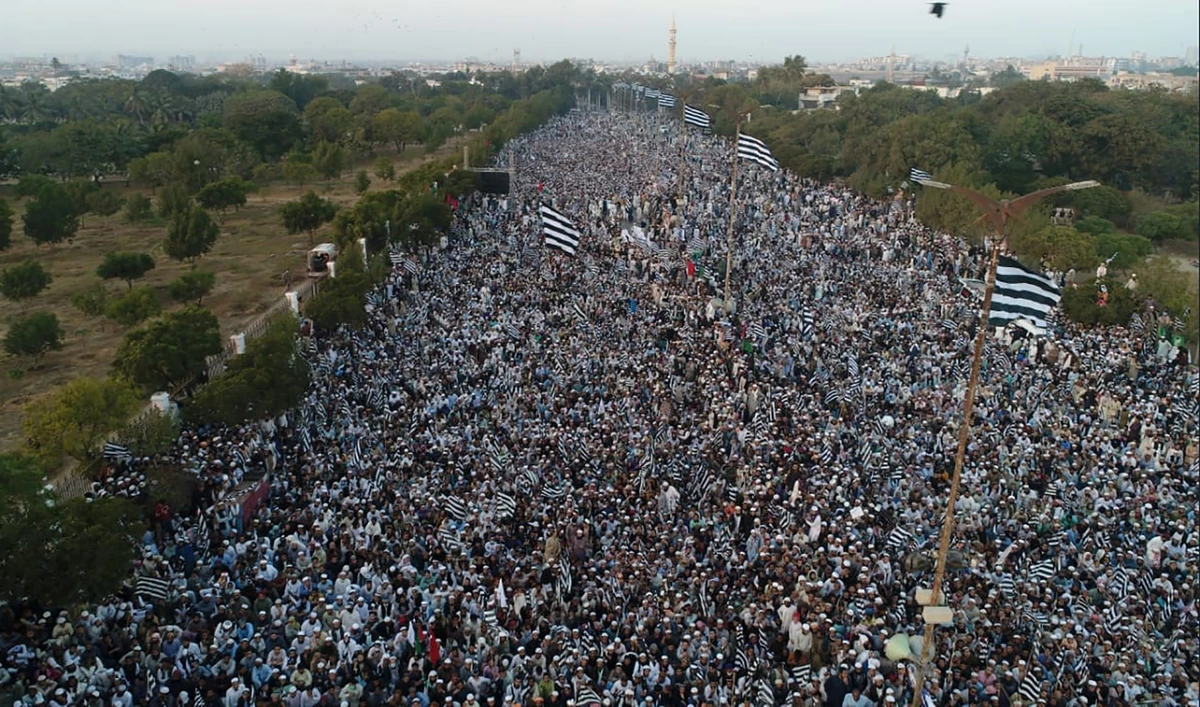
Massive opposition rally says no Pakistani will ever allow diplomatic recognition of Israel

1 / 2
Thousands participate in an anti-Israel rally organized by the Jamiat-e-Ulama-e-Islam (JUI-F) party in Karachi on Thursday, Jan. 21, 2021. (AN Photo/S.A. Babar)
2 / 2
Short Url
Updated 21 January 2021
Follow

Massive opposition rally says no Pakistani will ever allow diplomatic recognition of Israel

  • Pakistani media reported last November that the government was under international pressure to recognize the Jewish state
  • The opposition rally was addressed by the Grand Mufti of Jerusalem and a former Palestinian prime minister via video link

KARACHI: Thousands of opposition activists in Pakistan criticized any possibility of extending diplomatic recognition to Israel on Thursday, saying that the people of their country would not allow that to happen until the creation of Palestine and the return of its displaced people to their native land. 

Organized by the Jamiat-e-Ulama-e-Islam (JUI-F) party, the rally was also attended by leaders of the Pakistan Muslim League-Nawaz (PML-N), Pakistan Peoples Party (PPP) and other opposition factions who are part of the Pakistan Democratic Movement (PDM) that seeks to bring down Prime Minister Imran Khan’s government. 

The Pakistani media reported last November that the government was under pressure to recognize the Jewish state, though officials in Islamabad, including the prime minister, strongly ruled out the possibility of any normalization with Israel. 

Speaking to a local news channel, Prime Minister Khan said last month that Pakistan would refuse to recognize Israel until it guaranteed Palestinian rights. “Pakistan is a democratic society — and our entire nation stands with Palestinians,” he said. 
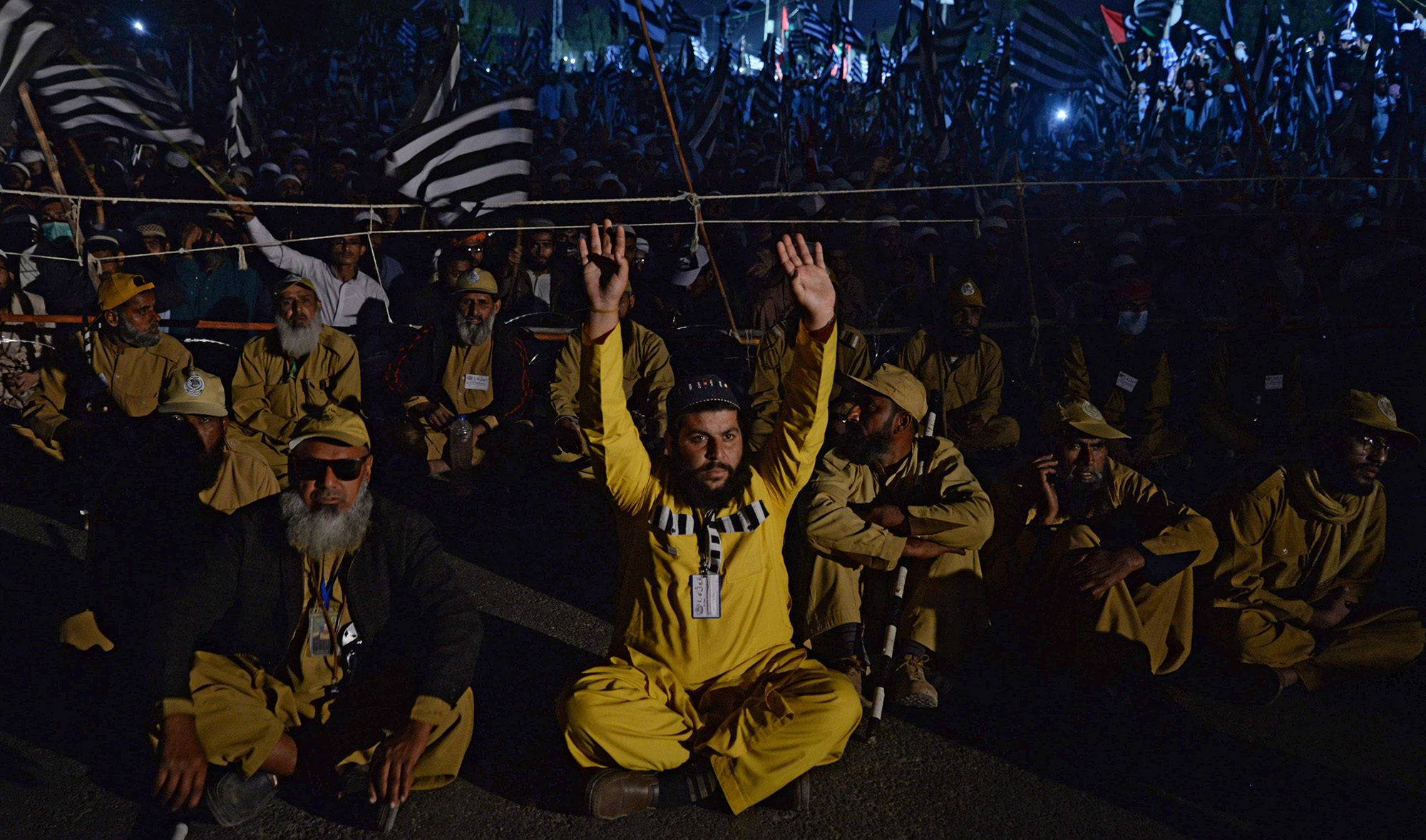


Supporters of opposition taking part in an anti-Israel rally organized by the Jamiat-e-Ulama-e-Islam (JUI-F) party in Karachi on Thursday, Jan. 21, 2021. (AN Photo/S.A. Babar)

The country’s opposition, however, blamed the ruling Pakistan Tehreek-e-Insaf (PTI) administration for generating debate over the issue. 

“A narrative is being built that Israel’s recognition is in Pakistan’s interest. The PML-N and PDM strongly reject this discourse,” former prime minister Shahid Khaqqan Abbasi said while addressing the rally. 

“This is not a matter of interests. It’s matter of ideology. There are more than 200 countries in the world, but only Pakistan’s passport stops its citizens from visiting Israel. How can we compromise on ideology for the sake interests?” he asked. 

“This gathering aims to tell those at the helm of affairs that this can never happen. Our 220 million are united that Pakistan cannot compromise on Palestine and Kashmir. The PDM is united on this, and Pakistan is united as well,” Abbasi added. 
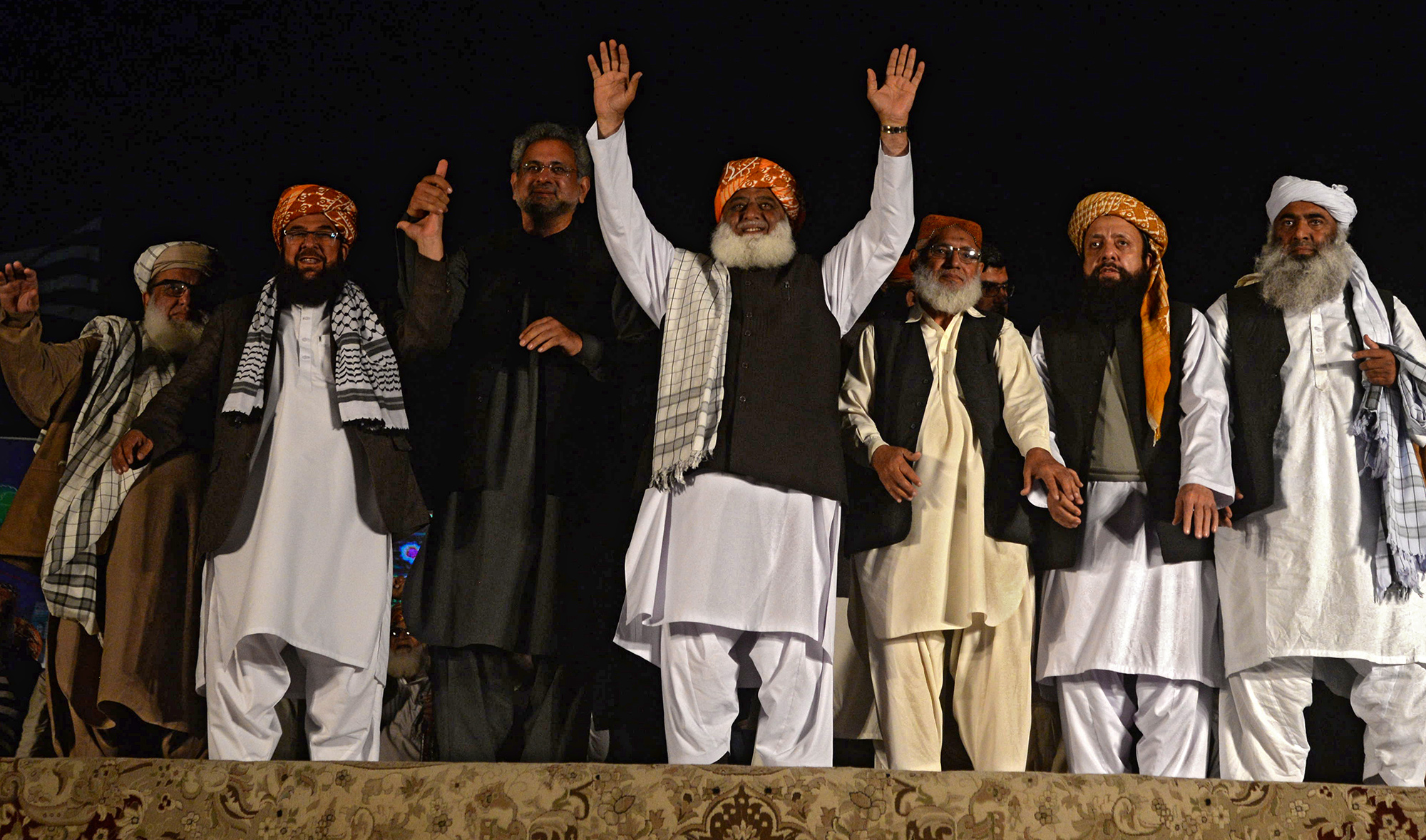


Opposition leaders during a rally organized by the Jamiat-e-Ulama-e-Islam (JUI-F) party in Karachi on Thursday, Jan. 21, 2021. (AN Photo/S.A. Babar)

The chief of the opposition PDM alliance, Maulana Fazlur Rehman, said that Pakistanis supported the people of Palestine in their struggle for an independent country. 

“I want to convey a clear message to our Palestinian brothers that Pakistani nation will support you till their last drop of blood. We will stand by you until Palestine is free,” Rehman said. “The founder of Pakistan said that his country would never recognize Israel since it had stabbed Palestinians. The Muslim ummah has not forgotten these words.” 

Senator Saeed Ghani, a senior PPP leader, said that his party shared the stance of JUIF on the issue. 

“No matter how much differences we have or which party we belong to, we are all united [against the idea of recognizing Israel],” he said. 

Jerusalem’s Grand Mufti Muhammad Ahmad Hussein and former prime minister of the Palestinian National Authority Ismail Haniyeh also spoke to the rally via video link.
Pakistan remittances seen surpassing $40 billion in FY26 as Saudi Arabia leads November inflows

Updated 4 sec ago
Follow

Pakistan remittances seen surpassing $40 billion in FY26 as Saudi Arabia leads November inflows

  • The country’s November remittances rose 9.4 percent year-on-year to $3.2 billion, official data show
  • Economic experts say rupee stability and higher use of formal channels are driving the upward trend

ISLAMABAD: Pakistan’s workers’ remittances are expected to exceed the $40 billion mark in the current fiscal year, economic experts said Tuesday, after the country recorded an inflow of $3.2 billion in November, with Saudi Arabia once again emerging as the biggest contributor.

Remittances are a key pillar of Pakistan’s external finances, providing hard currency that supports household consumption, helps narrow the current-account gap and bolsters foreign-exchange reserves. The steady pipeline from Gulf economies, led by Saudi Arabia and the United Arab Emirates, has remained crucial for Pakistan’s balance of payments.

A government statement said monthly remittances in November stood at $3.2 billion, reflecting a 9.4 percent year-on-year increase.

“The growth in remittances means the full-year figure is expected to cross the $40 billion target in fiscal year 2026,” Sana Tawfik, head of research at Arif Habib Limited, told Arab News over the phone.

“There are a couple of factors behind the rise in remittances,” she said. “One of them is the stability of the rupee. In addition, the country is receiving more inflows through formal channels.”

Tawfik said the trend was positive for the current account and expected inflows to remain strong in the second half of the fiscal year, noting that both Muslim festivals of Eid fall in that period, when overseas Pakistanis traditionally send additional money home for family expenses and celebrations.

The official statement said cumulative remittances reached $16.1 billion during July–November, up 9.3 percent from $14.8 billion in the same period last year.

It added that November inflows were mainly sourced from Saudi Arabia ($753 million), the United Arab Emirates ($675 million), the United Kingdom ($481.1 million) and the United States ($277.1 million).

“UAE remittances have regained momentum in recent months, with their share at 21 percent in November 2025 from a low of 18 percent in FY24,” said Muhammad Waqas Ghani, head of research at JS Global Capital Limited. “Dubai in particular has seen a steady pick-up, reflecting improved inflows from Pakistani expatriates owing to some relaxation in emigration policies.”