Pakistan’s religion ministry proposes expansion of ‘Makkah Route’ project

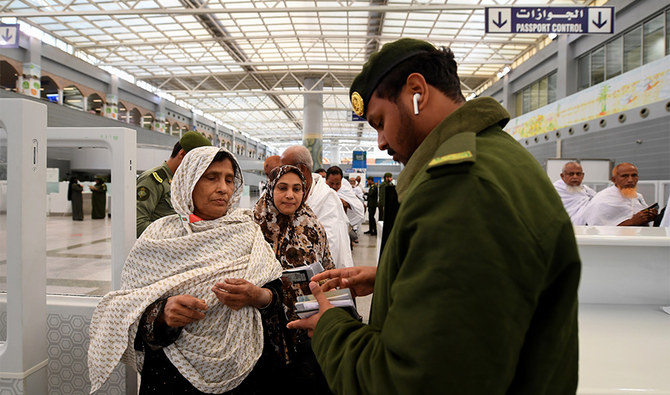
Muslim pilgrims go through passport control upon their arrival to King Abdulaziz International Airport in Jeddah on July 7, 2019. (AFP/File)
Short Url
Updated 22 January 2021
Follow

Pakistan’s religion ministry proposes expansion of ‘Makkah Route’ project

  • Under the project initiated by Saudi Arabia, all immigration requirements of Hajjis are to be fulfilled at airport of origin
  • A pilot project was launched at Islamabad airport last year but Pakistan now proposes to expand the facilities to Lahore and Karachi

ISLAMABAD: Pakistan’s religious affairs ministry presented a summary to the the top economic decision-making body, the Economic Coordination Committee (ECC), on Wednesday to scale up the Makkah Route project designed to ease Hajj journeys of pilgrims arriving in the kingdom from various Muslim countries. 
Under the Makkah Route project initiated by Saudi Arabia, all immigration requirements of pilgrims are to be fulfilled at the airport of origin. This saves pilgrims several hours upon reaching the kingdom since they can just enter the country, having gone through immigration already at home. The project also includes other Muslim countries, such as Indonesia and Malaysia.
Pakistan implemented a pilot project in 2019 at the Islamabad International Airport. The government now plans to extend the facility to potential pilgrims in Lahore and Karachi, making the two cities part of the expanded initiative.
“One of the pre-conditions for scaling up of Makkah Route Project was grant of special exemption on the import of technical equipments in Pakistan by the Kingdom of Saudi Arabia,” the ECC said in a handout after its Wednesday meeting, deciding that the Federal Board of Revenue would hold a separate consultation with the religion ministry to work out the details of the matter before seeking the ECC’s approval on it. 
Pakistan planned last year to widen the scope of the Makkah Route initiative, but the Hajj was performed on a limited scale amid rising coronavirus infection globally.


Pakistan tax revenue rises in January as direct taxes drive growth

Updated 5 sec ago
Follow

Pakistan tax revenue rises in January as direct taxes drive growth

  • Federal tax collection grows 16% year-on-year at the outset of 2026, led by income tax gains
  • Seven-month revenues reach Rs.7.18 trillion as authorities bank on recovery in manufacturing

ISLAMABAD: Pakistan’s Federal Board of Revenue (FBR) on Saturday reported a strong pickup in tax collection in January, driven by a sharp rise in direct taxes, as the government seeks to shore up public finances under a reform-led revenue mobilization drive.

The tax authority collected a provisional Rs1.02 trillion ($3.65 billion) in January, up 16% from Rs.873 billion ($3.14 billion) in the same month last year, surpassing the six-month average growth rate of 10-11%, according to an official statement.

“This month’s tax performance reveals a nuanced and strategically significant fiscal outcome, characterized by substantial increase in direct taxation, modest growth in indirect and excise streams and an overall healthy and improved performance in January 2026,” the statement said.

“It also reinforces the credibility of reform-driven revenue mobilization and transformation plan of FBR,” it added.

Income tax collection rose 26% to Rs483 billion ($1.74 billion) from Rs381 billion ($1.37 billion) a year earlier, reflecting what the FBR described as the impact of enforcement measures and efforts to unlock revenue tied up in litigation.

Sales tax receipts increased 12% to Rs360 billion ($1.30 billion) from Rs322 billion ($1.16 billion) last year, which the tax authority linked to signs of recovery in large-scale manufacturing.

The FBR said the results underscored the effectiveness of its reform program, including the use of digital infrastructure and enforcement tools to improve compliance and expand the tax base, while encouraging voluntary taxpayer participation.

Cumulatively, the FBR collected Rs7.18 trillion ($25.83 billion) in the first seven months of the 2026 fiscal year, compared with Rs6.49 trillion ($23.36 billion) in the same period last year.

The tax authority said it was optimistic that continued recovery in manufacturing would help it meet its full-year revenue targets, adding that it aimed to maintain momentum in the remaining months of the fiscal year.