White House says Biden will be discussing Iran with foreign partners

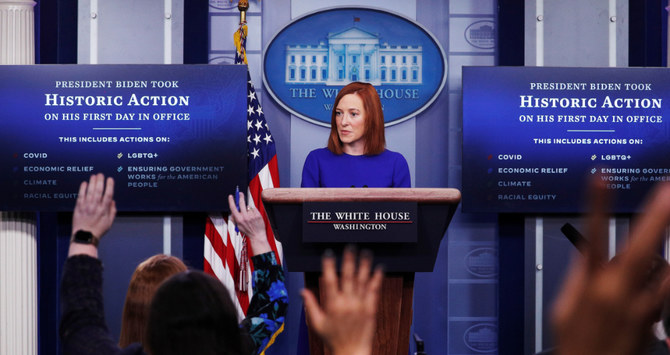
White House Press Secretary Jen Psaki takes questions from journalists. (Reuters)
Short Url
Updated 21 January 2021
Follow

White House says Biden will be discussing Iran with foreign partners

  • Former President Donald Trump abandoned the Iran nuclear deal in 2018

WASHINGTON: The US seeks to lengthen and strengthen the nuclear constraints on Iran through diplomacy and the issue will be part of President Joe Biden’s early talks with foreign counterparts and allies, White House Press Secretary Jen Psaki said.
Biden has said that if Tehran resumed strict compliance with the 2015 nuclear agreement — under which Iran restrained its nuclear program in return for relief from economic sanctions — Washington would too.

“The president has made clear that he believes that through follow-on diplomacy, the United States seeks to lengthen and strengthen nuclear constraints on Iran and address other issues of concern. Iran must resume compliance with significant nuclear constraints under the deal in order for that to proceed,” Psaki said in a briefing.
“We would expect that some of his earlier conversations with foreign counterparts and foreign leaders will be with partners and allies and you would certainly anticipate that this would be part of the discussions,” Psaki added.

Former President Donald Trump abandoned the Iran nuclear deal in 2018 and Iran in return has gradually breached its key limits, building up its stockpile of low enriched uranium, enriching uranium to higher levels of purity and installing centrifuges in ways barred by the deal.

Opinion

This section contains relevant reference points, placed in (Opinion field)


On Tuesday, Biden’s nominee for secretary of state Antony Blinken said Washington did not face a quick decision on whether to rejoin the nuclear deal and the Democratic president would need to see what Iran actually did to resume complying with the pact.

Soleimani’s shadow
Qassem Soleimani left a trail of death and destruction in his wake as head of Iran’s Quds Force … until his assassination on Jan. 3, 2020. Yet still, his legacy of murderous interference continues to haunt the region

Enter


keywords

Iran unrest persists, top judge warns protesters

Updated 08 January 2026
Follow

Iran unrest persists, top judge warns protesters

  • Demonstrations sparked by soaring inflation
  • Western provinces worst affected

DUBAI: Iran’s top judge warned protesters on Wednesday there would be “no ​leniency for those who help the enemy against the Islamic Republic,” while accusing Israel and the US of pursuing hybrid methods to disrupt the country.
The current protests, the biggest wave of dissent in three years, began last month in Tehran’s Grand Bazaar by shopkeepers condemning the currency’s free fall. 
Unrest has since spread nationwide amid deepening distress over economic hardships, including rocketing inflation driven by mismanagement and Western sanctions, and curbs on political and ‌social freedoms.
“Following announcements ‌by Israel and the US president, there is no excuse for those coming ‌to the ​streets for ‌riots and unrest, chief justice Gholamhossein Mohseni Ejei, the head of Iran’s judiciary, was quoted as saying by state media.
“From now on, there will be no leniency for whoever helps the enemy against the Islamic Republic and the calm of the people,” Ejei said.
Iranian authorities have not given ‌a death toll for protesters, but have said at least two members of the security services have died and more than a dozen have been injured.
Iran’s western provinces have witnessed the most violent protests.
“During the funeral of two people ​in Malekshahi on Tuesday, a number of attendees began chanting harsh, anti-system slogans,” said Iran’s Fars, news agency.
After the funeral, Fars said, “about 100 mourners went into the city and trashed three banks ... Some started shooting at the police trying to disperse them.”
The semi-official Mehr news agency said protesters stormed a food store and emptied bags of rice, which has been affected by galloping inflation that has made ordinary staples increasingly unaffordable for many Iranians.