

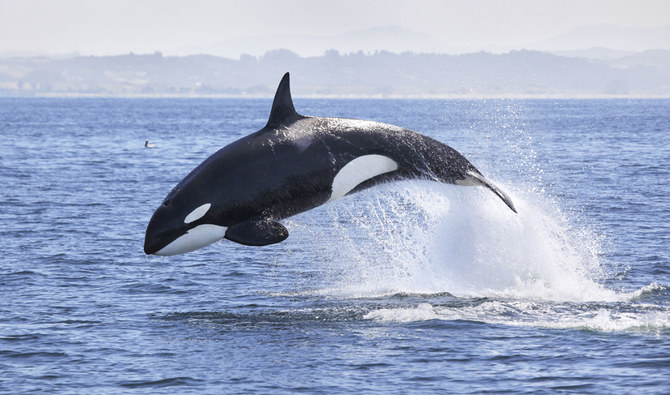
Call for new Red Sea whale studies after orca spotted off Saudi shores

Photo/Supplied
Short Url
Updated 19 January 2021
Follow

Call for new Red Sea whale studies after orca spotted off Saudi shores

  • The killer whales were spotted apparently attacking a dolphin close to shore off Ras Muhaisen, south of Jeddah

MAKKAH: Diver and marine life expert has called for new research into the activity of Red Sea whales after the first confirmed sighting of a pod of orcas in the waters since 2018.
The killer whales were spotted and filmed by sailors on a small boat on Jan. 12 apparently attacking a dolphin close to shore off Ras Muhaisen, south of Al-Lith governorate.
Orcas have previously been seen in the Red Sea off Eritrea and Egypt with the last sighting thought to be in the Gulf of Aqaba three years ago.
Marine science specialist Mahmoud Mohammed told Arab News that it was unusual for a pod to be seen so close to land.
“Whales are not studied in the Red Sea as often as they are in other seas around the world, and therefore it is important to intensify efforts to study marine life in the Red Sea more broadly,” he said.

“There are 16 species of whales in the Red Sea, including the orca, and some people believe that its appearance is due to climate and temperature changes.”
Although most commonly found in glacial waters, killer whales inhabit most of the world’s oceans and seas including the Red Sea and Gulf of Aden, but were rarely seen close to shore, he added. “In 2018, however, one was spotted on the shores of Al-Seif in Al-Lith governorate.”
The mammal feeds on 60 species of fish, as well as dolphins, giant squid, and octopus but although there have been isolated reports of killer whales attacking humans, Mohammed pointed out that these were not normally with the intention of getting food.

HIGHLIGHT

Orcas have previously been seen in the Red Sea off Eritrea and Egypt with the last sighting thought to be in the Gulf of Aqaba three years ago.

Dr. Abdullah Al-Shaalan, an environmental expert and academic at King Saud University, told Arab News that whales generally preferred deep waters far away from beaches and human activity.
“One of the most well-known of whales is the blue whale which is the largest living animal on Earth and can reach up to 30 meters in length and weigh nearly 200 tons. It is also one of the most endangered species, and therefore, it is illegal to catch it,” he said.
He noted that whales were the descendants of land mammals believed to have migrated into the water nearly 50 million years ago.
“Their bodies are streamlined, and they have a tail and dorsal fins that help them move. They also breathe through the lungs, and air enters them through the nozzle at the top of the head where it acts as a unique respiratory system that allows it to stay underwater for long periods without taking oxygen so that it moves sometimes under the surface of the water, and sometimes it jumps above the surface,” added Al-Shaalan.
Similar to other mammals, whales give birth rather than producing eggs and nurse their young with milk.
“Whales maintain a constant body temperature regardless of the temperature of the surrounding environment, while almost all fish are cold-blooded,” Al-Shaalan said.
“We often read about or see corpses of whales that may have died because their big bodies could not endure an injury or sickness, and their corpses were thrown by waves to the beaches. Some marine biologists have explained this mysterious phenomenon as a type of suicide by these marvelous marine creatures.”
Many countries around the world cooperate in preserving and protecting whale populations which play a vital role in maintaining the stability and health of marine ecosystems.


Saudi Film Festival to return in April with focus on Korean cinema

Since its launch in 2008, the Saudi Film Festival has played a central role in nurturing local and Gulf cinema. (Supplied)
Updated 15 February 2026
Follow

Saudi Film Festival to return in April with focus on Korean cinema

  • Ahmed Al-Mulla, founder and director of the Saudi Film Festival, said in a statement: “We’re excited to welcome filmmakers to our annual gathering. Our doors are open to all creators, and filmmakers remain at the heart of everything we do

DHAHRAN: The Saudi Film Festival, organized by the Cinema Association in partnership with the King Abdulaziz Center for World Culture and supported by the Saudi Film Commission, has announced that it will launch at Ithra in Dhahran between April 23-29.

This year’s festival explores the theme of “Cinema of the Journey,” presenting a selection of Arab and international films, both short and feature-length, that center on journeys and movement as essential storytelling elements. 

Since its launch in 2008, the Saudi Film Festival has played a central role in nurturing local and Gulf cinema. (Supplied)

The program includes road movies, travel narratives and films where physical or emotional journeys drive the narrative.

The theme encourages Saudi filmmakers to explore this subject through their own perspectives. It positions cinema itself as an act of continuous transition, where identity, place, and time converge to shape the human experience.

FASTFACTS

• This year’s Saudi Film Festival will explore the theme of ‘Cinema of the Journey,’ presenting a selection of Arab and international films that center on journeys and movement as essential storytelling elements.

• The program includes road movies, travel narratives and films where physical or emotional journeys drive the narrative.

Following last year’s focus on Japanese cinema, the festival will present a special “Spotlight on Korean Cinema” this year.

Ahmed Al-Mulla, founder and director of the Saudi Film Festival, said in a statement: “We’re excited to welcome filmmakers to our annual gathering. Our doors are open to all creators, and filmmakers remain at the heart of everything we do. This year’s festival creates an atmosphere filled with inspiration, idea exchange, and shared learning. It’s a celebration of cinematic creativity for everyone.”

Tariq Al-Khawaji, deputy director of the festival, added: “At Ithra, we’re proud of our longstanding partnership with the Cinema Association. It has enabled the festival’s growth and thematic diversity year after year, which we see clearly in how we empower filmmakers and create opportunities to engage with global cinema. 

“The festival continues to grow across all areas, from preparations and participation to industry expectations locally and regionally. That makes attention to every detail essential.”

Since its launch in 2008, the Saudi Film Festival has played a central role in nurturing local and Gulf cinema. After intermittent early editions, it has now established itself as an annual platform for narrative and documentary competitions, industry programs and project markets.

By bringing together emerging and established filmmakers in Dhahran each year, the festival strengthens Saudi Arabia’s growing presence on the global film stage.