UK asylum-seekers locked in unsafe barracks amid COVID-19 outbreak

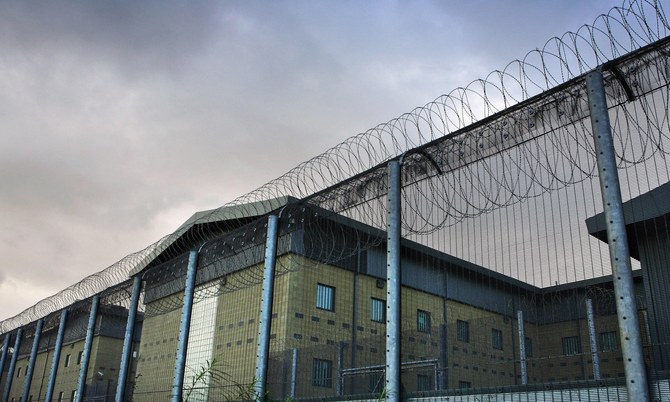
Harmondsworth, near London Heathrow Airport, is another immigration removal center in the UK to suffer a COVID-19 outbreak. (AFP/File Photo)
Short Url
Updated 18 January 2021
Follow

UK asylum-seekers locked in unsafe barracks amid COVID-19 outbreak

  • Around 400 men, some medically vulnerable, threatened with arrest if they leave Napier Barracks
  • Residents say the conditions are unsafe, and social distancing and isolation are impossible

LONDON: An outbreak of COVID-19 at an asylum-seeker holding center in the UK has led to hundreds of people being locked inside as part of blanket quarantine measures that campaigners and residents have called “dangerous.”

The disused Napier Barracks in Kent is home to around 400 people, including medically vulnerable individuals, who have been warned they face arrest if they attempt to leave.

It is alleged that asylum-seekers sleep more than 20 to a room, with just curtains hung between them for protection, and small communal bathrooms and eating areas.

A Yemeni at the site told The Independent newspaper that he had displayed symptoms of COVID-19 but had yet to receive any test results, and had not eaten since midday on Jan. 17.

He said he had been confined to a dormitory with 28 others, some with symptoms, but none had been able to isolate.

“People with coronavirus have been allowed to live normally among other refugees. Some people aren’t wearing masks and social distancing isn’t always followed,” he added.

“I’m scared. Yesterday and this morning I didn’t go to get my food because I was too scared and I feel unwell. One guy in this dorm has been coughing a lot in recent days and has fever. The conditions here risk the spread of coronavirus. I just fled the war from Yemen and I came to the UK to seek safety, but in the end I might end up dying from coronavirus in a barracks.”

Another Yemeni man in the same dormitory said: “It was a big mistake putting this many people together in same place. We should be moved as soon as possible. This is dangerous and it’s damaging our physical and mental health.”

Lawyers have written to the UK Home Office saying the conditions are illegal, and accusing the government of trying to “avoid scrutiny.”

There have been calls for the barracks to be closed, and for the asylum-seekers to be moved to accommodation that allows them to isolate effectively.

Bridget Chapman of the Kent Refugee Action Network said: “The Home Office was so determined to use ex-military facilities to appear tough that they ignored all the warnings. Now we’re in a situation where people who should’ve been safe have been put at risk.”

Chris Philp, the UK minister for immigration compliance, said the number of cases at Napier Barracks is “small,” adding: “We take the welfare of those in our care extremely seriously, and asylum-seekers can contact the 24/7 helpline run by Migrant Help if they have any issues.”


Pure extortion: foreign workers face violence and exploitation in Croatia

Updated 4 sec ago
Follow

Pure extortion: foreign workers face violence and exploitation in Croatia

ZAGREB — HRV: When DD left his home in India for Croatia last year, he expected his food delivery work to be hard, with long hours and low pay. He did not expect to be spat at in the street.
Twice last year the 27-year-old from Chandigarh was abused by groups of young people while working. Some spat at him, others shouted at him to “go back to your own country” as they tried to steal his delivery bag.
For the young foreign worker, one of the tens of thousands drawn to the EU nation every year, it was a rough welcome — but one he said is increasingly common among his colleagues.
As Croatia struggles with growing staff shortages, particularly in its key tourism sector, experts warn its badly needed foreign workers are left vulnerable to violence and exploitation.
“I just came to work and live peacefully,” DD, who asked to be referred to only by his initials, told AFP.
“We are not stealing jobs.”
Croatia has one of the five fastest-declining populations in the European Union, losing nearly 400,000 people over the past decade, according to the World Bank.
The shortages have driven a steady rise in the number of workers arriving from Asia — particularly since Croatia joined Europe’s passport-free Schengen zone in 2023.
Last year, four out of 10 work and residency permits were issued to Nepalis, Filipinos, Indians and Bangladeshis, mostly in the tourism, catering and construction industries.
It is a dramatic change for a largely conservative society with extremely limited experience of immigration from outside Europe.
According to the last census, more than 90 percent of Croatia’s 3.8 million people are ethnic Croats, while about 80 percent are Roman Catholic.

- Broken jaws, cracked ribs -

In WhatsApp groups used by DD’s fellow delivery riders, many share stories of almost weekly attacks, with the worst reporting broken jaws and cracked ribs.
While national crime data does not break down rates by victims’ nationality, the number of crimes against Nepali nationals rose sharply in 2024, outpacing the roughly 50-percent growth of its diaspora in Croatia.
Comparable increases were recorded among Indian, Filipino and Bangladeshi nationals.
But food delivery company Wolt said many attacks on its delivery riders, which are committed mainly by opportunistic young people, went unreported.
Most foreign workers arrive through private agencies or employers that usually offer little support, according to unions.
Some employers also offer overcrowded and unsafe housing at hefty rates.
Delivery rider Hasan, who did not give his surname for fear of losing his job, said he had been charged 270 euros ($319) a month for an “unliveable” room shared with five other men.
Breaches of arbitrary rules, such as a visitor ban, could attract hefty “fines” from his previous employer, who leased him the room.
“It’s pure extortion,” said the 27-year-old from India.
He was also expected to work 12 hours a day, seven days a week.
“You are like their slaves.”

- Hardening attitudes -

As migrant numbers grow, public attitudes appear to be hardening.
An Institute for Migration Research (IMR) survey found that more than 60 percent of Croatians were dissatisfied with the presence of foreign workers, up from 46 percent a year earlier.
Fears over a potential rise in crime rates, impacts on local wages, job losses and cultural differences were among the top complaints of those surveyed.
“When people feel their livelihoods are threatened, support for radical positions is more likely,” sociologist Ivan Balabanic said.
Some right-wing politicians have seized on the issue to push anti-immigrant rhetoric and portray foreign workers as part of a plot to “replace” European populations.
The conservative government, which has condemned the violence against foreign workers, recently moved to improve protections but also to require language tests for long-term workers.
DD said most Croatians were “generally friendly,” but without the ability to speak the local language, he had struggled to fit in.
Balabanic said politicians needed to stop treating the issue as “taboo” and discuss the need for foreign workers candidly.
“This is our reality and must be acknowledged as such.”