

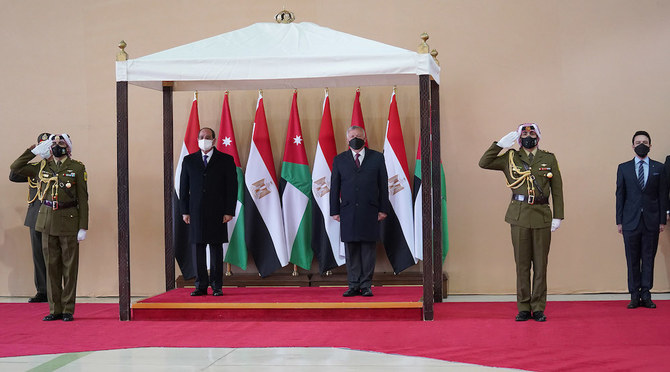
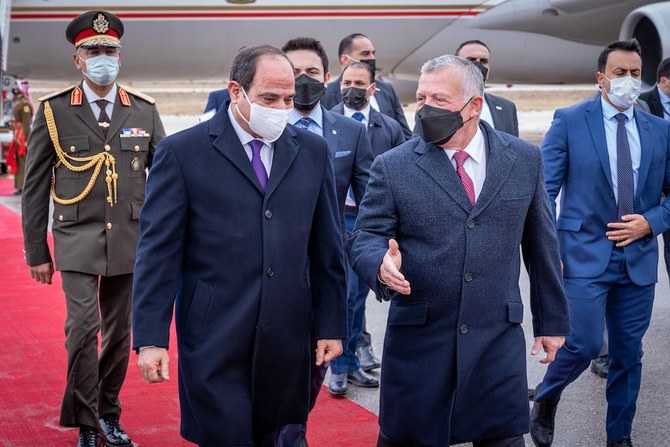


DUBAI: Jordan’s King Abdullah on Monday met with Egypt’s President Abdel Fattah El-Sisi during the Egyptian leader’s official visit to the capital Amman.
Their talks, also attended by Jordanian Crown Prince Hussein bin Abdullah and other senior ministers and officials from both sides, dealt with ways to strengthen bilateral relations and “the latest developments in the regional and Arab arena, foremost of which is the Palestinian issue,” state-run news agency Petra reported.
The king affirmed Jordan’s “clear and firm stance” on Palestine and called for a just and comprehensive peace based on a two-state solution guaranteeing the establishment of an independent, sovereign, and viable Palestinian state, with East Jerusalem as its capital.
The monarch also welcomed the outcomes of the 41st Gulf Cooperation Council (GCC) summit held in AlUla which had “contributed to strengthening solidarity and unity of the Arab ranks.”
مراسم استقبال رسمية للرئيس المصري عبدالفتاح السيسي في مطار ماركا #الأردن #مصر
An official welcoming ceremony is held for #Egypt President Abdel Fattah El Sisi at Marka Airport #Jordan pic.twitter.com/94VEte3atj
— RHC (@RHCJO) January 18, 2021
Both sides agreed to regularly coordinate to unify regional and international efforts to protect Arab national security and revitalize Middle East peace negotiations.
During their meeting, the two leaders also “discussed mechanisms to expand tripartite Jordanian-Egyptian-Iraqi cooperation, and their aspiration to continue building on what has been accomplished in the previous three summits.”
King Abdullah and El-Sisi met with Iraqi Prime Minister Mustafa Al-Kadhimi for the first time in Amman last August and the three countries have held a number of meetings in the past two years, mostly focused on trade, telecommunications, oil, and infrastructure and coordinating the fight against extremists.
Petra said the king “praised the level of coordination and consultation between the two countries (Jordan and Egypt) on various issues of common interest and both sides emphasized the depth of the historical relations between the two countries.”
His Majesty King Abdullah II and His Royal Highness Crown Prince Al Hussein receive #Egypt President Abdel Fattah El Sisi, upon arrival at Marka Airport #Jordan pic.twitter.com/2gZrBlZeKg
— RHC (@RHCJO) January 18, 2021
El-Sisi arrived at Amman’s Marka airport on Monday heading an official delegation to Jordan on the invitation of the king.
The meeting comes a week after Egypt hosted the foreign ministers of Germany, France, and Jordan to discuss ways to revive peace talks between Israel and the Palestinians, a week before US President-elect Joe Biden takes office.
Amman and Cairo are emerging as potential new members of the international Middle East Quartet for peace, which was set up in 2002 to help mediate regional negotiations and consists of the UN, the EU, the US, and Russia.
Palestinian President Mahmoud Abbas on Sunday hosted the Egyptian and Jordanian intelligence chiefs to brief them on plans to hold the first Palestinian elections in 14 years.
His Majesty King Abdullah II holds talks with #Egypt President Abdel Fattah El Sisi, attended by His Royal Highness Crown Prince Al Hussein, covering the deep-rooted ties and ways to bolster cooperation in service of mutual interests #Jordan pic.twitter.com/HCCnzE53Rn
— RHC (@RHCJO) January 18, 2021
Abbas issued a decree on Friday announcing plans for parliamentary elections in May and a presidential election in July. The rival Islamic militant group Hamas, which seized control of the Gaza Strip from Abbas’ forces in 2007, welcomed the decree.
The elections would mark a major step toward reconciling the Palestinian rift between Abbas’ Fatah movement, which runs the West Bank, and Hamas. But many obstacles remain, and past attempts at reconciliation have repeatedly failed.
The rival Palestinian factions are to meet in Egypt next week, hoping to settle their differences before election campaigning kicks off.
El-Sisi said last month that Cairo had been working toward a two-state solution to the Israeli-Palestinian conflict, “taking into account the regional and international changes.” He was apparently referring to Biden’s election and the establishment of ties with Israel by four Arab countries — the UAE, Bahrain, Sudan, and Morocco.
(With Agencies)


