

Pakistan’s consulate in Dubai helped 61,000 overseas nationals return home during pandemic

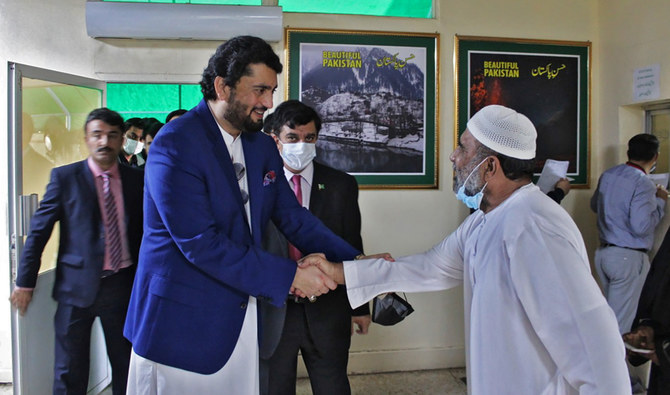
Pakistani lawmaker and chairman of the Parliamentary Committee on Kashmir, Shehryar Khan Afridi, visits the Pakistan Consulate in Dubai and meets with overseas Pakistanis on Jan. 17, 2021. (Photo courtesy: Shehryar Afridi’s Office)
Short Url
Updated 17 January 2021
Follow

Pakistan’s consulate in Dubai helped 61,000 overseas nationals return home during pandemic

  • Shehryar Afridi is visiting the UAE to discuss matters of national interest and welfare of overseas Pakistanis
  • The UAE is home to 1.2 million Pakistanis

ISLAMABAD: Pakistan’s consulate in Dubai helped 61,000 overseas Pakistanis return home after the coronavirus broke out in the UAE, a statement from the office of Pakistani lawmaker and chairman of the Parliamentary Committee on Kashmir, Shehryar Khan Afridi, said on Sunday.
Afridi was at the Pakistani consulate in Dubai, meeting with overseas Pakistanis and heard their feedback regarding consular services being offered to them.
The UAE is home to 1.2 million Pakistanis and the second largest host to overseas Pakistani workers and source of foreign remittances, after Saudi Arabia.
Afridi is currently visiting the UAE to discuss matters of “national interest and the welfare of overseas Pakistanis at relevant forums,” the statement said.



Pakistani lawmaker and chairman of the Parliamentary Committee on Kashmir, Shehryar Khan Afridi, visits the Pakistan Consulate in Dubai and meets with overseas Pakistanis on Jan. 17, 2021. (Photo courtesy: Shehryar Afridi’s Office)

Consul General of Pakistan, Ahmed Amjad Ali, briefed Afridi about the workings of the Consulate and the special efforts and initiatives taken from time to time for the welfare of the community.

Afridi said Pakistan would ‘leave no stone unturned’ to help its diaspora resolve any issues and said the Consulate General had played “an exemplary role” in facilitating Pakistanis by arranging special flights during the pandemic.  

Afridi also commended the provision of 17,500 ration bags distributed among stranded overseas Pakistanis.

On Wednesday, Afridi met with UAE’s Minister for Culture, Youth and Social Development, Sheikh Nahyan bin Mubarak Al-Nahyan, and requested the minister to play a role in resolving any problems faced by Pakistanis living and working in the UAE.


ADB, Pakistan sign over $300 million agreements to undertake climate resilience initiatives

Updated 30 December 2025
Follow

ADB, Pakistan sign over $300 million agreements to undertake climate resilience initiatives

  • Pakistan ranks among nations most vulnerable to climate change and has seen erratic changes in weather patterns
  • The projects in Sindh and Punjab will restore nature-based coastal defenses and enhance agricultural productivity

ISLAMABAD: The Pakistani government and the Asian Development Bank (ADB) have signed more than $300 million agreements to undertake two major climate resilience initiatives, Pakistan’s Press Information Department (PID) said on Tuesday.

The projects include the Sindh Coastal Resilience Sector Project (SCRP), valued at Rs50.5 billion ($180.5 million), and the Punjab Climate-Resilient and Low-Carbon Agriculture Mechanization Project (PCRLCAMP), totaling Rs34.7 billion ($124 million).

Pakistan ranks among nations most vulnerable to climate change and has seen erratic changes in its weather patterns. In 2022, monsoon floods killed over 1,700 people, displaced another 33 million and caused over $30 billion losses, while another 1,037 people were killed in floods this year.

The South Asian country is ramping up climate resilience efforts, with support from the ADB and World Bank, and investing in climate-resilient infrastructure, particularly in vulnerable areas.

“Both sides expressed their commitment to effectively utilize the financing for successful and timely completion of the two initiatives,” the PID said in a statement.

The Sindh Coastal Resilience Project (SCRP) will promote integrated water resources and flood risk management, restore nature-based coastal defenses, and strengthen institutional and community capacity for strategic action planning, directly benefiting over 3.8 million people in Thatta, Sujawal, and Badin districts, according to ADB.

The Punjab project will enhance agricultural productivity and climate resilience across 30 districts, improving small farmers’ access to climate-smart machinery, introducing circular agriculture practices to reduce residue burning, establishing testing and training facilities, and empowering 15,000 women through skills development and livelihood diversification.

Earlier this month, the ADB also approved $381 million in financing for Pakistan’s Punjab province to modernize agriculture and strengthen education and health services, including concessional loans and grants for farm mechanization, Science, Technology, Engineering and Mathematics (STEM) education, and nursing sector reforms.