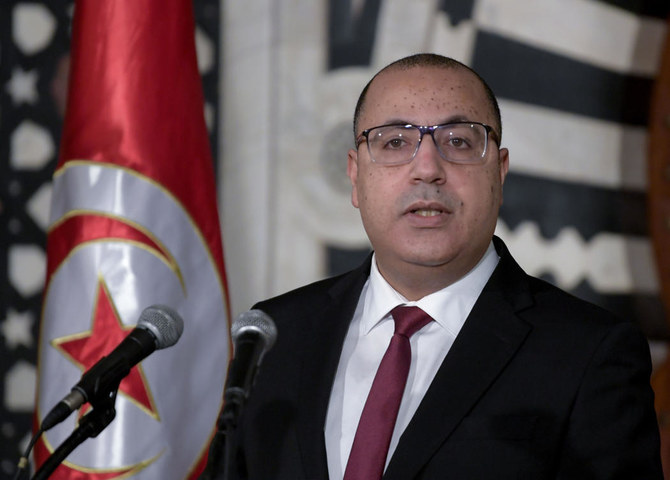
TUNIS: Tunisia’s Prime Minister Hichem Mechichi announced on Saturday a major cabinet reshuffle affecting 12 ministries, in the wake of high-profile sackings.
“The aim of this reshuffle is to achieve greater efficiency in the work of the government,” Mechichi said at a press conference in the capital Tunis.
The new line-up, which does not include any women, must be approved by parliament.
A few hours before the announcement, Mechichi had met with President Kais Saied, who insisted the “integrity” of proposed ministers should “raise no doubt,” according to a statement from the presidency.
“There is no place (in the government) for people who are subject to legal proceedings” or to “doubts about their background or their behavior that could undermine the state and the credibility of its institutions and the legitimacy of its decisions,” Saied said.
One of the officials to be replaced is former environment minister Mustapha Aroui, who was sacked and arrested in December in a scandal over hundreds of containers of household waste shipped from Italy.
Chiheb Ben Ahmed, CEO of the Tunisian Export Promotion Center (CEPEX), was proposed as his replacement.
Cabinet chief Walid Dhahbi has been put forward as interior minister to replace Taoufik Charfeddine.
The former lawyer and pillar of Saied’s election campaign was sacked earlier this month over high-level staffing changes he sought to make to some security agencies, according to a previous statement from Mechichi.
The reshuffle also impacts the ministries of health, justice, industry, energy and agriculture.
Ten years after the uprising that led to the fall of long-time dictator Zine El Abidine Ben Ali, Tunisia has successfully transformed into a democracy — albeit one still riven by corruption and economic pain.
The country has had nine governments in 10 years, but the transfers of power have been peaceful.
However, since a general election in 2019, the political class has been more fragmented than ever and paralyzed by infighting, fueling discontent over the continued economic malaise, which has been exacerbated by the novel coronavirus pandemic.

Tunisian premier announces major cabinet reshuffle
Short Url
https://arab.news/j3jh8
Tunisian premier announces major cabinet reshuffle
- The new line-up, which does not include any women, must be approved by parliament
- “The aim of this reshuffle is to achieve greater efficiency in the work of the government,” Mechichi said
Slain son of former Libya ruler Qaddafi to be buried near capital
TRIPOLI: The slain son of former Libyan ruler Muammar Qaddafi will be buried in a town south of the capital that remains loyal to the family, relatives said Thursday.
Seif Al-Islam Qaddafi, once seen by some as Libya’s heir apparent, was shot dead on Tuesday in the northwestern city of Zintan.
The burial will be held on Friday in the town of Bani Walid some 175 kilometers south of Tripoli, two of his brothers said.
“The date and location of his burial have been decided by mutual agreement among the family,” half-brother Mohamed Qaddafi said in a Facebook post.
Mohamed said the plan reflected “our respect” for the town, which has remained loyal to the elder Qaddafi years after he was toppled and killed in the 2011 Arab Spring uprisings.
Each year, the town of about 100,000 celebrates the anniversary of a 1969 coup that brought Muammar to power, parading through the streets holding the ex-leader’s portrait.
Saadi Qaddafi, a younger brother, said his dead sibling will be “buried among the Werfalla,” an influential local tribe, in a grave next to his brother Khamis Qaddafi, who died during the 2011 unrest.
Marcel Ceccaldi, a French lawyer who had been representing Seif Al-Islam, told AFP he was killed by an unidentified “four-man commando” who stormed his house on Tuesday.
Seif Al-Islam had long been widely seen as his father’s heir. Under the elder Qaddafi’s iron-fisted 40-year rule, he was described as the de facto prime minister, cultivating an image of moderation and reform despite holding no official position.
But that reputation soon collapsed when he promised “rivers of blood” in retaliation for the 2011 uprising.
He was arrested that year on a warrant issued by the International Criminal Court for alleged crimes against humanity, and a Tripoli court later sentenced him to death, although he was later granted amnesty.
In 2021 he announced he would run for president but the elections were indefinitely postponed.
He is survived by four out of six siblings: Mohamed, Saadi, Aicha and Hannibal, who was recently released from a Lebanese prison on bail.
Libya has struggled to recover from chaos that erupted after the 2011 uprising. It remains split between a UN-backed government based in Tripoli and an eastern administration backed by Khalifa Haftar.
Seif Al-Islam Qaddafi, once seen by some as Libya’s heir apparent, was shot dead on Tuesday in the northwestern city of Zintan.
The burial will be held on Friday in the town of Bani Walid some 175 kilometers south of Tripoli, two of his brothers said.
“The date and location of his burial have been decided by mutual agreement among the family,” half-brother Mohamed Qaddafi said in a Facebook post.
Mohamed said the plan reflected “our respect” for the town, which has remained loyal to the elder Qaddafi years after he was toppled and killed in the 2011 Arab Spring uprisings.
Each year, the town of about 100,000 celebrates the anniversary of a 1969 coup that brought Muammar to power, parading through the streets holding the ex-leader’s portrait.
Saadi Qaddafi, a younger brother, said his dead sibling will be “buried among the Werfalla,” an influential local tribe, in a grave next to his brother Khamis Qaddafi, who died during the 2011 unrest.
Marcel Ceccaldi, a French lawyer who had been representing Seif Al-Islam, told AFP he was killed by an unidentified “four-man commando” who stormed his house on Tuesday.
Seif Al-Islam had long been widely seen as his father’s heir. Under the elder Qaddafi’s iron-fisted 40-year rule, he was described as the de facto prime minister, cultivating an image of moderation and reform despite holding no official position.
But that reputation soon collapsed when he promised “rivers of blood” in retaliation for the 2011 uprising.
He was arrested that year on a warrant issued by the International Criminal Court for alleged crimes against humanity, and a Tripoli court later sentenced him to death, although he was later granted amnesty.
In 2021 he announced he would run for president but the elections were indefinitely postponed.
He is survived by four out of six siblings: Mohamed, Saadi, Aicha and Hannibal, who was recently released from a Lebanese prison on bail.
Libya has struggled to recover from chaos that erupted after the 2011 uprising. It remains split between a UN-backed government based in Tripoli and an eastern administration backed by Khalifa Haftar.
© 2026 SAUDI RESEARCH & PUBLISHING COMPANY, All Rights Reserved And subject to Terms of Use Agreement.


