

Kabul says no impact on security as US reduces troops to 2,500

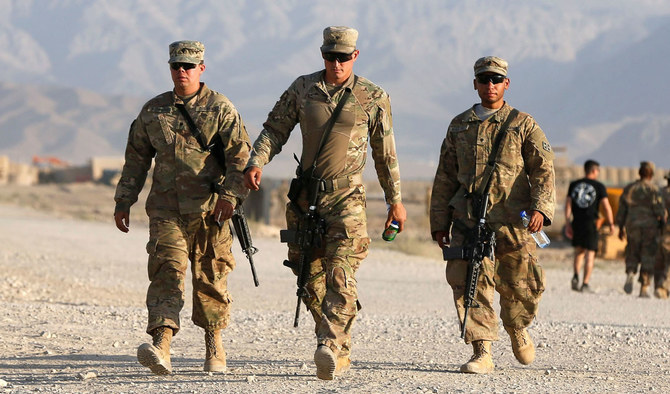
In this file photo, US troops walk at their base in Logar province, Afghanistan on Aug. 4, 2018. Taliban on Saturday denied US media reports saying that a Russian intelligence unit secretly rewarded them for targeting American troops in Afghanistan. (REUTERS)
Short Url
Updated 16 January 2021
Follow

Kabul says no impact on security as US reduces troops to 2,500

  • Reduction means the lowest level of US forces in Afghanistan since 2001, when the US invaded the country and ousted the Taliban
  • Taliban welcome the US move, describing it as important in the implementation of a historic deal signed by the group and Washington in February

ISLAMABAD: The Afghan National Security Council said on Saturday that the reduction of US forces in the country has no major impact on the security situation, as Washington announced it had met its goal of decreasing the number of troops to 2,500.

The Pentagon confirmed the reduction of US troops on Friday as in accordance with President Donald Trump administration’s November pledge to sharply cut the number of US forces in Afghanistan from 4,500 to 2,500 by mid-January.

The troop reduction means the lowest level of American forces in Afghanistan since 2001, when the US invaded the country and ousted the Taliban who were ruling Afghanistan from 1996.

“Reduction or increase of the American forces do not have any major negative impact on the fighting situation in Afghanistan,” Maulvi Rahmatullah, spokesman for the Afghan National Security Council said in a video response to the Pentagon announcement.

However, Afghanistan’s vice president, Amrullah Saleh, in a BBC interview on Friday said that the “pullout risks more violence in the unstable country.”

He added that the American mission, which began 20 years ago, is not yet accomplished and that the US had made a mistake by conceding too much to the Taliban.

The Taliban, meanwhile, have welcomed the US move, describing it as an important step toward the implementation of a historic deal signed by the group and Washington in Doha, Qatar, in February last year, under which all US-led troops would leave Afghanistan within 14 months.

“We consider the decision as a good and effective step toward the implementation of the Doha agreement. We, the Islamic Emirate, are also committed to all sections of the Doha agreement,” Taliban spokesman Zabihullah Mujahid told Arab News on Saturday.

He said the Taliban hope that the Doha agreement would be fully implemented and all American forces would leave Afghanistan as per the agreed timeframe.

“We consider withdrawal of the troops and leaving Afghan soil as a positive step for the people of the US and Afghans and welcome it,” Mujahid said.

While acting US Defense Secretary Chris Miller said on Friday that the US is planning “further reducing US troop levels to zero by May of 2021,” he added that “any such future drawdowns remain conditions-based.”

As the Trump administration is going to end its term when President-elect Joe Biden takes office on Wednesday, there have been few clues on what the new US government plans are for Afghanistan.


Pakistan saw 73% increase in combat-related deaths in 2025— think tank

Updated 8 sec ago
Follow

Pakistan saw 73% increase in combat-related deaths in 2025— think tank

  • Pakistan reported 3,387 deaths thus year, among them 2,115 militants and 664 security forces personnel, says think tank
  • Civilian deaths increased by 24% to 580 in 2025, compared to 468 in 2024, as Pakistan saw 1,063 militant attacks in 2025

ISLAMABAD: Combat-related deaths in Pakistan this year increased by 73%, with both security forces and militants suffering casualties in large numbers, a report published by an Islamabad-based think tank said on Sunday.

As per statistics released by the Pakistan Institute for Conflict and Security Studies (PICSS), combat-related deaths in 2025 rose 73% to 3,387, compared with 1,950 in 2024. These deaths included 2,115 militants, 664 security forces personnel, 580 civilians and 28 members of pro-government peace committees (combatants), the think tank said in a press release. 

“Militants accounted for about 62% of total combat-related deaths, and their 2,115 fatalities represented the highest annual militant death toll since 2015, when 2,322 militants were killed,” PICSS said. 

Compared to last year, militant deaths recorded a steep increase by 122% as the PICSS reported that 951 militants had been killed in 2024.

The think tank, however, said this year was also particularly bloody for Pakistani security forces. PICSS recorded 664 security personnel deaths in 2025, a 26% rise from 528 in 2024, and the highest annual figure since 2011, when 677 security forces personnel lost their lives. 

Civilian deaths also increased by 24% to 580 in 2025, compared with 468 in 2024, marking the highest annual civilian toll since 2015, when 642 civilians were killed. 

As per the PICSS report, at least 1,063 militant attacks took place in 2025, a 17% increase compared with 908 in 2024 and the highest annual total since 2014, when 1,609 militant attacks were recorded. 

The report also noted a 53 percent increase in suicide attacks this year, with 26 such incidents reported in 2025 compared with 17 in 2024. 

“PICSS noted an expanding trend in the use of small drones, including quadcopters, with 33 such incidents recorded during 2025, alongside increased use of unmanned aerial vehicles by security forces,” the report said. 

The report noted an 83% rise in arrests of suspected militants, with 497 arrested in 2025 compared to 272 in 2024. 

This 2025 figure is the highest annual total of suspected militants arrested since 2017, when 1,781 militants were either arrested or laid down their weapons.

“PICSS noted that most violence remained concentrated in Pashtun-majority districts of Khyber Pakhtunkhwa, including the tribal districts (erstwhile FATA), and in Balochistan,” it said. 

Pakistan has been grappling with a surge in militant attacks in its western provinces of Khyber Pakhtunkhwa and Balochistan, both bordering Afghanistan, this year. 

Islamabad blames Afghanistan for providing sanctuaries to militants it alleges use Afghan soil to carry out attacks against Pakistan. Kabul denies the charges.