

Probe suggests links between Assad regime, Beirut blast

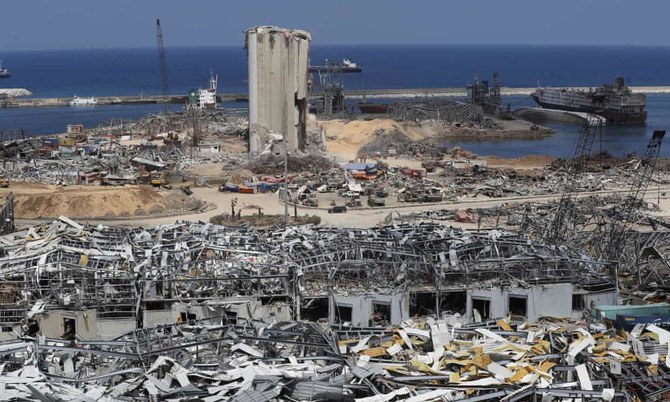
London-based company used to ship the ammonium nitrate that caused last August’s devastating explosion in Beirut has been linked to three individuals known to have ties to Syrian President Bashar Assad. (AP/File Photo)
Short Url
Updated 15 January 2021
Follow

Probe suggests links between Assad regime, Beirut blast

  • 3 people close to Syrian president connected to ammonium nitrate that detonated in Lebanese capital

LONDON: The London-based company used to ship the ammonium nitrate that caused last August’s devastating explosion in Beirut has been linked to three individuals known to have ties to Syrian President Bashar Assad.

An investigation by Lebanese filmmaker Firas Hatoum uncovered connections between London-based Savaro Ltd. and three figures who had been central to efforts to bolster Assad since the earliest months of the Syrian war.

Hatoum’s findings for the first time raise the possibility that the 2,750 tons of nitrate that leveled much of Beirut’s port and killed 200 people may have been a by-product of Syrian officials’ attempts to procure nitrate to use in weapons.

Joint Russian-Syrian citizens George Haswani, Mudalal Khuri and his brother Imad Khuri have all been previously sanctioned by the US for supporting Assad’s war effort.

Companies linked to Haswani and the Khuri brothers — Hesco Engineering and Construction, and the now-defunct IK Petroleum, respectively — shared a London address with Savaro, which purchased the nitrate in 2013.

Haswani was a go-to businessman for Assad, and was sanctioned by the US for his role in purchasing oil produced by Daesh on behalf of the Syrian regime.

Savaro is a shelf company — meaning it has never traded, conducted business or held assets — that was removed from the UK’s company lists on Tuesday, the same day that Hatoum revealed its links to the blast.

Mudalal was accused by the US of attempting to source ammonium nitrate in the months leading up to when the Russian freighter Rhosus docked in Beirut’s port and unloaded the chemical compound.

The ship’s opaque ownership and sudden diversion to Beirut, as well as the mysterious origins of its cargo, had fueled suspicion from the outset that the ammonium nitrate was always destined for Beirut rather than Mozambique, its official endpoint.

A number of other complicating factors have obscured the truth behind the source of the ammonium nitrate and its intended destination.

The shadowy world of international shipping, the volume of shelf companies used to move the nitrate, and the difficulty in tracking down and questioning witnesses in such a global context, have slowed the local investigation into the blast’s causes.

Lebanon’s caretaker Prime Minister Hassan Diab, three former ministers and more than 30 low-level officials have so far been charged in relation to the explosion.

But the connections between Haswani, the Khuri brothers and the Assad regime have rippled through Lebanese society since they were exposed on Tuesday.

Hatoum said he is skeptical that Lebanon will ever truly know how the blast was allowed to happen.

“I doubt that (Lebanon can resolve an investigation) for many reasons, looking at the way that things were handled in previous months,” he added.

“And I don’t trust any foreign or international investigation either because we have had such a bad experience in the past and politics always gets in the way.”

Kurds in Turkiye protest over Syria Aleppo offensive

Updated 09 January 2026
Follow

Kurds in Turkiye protest over Syria Aleppo offensive

  • Several hundred people gathered in Diyarbakir while hundreds more joined a protest in Istanbul
  • In the capital, Ankara, DEM lawmakers protested in front of the Turkish parliament

DIYARBAKIR, Turkiye: Protesters rallied for a second day in Turkiye’s main cities on Thursday to demand an end to a deadly Syrian army offensive against Kurdish fighters in Aleppo, an AFP correspondent said.
Several hundred people gathered in Diyarbakir, southeastern Turkiye’s main Kurdish-majority city, while hundreds more joined a protest in Istanbul that was roughly broken up by riot police who arrested around 25 people, the pro-Kurdish DEM party said.
In the capital, Ankara, DEM lawmakers protested in front of the Turkish parliament, denouncing the targeting of Kurds in Aleppo as a crime against humanity.
The protesters demanded an end to the operation by Syrian government forces against the Kurdish-led SDF force in Aleppo, where at least 21 people have been killed in three days of violent clashes.
It was the worst violence in the northwestern city since Syria’s Islamist authorities took power a year ago. The fighting erupted as both sides struggled to implement a March agreement to integrate autonomous Kurdish institutions into the new Syrian state.
In Istanbul, hundreds of protesters waving flags braved heavy rain near Galata Tower to denounce the Aleppo operation under the watchful eye of hundreds of riot police, an AFP correspondent said.
But some of the slogans drew a sharp warning from the police, who moved to roughly break up the gathering and arrested some 25 people, DEM’s Istanbul branch said.
“We condemn in the strongest terms the police attack on the Rojava solidarity action in Sishane. This brutal intervention, oppression, and violence against our young comrades is unacceptable!” the party wrote on X, demanding the immediate release of those arrested.
At the Diyarbakir protest during the afternoon, protesters carried a huge portrait of the jailed PKK militant leader Abdullah Ocalan, an AFP video journalist reported.
“We urge states to act as they did for the Palestinian people, for our Kurdish brothers who are suffering oppression and hardship,” Zeki Alacabey, 64, told AFP in Diyarbakir.
Although Turkiye has embarked on a peace process with the PKK, it remains hostile to the SDF, which controls swathes of northeastern Syria, seeing it as an extension of the banned militant group and a major threat along its southern border.
It has repeatedly demanded that the SDF merge into the main Syrian military. A defense ministry official said on Thursday that Ankara was ready to “support” Syria’s operation against the Kurdish fighters if needed.
Demonstrators had already taken to the streets in several major Turkish cities with Kurdish majorities on Wednesday, including Diyarbakir and Van, according to images broadcast by the DEM.