Beirut port explosion: Nearly five months on, residents’ trauma has healed little

1 / 2
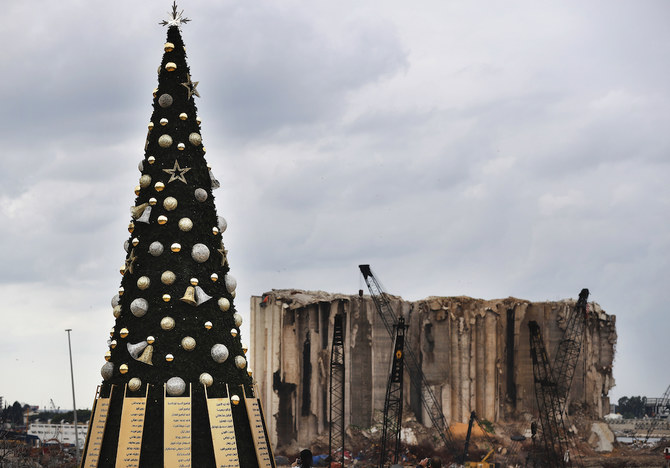
A Christmas tree decorated with names of those who died in the August explosion at the Beirut seaport is on display in front of damaged silos, in Beirut, Lebanon, Wednesday, Dec. 23, 2020. (AP)
2 / 2
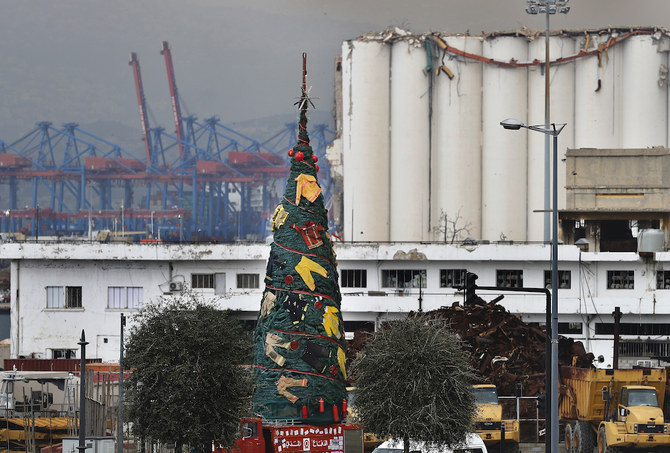
A Christmas tree decorated with firefighter uniforms to commemorate those who died while trying to extinguish the fire in the August explosion at the Beirut seaport is on display in front of damaged silos, in Beirut, Lebanon, Tuesday, Dec. 22, 2020. (AP)
Short Url
Updated 24 December 2020
Follow

Beirut port explosion: Nearly five months on, residents’ trauma has healed little

  • ‘The holidays in this region this year are sad... We need time to heal from the trauma’

BEIRUT: Christmas carols can be heard in the Beirut neighborhoods of Mar Mikhael and Gemmayzeh, stricken by the explosion of the city’s port almost five months ago, as restaurant and coffee shop owners and civil society organizations attempt to give some Christmas cheer to thousands of deserted residents.

People gather daily to light candles for the victims of the explosion. Their houses are still destroyed, missing walls, windows and doors. Nylon curtains have replaced the shattered glass and do little to keep out the cold air and rain.

Roy Bassil lost his father in the explosion while he was at home in Mar Mikhael, opposite the port. His mother was heavily injured. “Our lives were turned upside-down,” he said. “I pulled my father’s body from under the rubble after two walls fell on him. My mother, my aunt and I all moved to Jounieh, where we are renting an apartment until we can restore our house. Civil society organizations are helping us, but the money allocated to our house was quickly drained due to heavy damage. Even the furniture was completely destroyed, and I do not know how I will be able to continue the restoration. I am an accountant, and my work has stopped due to the economic crisis the country is going through.”

Bassil is like many others in the country who are still suffering from shock and deep frustration. “We feel as though we have been abandoned to our fate, no state to protect us. We will not forgive anyone for what they have done to us. How could we forgive? On Christmas Eve, we will pray in the church. This is our first holiday like this. We have never had such a bitter experience, not even at the peak of the Civil War.”

Bassil lives in East Beirut, which forms 30 percent of the capital and has a Christian majority. According to personal status registers, 72 percent of residents in the capital are Muslims, while 28 percent are Christians. The number of Christians in West Beirut declined during the Lebanese Civil War as the majority either emigrated from Lebanon or moved to other regions, rendering their presence in West Beirut symbolic. According to a member of the Beirut Municipality Council, Khalil Choucair, “Christians are heavily represented in commercial businesses, restaurants, pubs and hotels. Christians in Beirut were the backbone of the protests last year. They joined civil rather than party frames. The explosion of the Port of Beirut was a severe blow to them, and the emigration of Christian youth is an expression of their state of despair.”

Guy Donikian stands in front of his bookstore to observe Mar Mikhael Street. He inherited the bookstore, where he sells stationery and office supplies, from his father. A printing press is located behind the shop. Both were founded in 1924. “Everything was destroyed,” Donikian said. “I repaired it all, and I just want to move on with my life. 

“After the explosion, I could not sleep for a month and a half. Everything comes back to me whenever I close my eyes. The holidays in this region this year are sad. People’s houses are destroyed, and their hearts are broken. We need time to heal from the trauma.”

The damage from the explosion of the port, however, is only one problem facing the country.

“The economic situation and the new pandemic have only magnified our misery,” Donikian said. “Had I been 25 years old, I would have emigrated like all the youth are doing. After the age of 50, however, it is hard for me to rebuild myself in the diaspora.”

The dire economic crisis in Lebanon has made a fragile situation worse.

“The price of gift-wrapping paper has become LBP 12,000 ($8). Who can buy it at that price? It used to sell for only LBP 3,000. I have not sold anything yet, even with the holidays approaching. This means that people are not buying gifts. The atmosphere is sad, and there is no money in people’s pockets. The biggest trip someone can take is to the supermarket to buy food. Everything else has become a luxury.”

A number of restaurants and pub owners in Mar Mikhael and Gemmayzeh reopened after being restored. The pubs are crowded with old and new customers, which adds some joy to the area that was once a nightlife hotspot, bustling with jazz music fans.

Charbel, who works at the Bohemian Bar, said: “There are good vibes and good potential in the street. The pub customers have changed, though. Young people have traveled in search of jobs. What they earn has lost 80 percent of its value due to the depreciation of the Lebanese lira. Only those who are well off come to our pub.”

Jacqueline insisted on staying in her home, despite the destruction around her. “There was huge damage to our house, but we restored it all and we live in it with dignity now. Our losses are many, but we have faith in God, which makes us stand strong. After the explosion, this region, which was supposed to be for the wealthy, has ended up hosting families in need.”

When asked whether she forgives those responsible for the tragedy, she said: “My religion tells me to forgive, but when I see the gravity of the disaster, I say that I will not forgive. God forgives. On Christmas Eve, I will go to church to pray. We will not be gathering as a family because of the pandemic, and I did not buy gifts. I usually help Iraqi families who have sought refuge in Lebanon, but this year I only bought candies for children because the situation is abnormal.

“Who can console the families of the victims? People are depressed, and pharmacies say that their most-wanted medicines are for depression and panic attacks. The youth have either emigrated or are thinking of emigration. The corrupt are still in power and do not want reform.”

Kris Kashoush is a young Lebanese man living in Mar Mikhael. He said that the explosion of the port generated in him “unlimited anger.”

“People should have gone to politicians’ houses and killed them the same way people were killed in their own houses due to their negligence. I have decided to leave. Those who killed my ambition, destroyed my dreams, stole my country and wanted to exterminate my people are the same ones who made me put the flag of my country in my suitcase and carry it with me to the diaspora.

“I am one of the people who participated in the protests, but I have lost all hope in Lebanon and the Lebanese. We should never forget what happened on Aug. 4. It is true that people want to move on with their lives, but we should never accept what happened.”

Some of the churches that were destroyed in Beirut have been restored, while the reconstruction of others is still underway.

Father Boulos Abdel Sater, the curial bishop of the Maronite Catholic Patriarchate of Antioch in Beirut, said in his Sunday sermon before Christmas: “We, the people of Beirut, will stay in the city, even if the work of reconstruction and restoration never end. Our decision is clear: No one can evict us from our homes, and we will not sell them either.”


Retouched images of Israel’s first lady, distributed by the state, ignite a fiery ethics debate

Updated 11 January 2026
Follow

Retouched images of Israel’s first lady, distributed by the state, ignite a fiery ethics debate

  • Since the manipulation of images was revealed, the government has taken the unprecedented step of crediting Sara Netanyahu in its releases that include manipulated images

JERUSALEM: The photos seemed destined for posterity in Israel’s state archives.
In the snapshots, Prime Minister Benjamin Netanyahu is joined by his wife, Sara, as well as US Ambassador Mike Huckabee and a group of Israeli soldiers, as they light Hannukah candles at Western Wall, the holiest site where Jews pray. The leaders exchange triumphant looks.
But something is off.
Sara Netanyahu’s skin is poreless, her eyes overly defined and her hair perfectly coiffed — a look officials acknowledge is the result of heavy retouching.
Critics say the issue isn’t the use of photo-editing software, which is common on the social media accounts of celebrities and public figures. They say it’s the circulation of the images in official government announcements, which distorts reality, violates ethical codes and risks compromising official archiving and record-keeping efforts.
“All the pictures to this day in the archives in Israel are authentic pictures of reality as it was captured by the lenses of photographers’ cameras since the establishment of the state,” said Shabi Gatenio, the veteran political journalist who broke the story in The Seventh Eye, an Israeli site that covers local media. “These images, if entered into the database, will forever infect it with a virtual reality that never existed.”
Since the manipulation of images was revealed, the government has taken the unprecedented step of crediting Sara Netanyahu in its releases that include manipulated images. And it’s not clear if official archive will include images of her taken during the second half of last year, when Gatenio said the editing appears to have begun.
The first lady’s personal spokesperson did not respond to a request for comment.
Nitzan Chen, director of the Government Press Office, told The Associated Press that images of the prime minister are never manipulated and that his office would not upload any retouched photos to the official archive.
Personal Photoshop habit enters political realm
Sara Netanyahu, 67, has long used photo-editing software on her images. Her social media account is filled with images in which her face appears heavily retouched.
But the topic raised eyebrows since her Photoshop habit entered the public record.
Gatenio said he first noticed this last July, when the couple visited President Donald Trump in Washington, D.C., and again in September, as Sara Netanyahu joined her husband on the tarmac ahead of a trip to New York for the UN General Assembly.
At the time, the prime minister’s office released a video of the send-off along with a photo, credited to Avi Ohayon, an official government photographer.
Comparing the photo to the raw video, Hany Farid, a digital forensics expert at the University of California, Berkeley, said the image had been post-processed, bearing local manipulations to smooth the first lady’s skin and remove wrinkles.
Since then, photos showing the first lady meeting with Vice President JD Vance and his wife, Usha, in Washington also appear to have been retouched, Farid said.
“There’s been some Photoshop editing to — let’s call it — ‘beautify,’ lighten, smooth the face,” Farid said.
“Is it nefarious? No. Is it a problem? Yes. This is about something bigger than, ‘she Photoshopped her face to make herself look younger.’ This is about trust. Why should I trust any official photo coming out of that administration?”
Chen, the head of the Government Press Office, said office lawyers are trying to determine how to handle and properly identify photos “processed by people other than GPO photographers.”
He said the Justice Ministry is also examining the “criteria, limitations and possibilities” of the edited images, though he stressed there is nothing illegal about touching up photos. The issue, he said, is being transparent when such changes are made.
For now, his office has decided to add Sara Netanyahu’s name to press releases that include retouched images. Since November, press releases showing photos of her smiling next to Trump and the family of the last hostage in Gaza in Washington, visiting a Miami synagogue and attending a funeral for an Israeli mayor have included this label.
At least one outlet, the Times of Israel, has said it will no longer carry official state photos that appear to have been manipulated. The Associated Press does not publish images that appear to have been retouched or digitally manipulated.
A broader phenomenon
Chen said the prime minister is never edited: “No Photoshop, no corrections, no color. Nothing.”
While his face may not be retouched, the prime minister’s official Instagram account tells another story.
The page has posted a bevy of content that appears to be AI-edited or generated, including a picture of the couple with Trump and first lady Melania Trump celebrating the new year in Washington.
The photo raised suspicions in Israel because it shows Sara Netanyahu wearing a black dress absent from other photos of the event, where she wore a dark red frock. Appearing in the sky above the couples are brightly colored fireworks and American and Israeli flags that Farid said were “almost certainly” generated by AI.
It is now marked with a tag on Instagram indicating that it may have been altered or generated using AI. It is not clear when the tag was added nor by whom.
Netanyahu is not alone. Many world figures, including Trump, use AI-generated image manipulation frequently in their public output.
Tehilla Shwartz Altshuler, who runs the “Democracy in the Digital Age Program,” at the Israel Democracy Institute, a Jerusalem think tank, called it “part of the populist playbook” and said there was “no question” that Netanyahu was emulating how Trump uses the technology.
Netanyahu’s official Instagram has posted video of Trump and Netanyahu in a B-2 bomber that appears entirely AI-generated. It is captioned “on our victory lap,” referencing the joint Israel-US attacks on Iran last year.
“This is exactly what Netanyahu and his surrounding circle have tried to do for many years,” she said. “Presenting himself as a superhero, his wife as a supermodel, their family as a super loyal family. Even when it wasn’t the case, even at the expense of actual political work, administrative work and social work.”
She said Israel has reached a critical point in official government record-keeping and communications.
“The question of archiving the truth, archiving history, will be one of the questions of our time.”