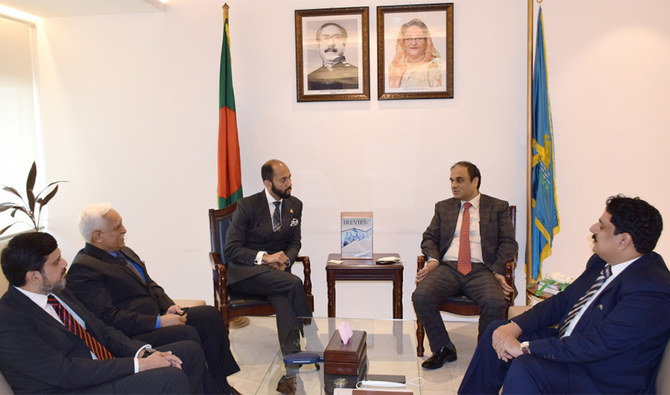
ISLAMABAD: Pakistan’s High Commissioner to Bangladesh Imran Ahmed Siddiqui met the President of the Dhaka Chamber of Commerce and Industry (DCCI), Rizwan Rahman, on Wednesday and stressed Islamabad’s ‘desire’ to strengthen economic and commercial relations with the neighboring country.
Last week, Siddiqui announced that Islamabad had lifted all restrictions on visas for Bangladeshi citizens and now awaited a similar response from Dhaka. In recent weeks, Pakistan has repeatedly said it wants to ‘strengthen’ bilateral ties, particularly after a meeting between Siddiqui and Bangladeshi Prime Minister Sheikh Hasina at her official residence last month.
On Wednesday, Siddiqui told Rahman he hoped the Joint Economic Commission between the two countries would be activated soon, and said direct flights between Dhaka and Karachi needed to be restored in order to promote trade. A direct shipment facility from the Karachi to Chattogram ports also needed to be launched, he said.
During the meeting, the envoy said Pakistan’s fashion industry could also enter into a “useful partnership” with Bangladesh’s textile sector.
As India’s relations with its neighbors in the South Asian region deteriorate, old foes Pakistan and Bangladesh are making a push to build diplomatic, economic and cultural ties that could upend decades of historic configurations in the region.
A number of recent diplomatic developments have hinted at a thaw in the long-troubled equation.
Prime Minister Imran Khan invited his Bangladeshi counterpart Sheikh Hasina to visit Islamabad in a rare call in July that came just weeks after a ‘quiet’ meeting between Pakistan’s high commissioner to Dhaka and Bangladeshi Foreign Minister A. K. Abdul Momen.
Relations between the two countries have never recovered from the 1971 war when Bengali nationalists, backed by India, broke away from what was then West Pakistan to form a new country.
Ties reached a new low in 2016 when Bangladesh executed several leaders of its Jamaat-e-Islami party on charges of committing war crimes in 1971. Pakistan called the executions and trials “politically motivated,” arguing that they were related to the pro-Pakistan stance of the convicts during the war.
But now, officials on both sides say it’s time for a reset.
In a statement issued by the Bangladeshi Foreign Ministry last week, Bangladesh’s State Minister for Foreign Affairs Shahriar Alam was quoted as saying: “We look forward to engaging with Pakistan.”
Both sides agreed on the need to hold long-pending foreign office consultations that were last held in 2010, the circular added.
Alam also urged Pakistan to grant access to more Bangladeshi products under the South Asia Free Trade Agreement (SAFTA), relax the negative list and remove trade barriers.
“The current trade balance tilts toward Pakistan,” he said, adding that the Pakistani side emphasized that it would address all non-trade barriers in order to establish “productive commercial relations” with Dhaka.

Pakistan, Bangladesh discuss trade in renewed push to mend ties
https://arab.news/cufsy
Pakistan, Bangladesh discuss trade in renewed push to mend ties
- Pakistan’s High Commissioner to Bangladesh meets Dhaka chamber of commerce president, stresses ‘desire’ to strength economic relations
- Siddiqui hopes Joint Economic Commission between two countries is activated soon, says direct flights from Dhaka to Karachi need to be restored to promote trade
Pakistan likely to import around 7 million cotton bales this year as local production nearly halves
- Pakistan produced 5.3 million cotton bales by mid-December against 10 million targeted, government data shows
- While the imports may ensure smooth supply of raw material, they may put pressure on foreign exchange reserves
KARACHI: Pakistan is likely to import around 7 million cotton bales this year owing to a decline of nearly half the annual target set by the Federal Committee on Agriculture (FCA), industry stakeholders said on Tuesday.
Pakistan’s cotton production stood at 5.3 million bales each weighing 170 kilograms as of Dec. 15, according to state-run Pakistan Central Cotton Committee (PCCC) data. The FCA had set a target of 10.2 million bales in April.
Karachi Cotton Brokers Forum (KCBF) Chairman Naseem Usman Osawala sees the country’s cotton production declining by 46 percent this season, compared to the FCA target.
“The country is expected to produce about 5.5 million bales this year,” he told Arab News, adding Pakistan would have to import around 7 million bales to meet requirement of its textile industry which consumes about 12 million bales a year.
The country had sown cotton over 2.002 million hectares, which was down by 11 percent from the targeted 2.26 million hectares.
Muhammad Waqas Ghani, head of research at Karachi-based JS Global Capital brokerage firm, said the South Asian country is likely to miss its cotton output target of 10 million bales.
“At the current rate of arrival, the output can reach 7 million bales at its best,” he added.
Cotton is a raw material for Pakistan’s largest textile industry and was the worst hit crop by climate-induced floods earlier this year.
Osawala said Pakistan’s cotton production has been falling because of an increasing number of sugar mills being established in the country’s cotton-producing regions.
Courts in Pakistan have been issuing significant rulings to bar the establishment of sugar mills in the designated cotton belt areas of the Punjab province. In 2018, the Supreme Court ordered relocation of three sugar mills from cotton-producing districts in southern Punjab to protect the crop.
Since cotton prices are low in the international market, textile millers would go for more imports, according to the KCBF chairman.
On Dec. 22, the price of cotton in the New York market stood at as much as 65.85 cents per pound, 1.64 cents lower than last year, according to the PCCC data.
Osawala said Pakistan’s increasing textile imports are also “hurting local cotton production.”
According to the Pakistan Bureau of Statistics’ (PBS) July-November data, the country had imported raw cotton, synthetic fiber, synthetic and artificial silk yarn and worn clothing worth $2.82 billion, 5 percent more than the imports during the same period last year.
Speaking of the impact of Pakistan’s falling cotton production, Kamran Arshad, chairman of All Pakistan Textile Mills Association (APTMA), said the millers would have to import “a lot of cotton” this year.
“I think approximately 7-7.5 million bales will have to be imported this year,” he said.
The textile and apparel sector is Pakistan’s largest exporter, accounting for more than half of the country’s overall exports and contributing around 8.5 percent of the gross domestic product (GDP) by employing nearly 40 percent of the industrial labor force. But high energy costs and outdated infrastructure among other factors continue to slow growth and leave the country trailing regional peers.
In the last fiscal year, Pakistan imported as much as 6.2 million cotton bales each weighing 220 kilograms, mostly from Brazil and the United States, according to KCBF Chairman Arshad.
Shankar Talreja, head of research at Karachi-based Topline Securities, said Pakistan is likely to import cotton worth $1.2 billion this year “considering the requirement.”
“The full-year import of cotton is likely to remain over $1 billion,” Talreja said.
Economic experts say while importing more cotton would ensure smooth supply of raw material to Pakistan’s textile sector, it may put pressure on the country’s foreign exchange reserves that rose to $15.9 billion last week after the International Monetary Fund (IMF) released a $1.2 billion tranche under Pakistan’s $7 billion loan program.


