

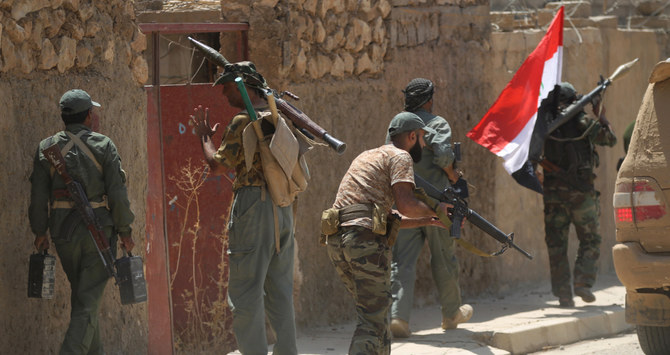

BAGHDAD: The United States on Wednesday imposed sanctions on an influential Iraqi militia leader and deputy of a powerful Iran-backed umbrella of mostly Shiite paramilitary groups, designating him a global terrorist figure.
The move by the US Treasury against Abdulaziz Al-Mohammadawi, known as Abu Fadak, was expected by many Iraqi officials. It was also the second time in a week that a senior Iraqi militia official has been sanctioned.
The chairman of the paramilitary umbrella, the Popular Mobilization Forces, Falih Al-Fayyadh was sanctioned last Friday under the Magnitsky Act and accused of rights abuses against antigovernment protesters. The law allows the US to target any foreigner accused of human rights violations and corruption.
Abu Fadak, a senior figure of the Iran-backed Kataib Hezbollah militia, is also acting deputy chairman of the Popular Mobilization Forces, a role he took on after a US airstrike last January in Baghdad killed the militia’s deputy head Abu Mahdi Al-Muhandis, a powerful founding member of Kataib Hezbollah and the lead architect of the umbrella group of paramilitaries.
Top Iranian Revolutionary Guard commander, Gen. Qassim Soleimani, was also killed in that airstrike.
Apart from being a member Kataib Hezbollah, which the US has described as an “Iran-backed terrorist organization,” the US claims Abu Fadak is working with the Iranian Revolutionary Guard’s expeditionary Quds Force to “reshape official Iraqi state security institutions ... to instead support Iran’s malign activities,” according to the US State Department.
The statement said Iran-backed elements, including Kataib Hezbollah, are involved in sectarian violence and are responsible for attacks against Iraqi government facilities and diplomatic missions.
The PMF was formed in 2014 to counter the Daesh group, following a fatwa from Iraq’s top Shiite cleric Ali Al-Sistani, and was later brought under the government’s fold. Its growing influence in Iraqi affairs has alarmed the US officials who accuse it of orchestrating attacks on the American Embassy in Baghdad.
Abu Fadak was a largely unknown figure until he replaced Al-Muhandis even though some militia groups opposed his selection.
In contrast to Abu Fadak’s designation, Iraq’s Foreign Ministry promptly denounced last week’s measures against Al-Fayyadh, who is a more established political figure and a former Iraqi national security adviser. The ministry said it would follow up with the incoming Biden administration in Washington on the matter.

keywords


