

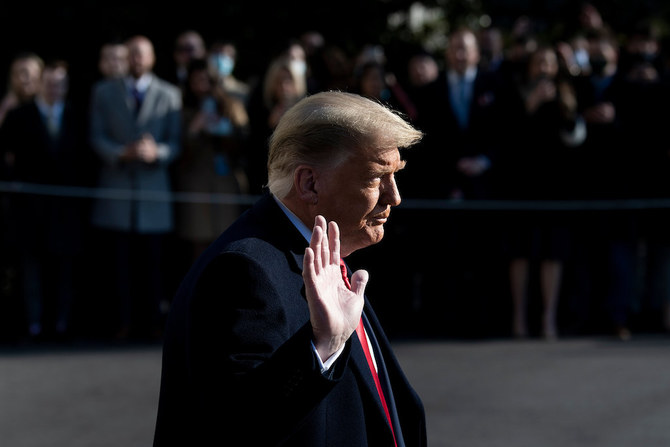

WASHINGTON: With the House set to impeach, President Donald Trump is blaming Democratic congressional foes for “tremendous anger” in the country and last week's deadly attack on the Capitol by his supporters after he urged them on their way.
The embattled president, in his first remarks to reporters since last week's attack, took no responsibility Tuesday for the deadly mob invasion of the building but also said he wanted “no violence.”
Trump defended his fiery rally remarks to a protest crowd last week as “totally appropriate,” and he showed no remorse for the following attack, the most serious and deadly domestic incursion at the Capitol in the nation's history.
On impeachment, Trump said it’s “a really terrible thing that they’re doing.”
“To continue on this path, I think it’s causing tremendous danger to our country, and it’s causing tremendous anger," he said. "I want no violence.
The president spoke as he left for Texas to survey the border wall with Mexico. He took no questions.
Impeachment ahead, the House on Tuesday will first try to convince the vice president and Cabinet to act even more quickly to remove Trump from office, warning he is a threat to democracy in the remaining days of his presidency.
House lawmakers are reconvening at the Capitol for the first time since the deadly pro-Trump riot to approve a resolution calling on Vice President Mike Pence to invoke the 25th Amendment to declare the president unable to serve. Pence is not expected to take any such action. The House would next move swiftly to impeach Trump.
Trump faces a single charge — “incitement of insurrection” — in the impeachment resolution that the House will begin debating Wednesday, a week before Democrat Joe Biden is set to be inaugurated, Jan. 20.
The unprecedented events, only the first U.S. president to be twice impeached, are unfolding in a nation bracing for more unrest. The FBI has warned ominously of potential armed protests in Washington and many states by Trump loyalists ahead of Biden’s inauguration. In a dark foreshadowing, the Washington Monument was closed to the public and the inauguration ceremony on the west steps of the Capitol will be off limits to the public.
It all added up to stunning final moments for Trump’s presidency as Democrats and a growing number of Republicans declare he is unfit for office and could do more damage after inciting a mob that violently ransacked the U.S. Capitol last Wednesday.
A Capitol police officer died from injuries suffered in the riot, and police shot a woman during the violence. Three others died in what authorities said were medical emergencies.
“We have to be very tough and very strong right now in defending the Constitution and democracy,” said Rep. Jamie Raskin, D-Md., an author of both pieces of legislation, in an interview.
Late Monday, the entire Congressional Hispanic Caucus, all 34 members, unanimously agreed to support impeachment, calling for Trump's immediate removal.
“It is clear that every moment Trump remains in office, America is at risk,” said a statement from the caucus, led by Rep. Raul Ruiz, D-Ca. It said Trump "must be held accountable” for his actions.
Democrats aren't the only ones who say Trump needs to go.
Rep. Liz Cheney, R-Wyo., encouraged House GOP colleagues late Monday to “vote your conscience,” according to a person granted anonymity to discuss the private call. She has spoken critically of Trump's actions but has not said publicly how she will vote.
Republican Sen. Pat Toomey of Pennsylvania joined GOP Sen. Lisa Murkowski of Alaska over the weekend in calling for Trump to “go away as soon as possible.”
Pence and Trump met late Monday for the first time since the Capitol attack, and had a “good conversation” pledging to continue working for the remainder of their terms, said a senior administration official, who spoke on condition of anonymity to discuss the private meeting.
Pence has given no indication he would proceed with invoking the 25th Amendment to remove Trump from office. No member of the Cabinet has publicly called for Trump to be removed from office through the 25th Amendment process.
As security tightened, Biden said Monday he was “not afraid” of taking the oath of office outside at the Capitol.
As for the rioters, Biden said, “It is critically important that there’ll be a real serious focus on holding those folks who engaged in sedition and threatening the lives, defacing public property, caused great damage -- that they be held accountable.”
Biden said he’s had conversations with senators ahead of a possible impeachment trial, which some have worried would cloud the opening days of his administration.
Senate Democratic leader Chuck Schumer was exploring ways to immediately convene the Senate for the trial as soon as the House acts, though Republican leader Mitch McConnell would need to agree. The president-elect suggested splitting the Senate's time, perhaps “go a half day on dealing with impeachment, a half day on getting my people nominated and confirmed in the Senate, as well as moving on the package" for more COVID relief.
As Congress resumes, an uneasiness swept government. Another lawmaker, Rep. Pramila Jayapal, D-Wash., announced Tuesday she had tested positive for COVID-19 after sheltering during the siege.
Many lawmakers may choose to vote by proxy rather than come to Washington, a process that was put in place last year to limit the health risks of travel.
House Republican leader Kevin McCarthy has discouraged GOP lawmakers from using the proxy option. But during a call with them he loosened his strict opposition for this week's votes, according to a Republican granted anonymity to discuss the private call.
Among Trump's closest allies in Congress, McCarthy said in a letter to colleagues that “impeachment at this time would have the opposite effect of bringing our country together.”
He said he would review possible censure of the president. But House Republicans are split and a few may vote to impeach.
Democrats say they have the votes for impeachment. The impeachment bill from Reps. David Cicilline of Rhode Island, Ted Lieu of California, Raskin of Maryland and Jerrold Nadler of New York draws from Trump's own false statements about his election defeat to Biden.
Judges across the country, including some nominated by Trump, have repeatedly dismissed cases challenging the election results, and former Attorney General William Barr, a Trump ally, has said there was no sign of widespread fraud.
The impeachment legislation also details Trump's pressure on state officials in Georgia to “find” him more votes, as well as his White House rally ahead of the Capitol siege, in which he encouraged thousands of supporters last Wednesday to “fight like hell” and march to the building.
The mob overpowered police, broke through security lines and windows and rampaged through the Capitol, forcing lawmakers to scatter as they were finalizing Biden’s victory over Trump in the Electoral College.
While some have questioned impeaching the president so close to the end of his term, Democrats and others argue he must be prevented from holding future public office.
There is precedent for pursuing impeachment after an official leaves office. In 1876, during the Ulysses Grant administration, War Secretary William Belknap was impeached by the House the day he resigned, and the Senate convened a trial months later. He was acquitted.


