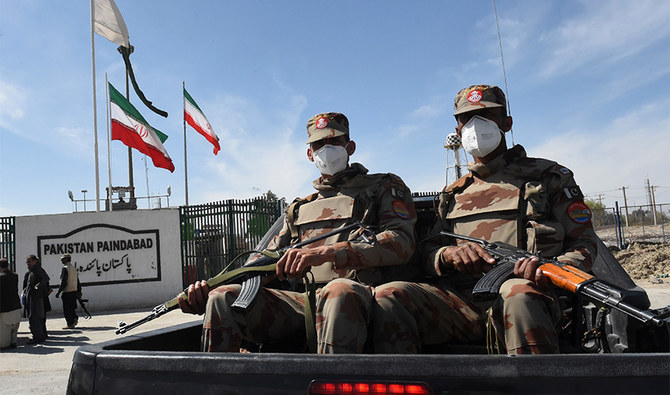
ISLAMABAD: Pakistan’s army spokesman said on Monday nearly 37 percent fencing work along the country’s 900-kilometer border with Iran had been completed.
The Pak-Iran border begins at the Koh-i-Malik Salih mountain and ends at Gwadar Bay in the Gulf of Oman, passing through a diverse landscape of mountain ridges, seasonal streams and rivers.
In recent years, relations between Iran and Pakistan have been strained with both sides accusing each other of not doing enough to stamp out militants allegedly sheltering across the border.
“More than 37 percent of the Pak-Iran border has been fenced and we hope it will be completed in a year,” the spokesperson for the Pakistani military, Major General Babar Iftikhar, told reporters, adding that nearly 83 precent of Pakistan’s over 2,600-kilometer-long border with Afghan had also been fenced and work on it would be completed by mid-2021.
In 2019, Iran and Pakistan said they would form a joint quick reaction force to combat militant activity on their shared border. Pakistan has set aside nearly $20 million to fence its frontier with Iran.

Pakistan army says 37% fencing work on Iran border completed
https://arab.news/zw3c4
Pakistan army says 37% fencing work on Iran border completed
- Pakistan has set aside nearly $20 million to fence its frontier with Iran
- Ties strained in recent years over accusations militants allegedly sheltering on both sides of shared border
Pakistan’s Sharif hopes to further ties with Bangladesh as Rahman takes oath as PM
- Tarique Rahman’s election comes amid a thaw in relations between Pakistan and Bangladesh
- Planning Minister Ahsan Iqbal also met Rahman after oath-taking, invited him to visit Pakistan
ISLAMABAD: Pakistan Prime Minister Shehbaz Sharif on Tuesday said he hoped to further strengthen relations with Bangladesh as Tarique Rahman took oath as the country’s new premier.
Rahman was sworn in on Tuesday after his Bangladesh Nationalist Party’s landslide win in parliamentary elections last week, the country’s first since the massive 2024 uprising and a vote billed as key to the nation’s future political landscape after years of intense rivalry and disputed polls.
The 60-year-old, whose term will last for five years, is the son of former prime minister Khaleda Zia and former president Ziaur Rahman. He is also Bangladesh’s first male prime minister in 35 years. Since 1991, when Bangladesh returned to democracy, either Rahman’s mother or her archrival Sheikh Hasina had served as PMs.
His election as PM comes at a time when Pakistan and Bangladesh appear to be coming increasingly closer, following a thaw in their relations since the ouster of Hasina, who was widely viewed as an India ally. Ties between Bangladesh and New Delhi remain strained over India’s decision to grant asylum to Hasina.
“Warmest felicitations to Tarique Rahman on having been sworn in as the Prime Minister of the People’s Republic of Bangladesh,” Pakistan’s Sharif said on X Tuesday evening.
“I look forward to close and meaningful engagements with my brother, to further strengthen our bilateral cooperation across mutually beneficial areas and to deepen the historic ties between our two countries.”
Earlier in the day, Pakistani Planning Miniter Ahsan Iqbal called on Rahman after his oath-taking ceremony in Dhaka and conveyed warm congratulations on behalf of the government and people of Pakistan on his election, according to the Pakistani information ministry.
“He extended best wishes for the peace, progress and prosperity of Bangladesh under his leadership,” the ministry said. “Iqbal conveyed a formal invitation from the prime minister of Pakistan to Prime Minister Tarique Rahman to undertake an official visit to Pakistan at a mutually convenient date.”
Pakistan and Bangladesh were part of the same country until Bangladesh’s secession following a bloody civil war in 1971. However, Islamabad and Dhaka have lately been looking to strengthen institutional linkages to broaden their cooperation, following a reset of ties.


