

Pakistan government announces new instant digital payment system

This photograph taken on November 19, 2015 shows Pakistani employees of online marketplace company Kaymu at work in Karachi. (AFP/File)
Short Url
Updated 12 January 2021
Follow

Pakistan government announces new instant digital payment system

  • The “Raast” system will be rolled out in three phases culminating in early 2022, aims to boost financial inclusion and government revenue
  • Merchants, businesses, individuals, fintechs, and government entities will be able to send and receive real-time payments through the Internet, mobile phones and agents

ISLAMABAD: Pakistan has announced a new government-run instant digital payment system in a bid to boost financial inclusion and government revenue in the country where only a fraction of economic transactions occur on the books.
The new system, called “Raast” or “direct way”, will be rolled out in three phases culminating in early 2022, officials from the State Bank of Pakistan said on Monday.
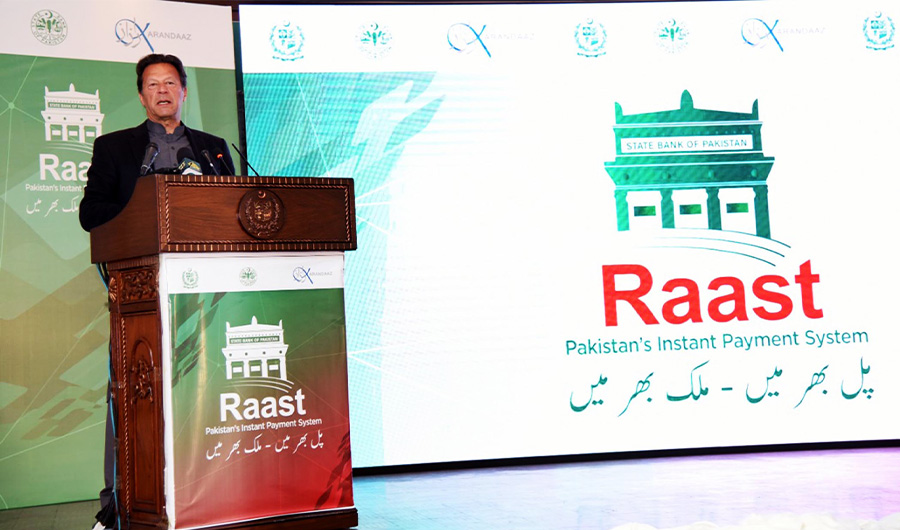


Pakistan's Prime Minister Imran Khan addresses the launching ceremony of Raast, Pakistan's first instant payment system in Islamabad on 11th January, 2021. (Photo courtesy: PID)

Developed through a multi-year collaboration between the State Bank of Pakistan and the Bill & Melinda Gates Foundation, with support from the World Bank, Britain and the United Nations, one goal for Raast is to boost involvement of women in the formal economy.
Several private-sector digital cash transfer systems that do not require a bank account, such as Jazzcash operated by telecommunications company Jazz and Easypaisa operated by telecommunications company Telenor Pakistan, are already available in Pakistan, but Raast would be the first to link government entities and financial institutions.
“I hope that in years to come we will look back and see this new digital public good as an important contribution to our shared goal of giving all people the tools they need to lift themselves out of poverty,” Bill Gates said in a statement read out at the announcement on Monday.
Merchants, businesses, individuals, fintechs, and government entities will be able to send and receive near real-time payments through the Internet, mobile phones and agents. Government payments, including salaries and pensions, will also be made through Raast, as well as payments for nationwide financial support programs, such as the Benazir Income Support Programme, and the Ehsaas Emergency Cash program.
Pakistan’s ability to curb illegal financial transactions, including the financing of militant and extremist groups, has been under close scrutiny from international financial watchdog the Financial Action Task Force (FATF).
Prime Minister Imran Khan, whose government has taken steps to automate collection of taxes on transactions and tightened rules on banking, said shifting away from a cash-based economy and tackling corruption were the chief motivations behind Raast.
“Pakistan collects about the least amount of tax in the world,” Khan said. “We cannot build infrastructure, we cannot work on human development, or educate children, or improve hospitals.”


Pakistan, ADB ink $61.8 million agreements for three development projects

Updated 4 sec ago
Follow

Pakistan, ADB ink $61.8 million agreements for three development projects

  • Agreements pertain to the upgradation of ML-1 railway link, key bus project in Quetta and water sector development in Balochistan
  • Pakistani official says projects will “significantly contribute” to long-term, sustainable economic growth, address infrastructure needs

ISLAMABAD: Pakistan and the Asian Development Bank (ADB) on Friday signed agreements for three major development initiatives worth $61.8 million to boost connectivity, urban transport and water sector in various parts of the country, state-run media reported. 

The two side signed agreements relating to project readiness financing for the Karachi-Rohri Section of the Main Line-I, a critical link needed to transport copper and gold from the Reko Diq mine in southwestern Pakistan to export hubs, for $10 million. 

Another project readiness financing agreement was signed for a bus rapid transit project in the southwestern city of Quetta worth $3.8 million. The last agreement pertained to additional financing for the Balochistan Water Resources Development Sector Project, which amounts to $48 million. 

“The secretary, Ministry of Economic Affairs, expressed appreciation for ADB’s role as a trusted development partner, and its continued support to Pakistan to complement the development agenda of the country,” the state-run Associated Press of Pakistan (APP) said. 

He said the critical projects would “significantly contribute” to Pakistan’s long-term and sustainable economic growth, address urban infrastructure needs of the provincial capital of Quetta, and enhance agricultural productivity in Balochistan.

ADB’s Country Director for Pakistan Emma Fan appreciated Pakistan’s commitment toward development initiatives. 

“She also reaffirmed ADB’s continued commitment to working closely with the Ministry of Economic Affairs and other stakeholders to ensure its support remains aligned with Pakistan’s development priorities,” APP said. 

ADB has undertaken initiatives to support Pakistan’s economic recovery by strengthening its public finances, social protection systems and helping Islamabad with its post-flood reconstruction efforts. 

The bank says it has committed 764 public sector loans, grants, and technical assistance to the South Asian country totaling $43.4 billion to date.