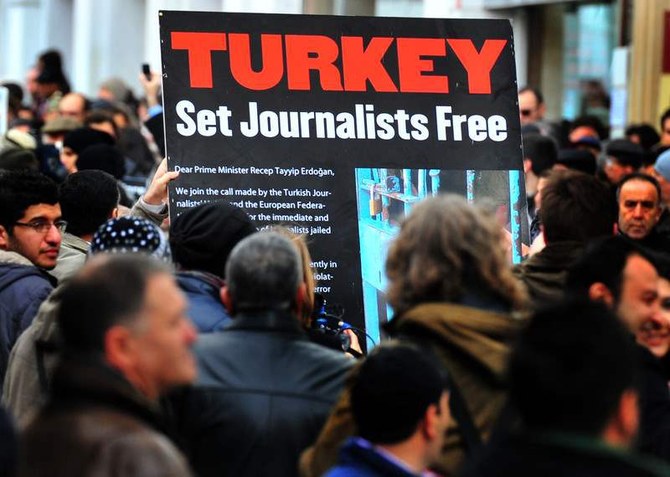

ANKARA: Turkey marked Working Journalists’ Day on Jan. 10 as media workers in the country face increasing curbs on press freedom.
Currently there are about 62 journalists in Turkish prisons, mostly facing trials under the Anti-Terror Law and Turkish Penal Code.
According to Press in Arrest, a volunteer group monitoring trials of Turkish journalists, at least 352 journalists have been prosecuted in 230 press trials over the past two and a half years.
The country ranked 154th among 180 countries in Reporters Without Borders’ 2020 World Press Freedom Index.
A report by Turkey’s main opposition Republican People’s Party (CHP) revealed that journalists appeared 479 times in court over the past year for their journalistic activities.
“We even didn’t experience such oppression during the coup of 1980,” Kemal Kilicdaroglu, leader of the CHP, said in a press statement.
Olay TV, a private news channel with a reputation for independent and objective reporting, was shut down by governmental pressure after being on air for only 26 days at the end of last year.
About 90 percent of the media landscape is controlled by pro-government conglomerates in Turkey.
Despite the deteriorating conditions for press freedom in the country, President Recep Tayyip Erdogan released a message to mark Working Journalists’ Day, saying: “We will never allow this concept to be abused and used for black propaganda against our country both within our country and abroad.”
In a new book, Turkish journalist Serdar Akinan has claimed that then Prime Minister Erdogan squeezed his neck in 2005 during a press conference in Abu Dhabi. “My neck hurt, but I couldn't say anything,” he wrote in his book.
Erdogan recently targeted an opposition newspaper, saying “I don’t read Sozcu newspaper. Nobody buys it.” The warning was seen as a clear sign of pressure over the media in the country.
Last year, Turkish radio and TV channels failed to cover the news about the resignation of Finance and Treasury Minister Berat Albayrak, Erdogan’s son-in-law, for 27 hours for fear of drawing government’s ire.
The Turkish Health Ministry removed a female journalist from its online communications group over her critical questions about social distancing rules in gatherings of state officials.
Utku Cakirozer, a lawmaker from the CHP who is a journalist by profession, said the ruling government cannot tolerate the slightest opposition to its official narrative and tries to suppress the media’s role in informing people.
“If they are sincere in their reform commitments, they should start by bringing more freedom to the media sphere. However, the trials and arrests against journalists keep increasing and journalism is still seen as a ‘major crime’ in Turkey,” he told Arab News.
Cakirozer noted that the government uses the judiciary as leverage over the media, and that political intervention into the judicial sphere further undermines press freedom in the country.
“Turkey must end the public ad bans on independent newspapers that curbs their independent journalism. However, the government uses its stick all time over them,” he said.
Last year, five dissident newspapers were banned from receiving advertisements for a total of 333 days.
Cakirozer criticized the current practice in the government’s provision of press cards to the media officials.
“Independent and dissident journalists are often denied access to this press card that guarantees them social security provisions in performing their job. Press cards should be provided by professional organizations, not state authorities,” he said.
After publishing a controversial book based on investigations about the state apparatus, two journalists from the dissident news site Oda TV potentially face a total of 158 years’ imprisonment for charges mainly filed by Erdogan’s lawyers over claims made in the book.
Ozgur Ozel, another senior lawmaker from CHP, recently claimed that the deputy of the presidency’s Communications Director Fahrettin Altun called all the mainstream TV channels on Jan. 5 to tell them to end their live broadcast of the CHP’s weekly group meeting at the parliament. The directorate denied the claim.