

US intends to designate Houthi movement in Yemen as foreign terror group

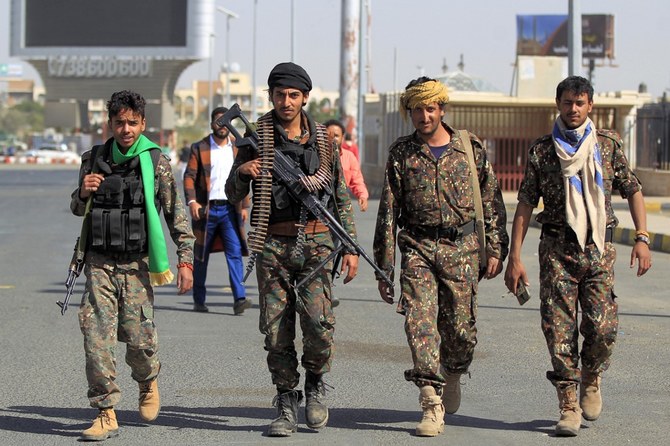
Security forces loyal to the Houthi militia walk while on duty during a mass wedding for thousands of couples on Dec. 9, 2020. (File/AFP)
Short Url
Updated 11 January 2021
Follow

US intends to designate Houthi movement in Yemen as foreign terror group

WASHINGTON: The United States will designate Yemen’s Houthi rebels as a terrorist group, Secretary of State Mike Pompeo said Sunday, a late-term move that aid groups fear will worsen a humanitarian crisis.
With just 10 days left before President-elect Joe Biden takes office, the action could complicate the new administration’s efforts to restart diplomacy with Iran, which has ties to the Houthis, and to reassess the US relationship with Saudi Arabia.
“The designations are intended to hold Ansar Allah accountable for its terrorist acts, including cross-border attacks threatening civilian populations, infrastructure and commercial shipping,” Pompeo said in a statement, using the official name of the Houthi movement.
It has led a brutal campaign that has “killed many people, continues to destabilize the region and denies Yemenis a peaceful solution to the conflict in their country,” he added.
Pompeo pointed to a December 30 attack on an airport in Yemen’s second city Aden, which killed 26 people and was blamed by the Saudi-backed government on the Houthis.
But a designation as a terrorist group is expected to scare away outside actors from many transactions with Houthi authorities, including bank transfers and buying food and fuel.
Aid groups as well as members of Biden’s Democratic Party have warned that the move will severely impede efforts to address what the United Nations calls the world’s largest humanitarian crisis.
Pompeo insisted that the designations — which will come into effect a day before Biden takes office on January 19 — will not impact relief work.
“We are planning to put in place measures to reduce their impact on certain humanitarian activity and imports into Yemen,” Pompeo said.
“We have expressed our readiness to work with relevant officials at the United Nations, with international and non-governmental organizations and other international donors to address these implications.”

Soleimani’s shadow
Qassem Soleimani left a trail of death and destruction in his wake as head of Iran’s Quds Force … until his assassination on Jan. 3, 2020. Yet still, his legacy of murderous interference continues to haunt the region

Enter


keywords

Iraq PM candidate Al-Maliki meets senior US diplomat

Updated 5 sec ago
Follow

Iraq PM candidate Al-Maliki meets senior US diplomat

  • Last month President Donald Trump intervened in Iraq’s affairs by issuing an ultimatum that if Al-Maliki — a two-time former premier with close ties to Iran — was named Iraq’s next prime minister, the US would no longer help the country

BAGHDAD: The leading candidate to become Iraq’s next prime minister, Nouri Al-Maliki, met with US diplomat Tom Barrack on Friday after refusing to withdraw his nomination despite the US threatening to stop supporting the country if he returns to the post.
Barrack, the US envoy to Syria and ambassador to Turkiye, has recently visited Iraq multiple times to meet with senior officials.
Maliki’s media office said in a short statement that the PM candidate stressed during the meeting “the need to respect Iraq’s sovereignty and the will of its people.”
He also spoke of the “importance of supporting the democratic process and strengthening political stability” in Iraq.
It wasn’t clear what message Barrack conveyed to Maliki.
Last month President Donald Trump intervened in Iraq’s affairs by issuing an ultimatum that if Al-Maliki — a two-time former premier with close ties to Iran — was named Iraq’s next prime minister, the US would no longer help the country.
Trump’s threat left Iraqi leaders at a loss, particularly within the Coordination Framework — a ruling alliance of Shiite groups with varying degrees of links to Iran that nominated Maliki.
Earlier this week, Al-Maliki told AFP he would not withdraw his nomination, while also seeking to allay Washington’s concerns.
“I have absolutely no intention of withdrawing out of respect for my country, its sovereignty, and its will,” Al-Maliki told AFP in an interview.