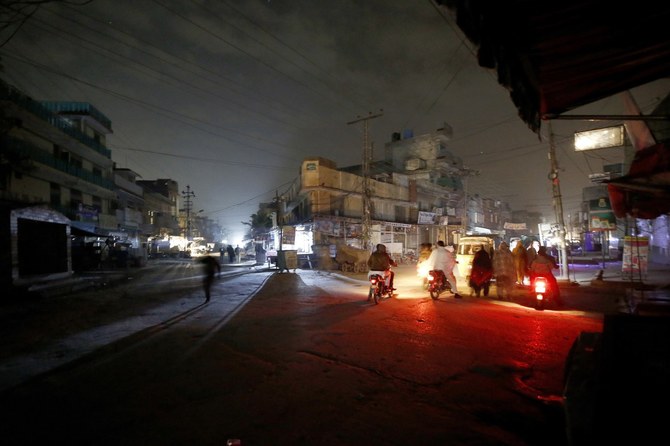
ISLAMABAD: Power was gradually being restored to major cities across Pakistan Sunday after it was hit by a massive electricity blackout, officials said.
The electricity distribution system in the nation of more than 210 million people is a complex — and delicate — web, and a problem in one section of the grid can lead to cascading breakdowns countrywide.
The latest blackout was caused by “an engineering fault” in southern Pakistan at 11:41 p.m. local time on Saturday (1841 GMT), which tripped the system and caused power plants to shut down, power minister Omar Ayub Khan told a press conference in Islamabad.
“Our experts are trying to determine the exact location of fault, which we have not been able to find out.”
Khan said that will take “another few hours as the area is still covered in dense fog,” and that power supply had been partially restored in most areas of Punjab, the most populous province, as well as the economic hub Karachi in the south.
The blackout had plunged all of Pakistan’s major cities into darkness, including the capital Islamabad, economic hub Karachi and the second-largest city Lahore.
There were no immediate reports of disruption at hospitals, which can often rely on back-up generators.
A water and power ministry spokesman said electricity had been restored to some parts of the country but many areas in Lahore, Pakistan’s second-largest city, and Karachi were still waiting.
Netblocks, which monitors Internet outages, said Internet connectivity in the country “collapsed” as a result of the blackout.
Connectivity was at “62 percent of ordinary levels,” it said in a tweet.
This was Pakistan’s second major power breakdown in less than three years. In May 2018, power supply was partially disrupted for more than nine hours.
In 2015, an apparent rebel attack on a key power line plunged around 80 percent of Pakistan into darkness.
That blackout, one of the worst in Pakistan’s history, caused electricity to be cut in major cities nationwide, including Islamabad, and even affected one of the country’s international airports.

Pakistan hit by nationwide power blackout
https://arab.news/netjn
Pakistan hit by nationwide power blackout
- Problem in one section of the grid can lead to cascading breakdowns countrywide, says minister
- This was Pakistan’s second major power breakdown in less than three years
Pakistan opposition rallies in Khyber Pakhtunkhwa to demand release of Imran Khan
- PTI-led gathering calls the former PM a national hero and demands the release of all political prisoners
- Government says the opposition failed to draw a large crowd and accuses PTI of damaging its own politics
ISLAMABAD: Pakistan’s opposition led by the Pakistan Tehreek-e-Insaf (PTI) party demanded the release of jailed former prime minister Imran Khan at a rally in the northwestern Khyber Pakhtunkhwa province on Sunday, describing him as a national hero who continues to command public support.
The gathering came days after a rare and strongly worded briefing by the military’s media chief, Lt. Gen. Ahmed Sharif Chaudhry, who dismissed Khan as “narcissistic” and “mentally ill” on Friday while responding to the former premier’s allegations that Pakistan’s chief of defense forces was responsible for undermining the constitution and rule of law.
He said that Khan was promoting an anti-state narrative which had become a national security threat.
The participants of the rally called for “civilian supremacy” and said elected representatives should be treated with respect.
“We, the people of Pakistan, regard Imran Khan as a national hero and the country’s genuinely elected prime minister, chosen by the public in the February 8, 2024 vote,” said a resolution presented at the rally in Peshawar. “We categorically reject and strongly condemn the notion that he or his colleagues pose any kind of threat to national security.”
“We demand immediate justice for Imran Khan, Bushra Bibi and all political prisoners, and call for their prompt release,” it added, referring to Khan’s wife who is also in prison. “No restrictions should be placed on Imran Khan’s meetings with his family, lawyers or political associates.”
Addressing the gathering, Sohail Afridi, the chief minister of Khyber Pakhtunkhwa, denied his administration was not serious about security issues amid increased militant activity. However, he maintained the people of his province had endured the worst of Pakistan’s conflict with militancy and urged a rethinking of long-running security policies.
The resolution asked the federal government to restore bilateral trade and diplomatic channels with Afghanistan, saying improved cross-border ties were essential for the economic stability of the region.
The trade between the two neighbors has suffered as Pakistan accuses the Taliban administration in Kabul of sheltering and facilitating armed groups that it says launch cross-border attacks to target its civilians and security forces. Afghan officials deny the claim.
The two countries have also had deadly border clashes in recent months that have killed dozens of people on both sides.
Some participants of the rally emphasized the restoration of democratic freedoms, judicial independence and space for political reconciliation, calling them necessary to stabilize the country after years of political confrontation.
Reacting to the opposition rally, Information Minister Attaullah Tarrar said the PTI and its allies could not gather enough people.
“In trying to build an anti-army narrative, they have ruined their own politics,” he said, adding that the rally’s reaction to the military’s media chief’s statement reflected “how deeply it had stung.”
“There was neither any argument nor any real response,” he added, referring to what was said by the participants of the rally.


