

UAE confirms 2,998 new COVID-19 cases, 5 deaths

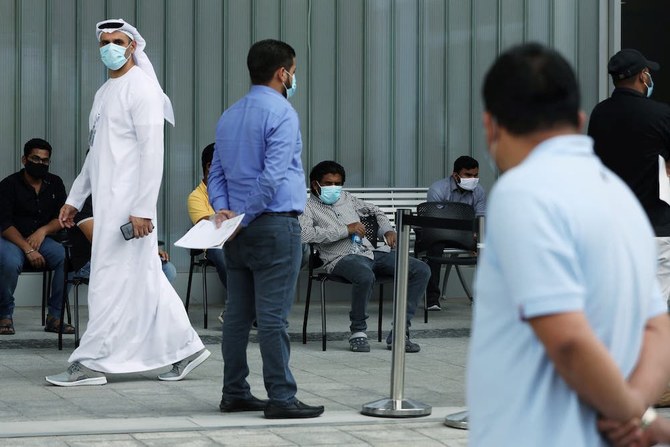
A member of hospital staff, wearing a protective face mask, watches over people queuing to be tested for coronavirus, at the Cleveland Clinic hospital in Abu Dhabi, UAE. (File/Reuters)
Short Url
Updated 10 January 2021
Follow

UAE confirms 2,998 new COVID-19 cases, 5 deaths

  • Free Pfizer vaccine now available at 7 centers in Dubai
  • Kuwait records 427 cases and 2 deaths, Bahrain reports 287 cases and 1 death

DUBAI: The UAE on Saturday recorded 2,998 new coronavirus cases and five virus-related deaths.
Officials from the Ministry of Health and Prevention (MoHAP) said the total number of cases since the pandemic began had reached 227,702, while the death toll rose to 702.
It also said that 2,264 people had recovered from the virus in the past 24 hours. The total number of recoveries is 203,660.
Dubai Health Authority said on Saturday it had opened a seventh health center to offer the COVID-19 Pfizer-BioNTech vaccine.

Dr. Farida Al-Khajja, CEO of Clinical Support Services and Nursing Sector at DHA and Chairperson of the COVID-19 Vaccination Steering Committee, said the authority added the Al-Safa primary health care center to the six existing facilities.
The centers are offering the vaccine for free, to accommodate for the notable turnout, and to “meet the growing requirements and the expected increased demand for the vaccination in the coming period.”
The inoculation campaign is targeting four main categories, with priority going to individuals aged 60 and above and those with chronic diseases, as well as frontline workers.
Elsewhere, Kuwait reported 427 new coronavirus cases, raising the total number to 153,900. The death toll rose to 942 after two coronavirus-related deaths were reported in the previous 24 hours.

In Bahrain, one death was reported, raising the death toll to 355, while 287 new infected cases were confirmed.


Trump warns Iran of ‘very traumatic’ outcome if no nuclear deal

Updated 5 sec ago
Follow

Trump warns Iran of ‘very traumatic’ outcome if no nuclear deal

WASHINGTON: US President Donald Trump threatened Iran Thursday with “very traumatic” consequences if it fails to make a nuclear deal — but Israeli Prime Minister Benjamin Netanyahu said he was skeptical about the quality of any such agreement.
Speaking a day after he hosted Netanyahu at the White House, Trump said he hoped for a result “over the next month” from Washington’s negotiations with Tehran over its nuclear program.
“We have to make a deal, otherwise it’s going to be very traumatic, very traumatic. I don’t want that to happen, but we have to make a deal,” Trump told reporters.
“This will be very traumatic for Iran if they don’t make a deal.”
Trump — who is considering sending a second aircraft carrier to the Middle East to pressure Iran — recalled the US military strikes he ordered on Tehran’s nuclear facilities during Israel’s 12-day war with Iran in July last year.
“We’ll see if we can get a deal with them, and if we can’t, we’ll have to go to phase two. Phase two will be very tough for them,” Trump said.
Netanyahu had traveled to Washington to push Trump to take a harder line in the Iran nuclear talks, particularly on including the Islamic Republic’s arsenal of ballistic missiles.
But the Israeli and US leaders apparently remained at odds, with Trump saying after their meeting at the White House on Wednesday that he had insisted the negotiations should continue.

- ‘General skepticism’ -

Netanyahu said in Washington on Thursday before departing for Israel that Trump believed he was laying the ground for a deal.
“He believes that the conditions he is creating, combined with the fact that they surely understand they made a mistake last time when they didn’t reach an agreement, may create the conditions for achieving a good deal,” Netanyahu said, according to a video statement from his office.
But the Israeli premier added: “I will not hide from you that I expressed general skepticism regarding the quality of any agreement with Iran.”
Any deal “must include the elements that are very important from our perspective,” Netanyahu continued, listing Iran’s ballistic missile program and its support for armed groups such as the Palestinian movement Hamas, Yemen’s Houthi rebels and Hezbollah in Lebanon.
“It’s not just the nuclear issue,” he said.
Despite their differences on Iran, Trump signaled his strong personal support for Netanyahu as he criticized Israeli President Isaac Herzog for rejecting his request to pardon the prime minister on corruption charges.
“You have a president that refuses to give him a pardon. I think that man should be ashamed of himself,” Trump said on Thursday.
Trump has repeatedly hinted at potential US military action against Iran following its deadly crackdown on protests last month, even as Washington and Tehran restarted talks last week with a meeting in Oman.
The last round of talks between the two foes was cut short by Israel’s war with Iran and the US strikes.
So far, Iran has rejected expanding the new talks beyond the issue of its nuclear program. Tehran denies seeking a nuclear weapon, and has said it will not give in to “excessive demands” on the subject.