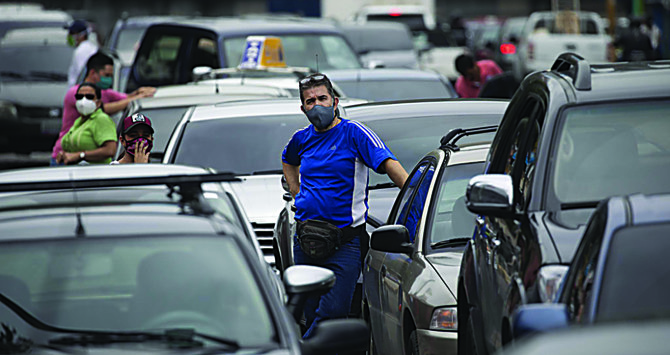
SAN CRISTOBAL, Venezuela: In crisis-hit Venezuela, even soldiers are struggling to make ends meet on meager salaries rendered practically worthless by the highest inflation in the world and have taken to moonlighting — as taxi drivers.
Some have taken to sneaking out of their barracks to pick up customers needing a lift — a job that can earn them 60 times their monthly salary with just one trip.
“I’m a father and given the situation in the country, my salary is worth nothing,” a 39-year-old sergeant said. “I do my taxi journeys and I earn much more than in my other job — that’s why I do it.”
The sergeant can earn more than $500 for driving passengers from San Cristobal on the border with Colombia to the capital Caracas, some 800 km to the northeast. His monthly wage as a soldier — 9 million bolivars — is worth just $8.
However, regular taxi drivers are furious and say members of the armed forces have an unfair advantage: Their uniform.
“They don’t get stopped at police checkpoints” where drivers are often asked for a bribe, and “they don’t have problems getting fuel,” complained Eusebio Correa, a 57-year-old career taxi driver.
“The military that should be providing security are now chauffeurs in uniform.”
Sourcing fuel for vehicles is a major issue in Venezuela, but especially in remote Tachira state and its capital San Cristobal.
Fuel shortages have led to people waiting at gas stations for days at a time to fill their tanks, or alternatively turning to the black market, where prices are considerably higher. That added cost has subsequently pushed up the price of taxi rides.
But since the military controls gas stations, soldiers don’t face the same restrictions the general population does.
“This uniform that I wear represents respect. With the uniform, I can come and go anywhere,” admitted the sergeant.
The salaries of the rank and file may have plummeted alongside everyone else’s earnings in a country that has been in recession for seven years, but the military as an institution remains powerful.
It is the main power propping up the government of President Nicolas Maduro.
The military also controls oil, mining and food distribution companies, as well as customs and several key ministries.
Venezuela’s opposition and some rights organizations claim many top military officials have gotten rich through corruption.
The taxi-driving sergeant said he started “escaping” his barracks to moonlight once the country was put under a coronavirus lockdown.
“For the release permits, sometimes I ask for medical leave. You even make up stuff to your own colleagues. I know many who do this job, right up to our superiors,” said the sergeant.
Under the lockdown, regular comings and goings were restricted — and only authorized via passes issued by the military.


Venezuela’s new taxi drivers: Moonlighting soldiers
https://arab.news/pkxme
Venezuela’s new taxi drivers: Moonlighting soldiers


Diriyah Co. partners with Midad to develop Four Seasons hotel in Diriyah
RIYADH: Saudi Arabia’s sovereign wealth fund-backed developer, Diriyah Co., has signed a joint development agreement with Midad Real Estate Investment and Development Co. to construct the Four Seasons Diriyah Hotel and private residences.
The partnership will strengthen collaboration between the two companies through the development of the luxury Four Seasons Diriyah, which will feature 159 rooms, alongside private Four Seasons residences, spanning approximately 235,000 sq. meters within Diriyah’s master plan.
The project’s total value is projected at SR3.1 billion (approximately $827 million), encompassing both land acquisition and construction expenses.
Midad is one of the Kingdom’s leading real estate developers, expanding its portfolio of high-end projects and maintaining numerous strategic partnerships with prominent global brands, reinforcing its reputation as a trusted name in luxury residential and hospitality development across Saudi Arabia.
This partnership marks the first major collaboration between Diriyah Co. and Midad, supporting Diriyah’s plans to develop 40 luxury hotels across its two main projects: the 14-sq.-km Diriyah Project and the 62-sq.-km Wadi Safar Project, a premium destination that blends lifestyle, culture, and entertainment.
Commenting on the agreement, Minister of Tourism and Secretary-General of Diriyah Co., Ahmad Al-Khatib, said: “The Kingdom continues to set new standards in developing tourism destinations, with Diriyah at the forefront.”
He added that such partnerships enhance the world-class experiences Saudi Arabia offers and strengthen the Kingdom’s position as a leading destination in this sector.
Diriyah Co. CEO Jerry Inzerillo commented that the Four Seasons Diriyah Hotel and Residences will be one of the Kingdom’s largest luxury hotels.
“We are proud to announce this joint development with Midad, one of Saudi Arabia’s top real estate developers. This agreement reflects our ongoing commitment to enabling Saudi partners to contribute to Diriyah’s transformative journey and confirms Midad’s confidence in the opportunities the project presents,” Inzerillo added.
Midad CEO Abdelilah bin Mohammed Al-Aiban said: “This project is a pivotal milestone for our company, allowing us to bring the Four Seasons experience to one of the Kingdom’s most prominent heritage destinations.”
He added: “We are excited to deliver a project that embodies design excellence, world-class service, and sustainable value, while contributing meaningfully to Saudi Arabia’s tourism, cultural, and economic ambitions.”
The collaboration comes amid rapid progress on the SR236 billion Diriyah project, which has awarded construction contracts worth more than SR101.25 billion to date.
Diriyah is expected to contribute approximately SR70 billion directly to the Kingdom’s gross domestic product, create more than 180,000 jobs, accommodate 100,000 residents, and host around 50 million annual visitors.
The development will feature contemporary office spaces accommodating tens of thousands of professionals across technology, media, arts, and education, complemented by museums, retail destinations, a university, an opera house, and the Diriyah Arena.
It will also offer a diverse selection of restaurants and cafes, alongside nearly 40 world-class resorts and hotels distributed across its two primary master plans.