

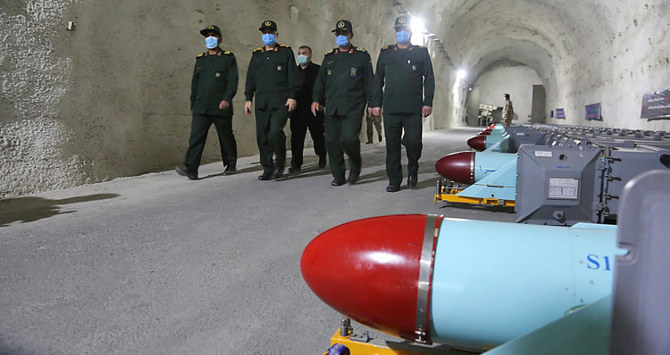

JEDDAH: Saudi political analyst Hamdan Al-Shehri has strongly criticized the Iranian regime’s unveiling of an underground missile base on Friday.
Iran’s Revolutionary Guards revealed the base, without disclosing its location, at a time of heightened tension between Washington and Tehran.
“The base is one of several housing the Guards’ Navy’s strategic missiles,” Maj. Gen. Hossein Salami, head of the Guards, was quoted as saying by state media.
Its revelation is a “threatening” message to the Gulf Cooperation Council, Al-Shehri told Arab News, adding that it could be seen as a warning that the GCC could be affected “if a war were to break out between the US and Iran.”
“It is meant to provoke, but it is also a testament to the threat Iran poses — from secret bases, secret missions — to the region’s stability,” Al-Shehri, who is also an international relations scholar, said.
Last year, the Guards said Iran had built underground “missile cities” along the Gulf coastline, warning of a “nightmare for Iran’s enemies.”
“These missiles have ranges of hundreds of kilometers, enjoy pinpoint accuracy and huge destructive power, and can overcome the enemy’s electronic warfare equipment,” Maj. Gen. Salami said on Friday.
Recent years have seen periodic confrontations break out in the Gulf between the Guards and the US military, which has accused Tehran’s regime of sending speedboats to harass US warships as they pass the Strait of Hormuz.
Also on Friday, Iran’s supreme leader made a televised speech in which he said that his country is in no hurry for the US to return to the 2015 nuclear deal after Joe Biden is sworn in as president later this month.
“We are in no rush and we are not insisting on their return. Our demand, which is both logical and rational, is the lifting of sanctions,” Ayatollah Ali Khamenei said, referring to sanctions imposed by outgoing US President Trump when he quit the deal — to which several major powers are signatories — in 2018, a decision that escalated decades-old tensions between the two nations.
Al-Shehri pointed out that sanctions would not be lifted “unless the two countries come to an agreement and sign some memorandums where both parties get what they want, just like the $150 billion deal with Obama in 2015.”
President-elect Biden, who is set to replace Trump on Jan. 20, has signaled a willingness for the US to rejoin the deal known formally as the Joint Comprehensive Plan of Action, or JCPOA.
Biden has indicated that he wants to negotiate more broadly with Tehran after Washington returns to the deal, notably over its missiles and regional influence.
Since 2019, Iran has gradually suspended the implementation of most of its key obligations under the JCPOA, which set strict limits on its activities in return for the lifting of sanctions.
The supreme leader reiterated Iran’s position that the missile program was developed to “defend” the country against any external threats.
Khamenei also said that he has banned Iran from importing COVID-19 vaccines from the US and Britain, labeling the Western powers “untrustworthy,” as the infection spreads in the Middle East’s hardest-hit country, according to Reuters.
He raised the prospect of the two countries — long-time adversaries of Iran — possibly seeking to spread infection in other countries.
“Imports of US and British vaccines into the country are forbidden ... They’re completely untrustworthy. It’s not unlikely they would want to contaminate other nations,” Khamenei said.
“Given our experience with France’s HIV-tainted blood supplies, French vaccines aren’t trustworthy either,” he added, referring to the country’s contaminated blood scandal of the 1980s and 1990s.
However, he added that Iran could obtain vaccines “from other reliable places.”


