Oil prices touch fresh 11-month highs after fall in US crude stockpiles

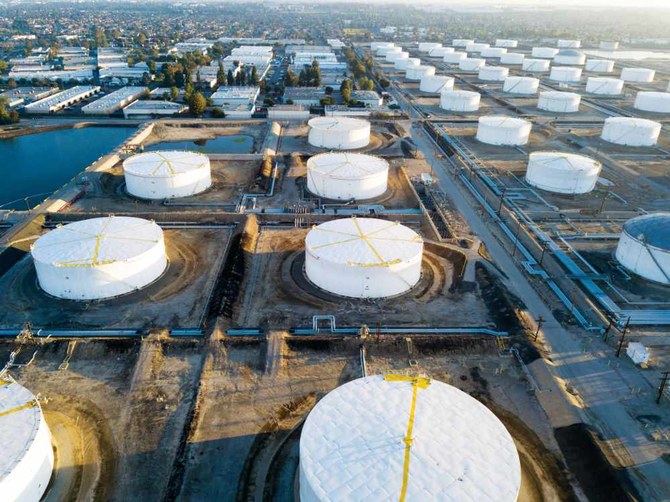
The drop in US crude stocks is a typical year-end occurrence as energy companies take oil out of storage to avoid tax bills. (AFP file photo)
Short Url
Updated 08 January 2021
Follow

Oil prices touch fresh 11-month highs after fall in US crude stockpiles

  • Oil prices have been supported this week by a pledge by Saudi Arabia to cut output

LONDON: Oil prices were steady on Thursday after hitting fresh 11-month highs on a fall in US stockpiles and in the wake of a pledge by Saudi Arabia to cut output by more than expected.

Brent crude was up 5 cents to $54.35 a barrel at London afternoon trade after touching $54.90, a fresh high not seen since before the first COVID-19 lockdowns in the West.

US West Texas Intermediate (WTI) was up 26 cents, or 0.5 percent to $50.89 after touching $51.28.

Wednesday’s storming of the US Capitol by supporters of US President Donald Trump appeared to have little impact, while a slight rise in global equities suggested investors believed President-elect Joe Biden would be empowered to spend more freely.

Oil prices have been supported this week by a pledge by Saudi Arabia to cut output by an additional 1 million barrels per day (bpd) in February and March.

“Saudi Arabia ... intimately knows the relationship between the oil price and the global inventory levels. Lower inventories equal higher prices,” SEB chief commodity analyst Bjarne Schieldrop said.

BACKGROUND

$63 - UBS expects Brent to trade at $63 per barrel in the second half of 2021 and WTI to trade at a $3 per barrel discount to Brent prices.

“The strategy of course only works if the OPEC+ (group of oil producers) stays disciplined,” he added. UBS analysts raised their forecast for Brent to $60 per barrel by mid-year, citing the Saudi output decision.

“The Kingdom’s preemptive move suggests to us a desire to defend prices and support the oil market amid demand concerns due to extended mobility restrictions in Europe,” they said.

US crude stocks fell and fuel inventories rose, the Energy Information Administration said on Wednesday.

Crude inventories were down by 8 million barrels in the week to Jan. 1 to 485.5 million barrels, against a Reuters poll showing analysts expected a 2.1 million barrel fall.

The drop in crude stocks is a typical year-end occurrence as energy companies take oil out of storage to avoid tax bills.

UBS raised its Brent forecast amid expectations of a sharp recovery in demand in the second quarter on vaccine rollouts and increased travel.

With Saudi Arabia’s move, OPEC’s production increase of 0.5 million barrels per day (bpd) for January is reversed in full, which will result in a tighter oil market in the first half of the year, analysts at the Swiss bank wrote in a note.

The bank expects Brent to trade at $63 per barrel in the second half of 2021 and WTI to trade at a $3 per barrel discount to Brent prices.


Ramallah talks focus on border crossings

Palestinian Prime Minister Mohammad Mustafa speaks during a press conference in Ramallah on March 24, 2025. (AFP)
Updated 6 sec ago
Follow

Ramallah talks focus on border crossings

  • The meeting discussed ways to upgrade infrastructure and facilities at the Karama crossing, particularly arrival halls and cargo and transport areas, automate procedures and services, strengthen staff capacities, and combat smuggling

RAMALLAH: Palestinian Prime Minister Mohammed Mustafa chaired a meeting at his office in Ramallah on Saturday to review developments at border crossings, including the Karama crossing in the West Bank and the Rafah crossing in the Gaza Strip, as well as ways to develop and upgrade the crossings.
The meeting focused on improving the management and governance system for Palestinian crossings to clearly define the roles, responsibilities, and tasks of the parties involved, thereby contributing to the national economy, commercial activity, and travel services.
Mustafa reiterated that the crossings issue is a priority at all levels, as it directly affects citizens. 
He stressed the need to intensify engagement with all parties to extend operating hours for passenger and cargo movement, and to develop travel and cargo transport mechanisms.
The meeting also discussed ways to upgrade infrastructure and facilities at the Karama crossing, particularly arrival halls and cargo and transport areas, automate procedures and services, strengthen staff capacities, and combat smuggling.
These measures aim to improve services for citizens, facilitate travel procedures, and enhance readiness to address congestion and travel crises, especially during the Umrah and Hajj seasons and holidays.
Meanwhile, according to local sources, Israeli forces forced Kamal Saeed Shawaneh, a Palestinian owner of a marble factory from the town of Kafr Thulth, south of Qalqilya, to carry out the demolition of his industrial facility located east of the town, on Saturday.
The facility, built on an area of roughly 300 square meters, suffered material losses estimated at more than $26,000. Israeli authorities claimed that Shawaneh did not have a permit for the factory’s construction. 
The sources added that Israeli forces threatened Shawahneh with heavy fines if he did not carry out the demolition, noting that he had previously received a stop-work order for the factory in 2018.