

Pakistan's military tests guided multi-launch rocket system

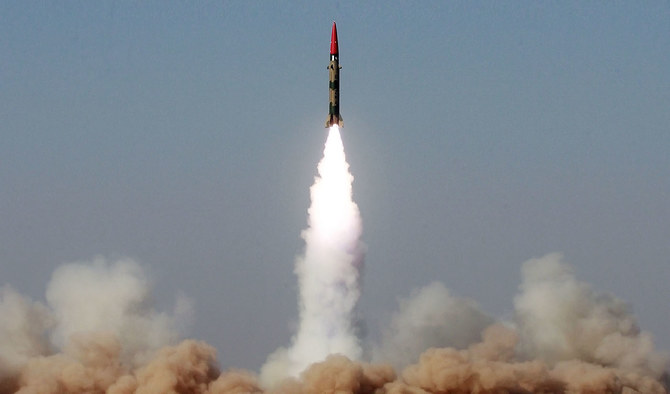
In this hand out picture released by the Inter Services Public Relations (ISPR) on February 13, 2008 a Hatf III (Ghaznavi), a short-range nuclear-capable ballistic missile is successfully launched from an undisclosed location in Pakistan. (ISPR via AFP/File)
Short Url
Updated 07 January 2021
Follow

Pakistan's military tests guided multi-launch rocket system

  • Says it will give the army 'capability of precision target engagement deep in enemy territory'
  • Pakistani president, prime minister and military officials congratulated scientists and troops on the 'successful' flight test

ISLAMABAD: Pakistan’s military said Thursday it successfully conducted a successful test flight of a rocket system capable of carrying a conventional warhead up to a range of 140 kilometers (about 90 miles).
In a statement, military leaders said the weapon system, called Fatah-1, will give Pakistan's army “capability of precision target engagement deep in enemy territory." It said President Arif Alvi, Prime Minister Imran Khan and the military leaders congratulated scientists and troops on the “successful" flight test.

The statement provided no further details. Pakistan became a declared nuclear power in 1998, when it conducted underground nuclear tests in response to those carried out by its rival and neighbor India.
The nations have fought three wars since gaining independence from Britain in 1947.


79 foreign firms, including Middle Eastern investors, enter Pakistan in three years — SECP

Updated 6 sec ago
Follow

79 foreign firms, including Middle Eastern investors, enter Pakistan in three years — SECP

  • Foreign firms invested about $145 million across energy, logistics, IT and agriculture
  • Pakistani regulator says 19 companies exited market over the same three-year period

KARACHI: Middle Eastern energy and logistics companies including Saudi Aramco, Wafi Energy and DP World expanded their footprint in Pakistan, as 79 new foreign firms commenced operations in the country over the past three years, according to an official statement released on Tuesday.

The figures come as Pakistan seeks to rebuild investor confidence and attract foreign capital to shore up its economy after years of financial turbulence that saw foreign currency reserves shrink, the rupee weaken sharply and inflation surge. Islamabad has been pursuing structural reforms and courting overseas partners to stabilize growth and ease external financing pressures.

“79 new foreign companies commenced operations in Pakistan over the past three years, while foreign firms invested Rs 40.7 billion [$145 million] in key sectors during the same period,” the Securities and Exchange of Pakistan (SECP) said in a statement.

“A total of 61 foreign companies also carried out shareholding transactions involving local entities,” it added. “Of the 61 shareholding transactions, 29 involved transfers to other foreign companies, four to foreign individual investors, 20 to local individual investors, and eight to local corporate entities.”

According to the regulator, several transactions were linked to global corporate restructuring among multinational companies. Saudi Arabia’s Wafi Energy acquired Shell Pakistan’s operations, while Dubai-based PTA Global Holdings secured a majority stake in Lotte Chemical Pakistan.

Saudi Aramco purchased a 40 percent equity stake in Gas & Oil Pakistan Limited, and Switzerland’s Gunvor Group alongside Total Parco Limited acquired equal stakes in TotalEnergies Pakistan.

In logistics, UAE-based DP World entered into a joint venture with Pakistan’s National Logistics Corporation, while investments in the technology and telecommunications sectors included acquisitions and stake purchases involving regional and international firms.

The statement said 1,157 foreign companies are currently registered and operational in Pakistan, with 19 exits recorded over the past three years.