

Italy welcomes signing of AlUla agreement

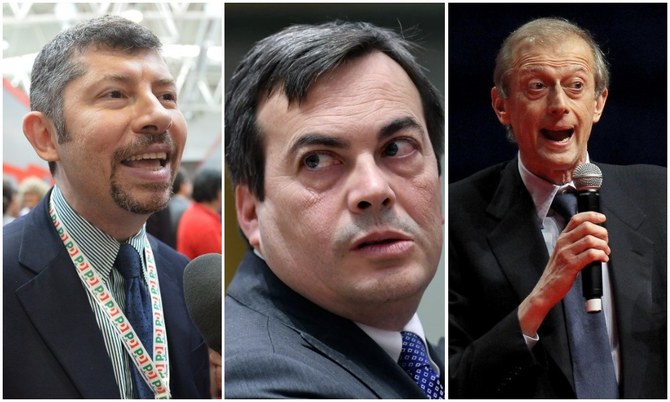
Ivan Scalfarotto (L), undersecretary for foreign affairs, Vincenzo Amendola (C), Italy’s minister for EU affairs and Piero Fassino, chairman of the Foreign Committee of the Italian Chamber of Deputies all welcomed the AlUla Declaration signing. (AFP/File Photos)
Short Url
Updated 05 January 2021
Follow

Italy welcomes signing of AlUla agreement

  • Italian politicians cheered news that Gulf states will restore ties with Qatar

ROME: Italian politicians have welcomed the move by Saudi Arabia and other Gulf states to mend relations with Qatar.

They hailed the AlUla Agreement, which was signed by leaders of Gulf Cooperation Council (GCC) member states during the organization’s summit in the Kingdom on Tuesday, as a development that will help to ensure peace and ease regional tensions. Ministers in the Italian government of Prime Minister Giuseppe Conte cheered the announcement.

The Kingdom’s Crown Prince Mohammed bin Salman described the agreement as “an accord for solidarity and stability” in the region. It ends a diplomatic crisis that began in 2017 when Egypt and GCC members Saudi Arabia, the UAE and Bahrain severed ties with Doha. Kuwait had announced on Monday that Saudi Arabia was reopening its airspace and borders to Qatar.

“Today we have really good news from the Gulf,” Vincenzo Amendola, Italy’s minister for EU affairs and an expert on Middle East politics and issues told Italian news agency ANSA. “It's now time to return to the table of dialogue and cooperation.

Ivan Scalfarotto, the undersecretary for foreign affairs, who represented Italy at the G20 Summit in Riyadh in November, told Arab News: “Every sign of detente and dialogue in a crucial area such as the Gulf is to be positively evaluated. This is good news, which Italy welcomes with satisfaction.”

MP Piero Fassino, chairman of the Foreign Committee of the Italian Chamber of Deputies, said: “The agreement between Saudi Arabia, Qatar and the Gulf countries represents an act of detente in a region that has been hit by conflicts and tensions for too long. Now it is urgent to quickly reach a peace agreement in Yemen.”

Fassino also called for a “relaunch of the application of the JPCOA agreement on Iranian nuclear power, in order to prevent the authorities of Tehran adopting decisions that could be harbingers of new tensions in the area.” He was referring to the 2015 Joint Comprehensive Plan of Action. Also known as the Iran nuclear deal, it was signed by the five permanent members of the UN Security Council — the US, the UK, China, France and Russia — along with Germany and the EU. President Donald Trump withdrew the US from the agreement in 2018.

Matteo Salvini, the leader of opposition party the Northern League also welcomed the AlUla agreement.

“The normalization of relations between Qatar and the Gulf countries after three years of blockade is great news,” he said. “Congratulations to all those who made this possible with their efforts. It’s always good when dialogue and diplomacy prevail.”

A source close to Prime Minister Conte said that Italy has always supported efforts to find an intra-Gulf solution to the crisis and had consistently called for dialogue.

“Therefore, we are delighted about this agreement that leads to a normalization of relations in the area,” the source added. “It is an important step that could strengthen the unity of the region.”


Top Australian writers’ festival canceled after Palestinian author barred

Updated 4 sec ago
Follow

Top Australian writers’ festival canceled after Palestinian author barred

SYDNEY: One of Australia’s top writers’ festivals was canceled on Tuesday, after 180 authors boycotted the event and its director resigned saying she could not ​be party to silencing a Palestinian author and warned moves to ban protests and slogans after the Bondi Beach mass shooting threatened free speech.
Louise Adler, the Jewish daughter of Holocaust survivors, said on Tuesday she was quitting her role at the Adelaide Writers’ Week in February, following a decision by the festival’s board to disinvite a Palestinian-Australian author.
The novelist and academic Randa Abdel-Fattah said the move to bar her was “a blatant and shameless act of anti-Palestinian racism ‌and censorship.”
Prime ‌Minister Anthony Albanese on Tuesday announced a national day ‌of ⁠mourning ​would ‌be held on January 22 to remember the 15 people killed in last month’s shooting at a Jewish Hanukkah celebration on Bondi Beach.
Police say the alleged gunmen were inspired by the Islamic State militant group, and the incident sparked nationwide calls to tackle antisemitism, and prompted state and federal government moves to tighten hate speech laws.
The Adelaide Festival board said on Tuesday its decision last week to disinvite ⁠Abdel-Fattah, on the grounds it would not be culturally sensitive for her to appear at the literary ‌event “so soon after Bondi,” was made “out of respect ‍for a community experiencing the pain ‍from a devastating event.”
“Instead, this decision has created more division and ‍for that we express our sincere apologies,” the board said in a statement.
The event would not go ahead and remaining board members will step down, it added.
Former New Zealand Prime Minister Jacinda Ardern, British author Zadie Smith, Australian author Kathy Lette, Pulitzer Prize-winning American Percival ​Everett and former Greek finance minister Yanis Varoufakis are among the authors who said they would no longer appear at the festival ⁠in South Australia state, Australian media reported.
The festival board on Tuesday apologized to Abdel-Fattah for “how the decision was represented.”
“This is not about identity or dissent but rather a continuing rapid shift in the national discourse around the breadth of freedom of expression in our nation following Australia’s worst terror attack in history,” it added.
Abdel-Fattah wrote on social media that she did not accept the apology, saying she had nothing to do with the Bondi attack, “nor did any Palestinian.”
Adler earlier wrote in The Guardian that the board’s decision to disinvite Abdel-Fattah “weakens freedom of speech and is the harbinger of a less free nation, where lobbying and political ‌pressure determine who gets to speak and who doesn’t.”
The South Australian state government has appointed a new festival board.