


ISLAMABAD: A ban in the province of Punjab on an outdated medical procedure that subjects rape survivors to an invasive virginity exam would be applicable throughout Pakistan, a top official at the ministry of human rights said on Tuesday.
The Lahore High Court on Monday ruled against the two-finger or hymen test, calling it a “highly invasive” and “humiliating practice” that was not a “scientific or medical requirement” in sexual violence cases.
The court announced its judgment after hearing two public interest petitions challenging the test in Pakistan’s largest province of Punjab, which is home to about 110 million people.
“The federal government already banned the archaic and controversial two-finger virginity test in rape cases by imposing a presidential ordinance last month,” Mohammad Hussain Mangi, director-general at the Ministry of Human Rights, told Arab News.
Though the ordinance will lapse after 120 days unless it is voted into law by parliament, Mangi said, the court verdict would continue to serve as a precedent in all four provinces of Pakistan.
“It’s also the responsibility of provincial authorities to ensure the implementation of this verdict in letter and spirit,” Mangi said.
Supporters of the virginity test have argued it can evaluate a woman’s promiscuity and her “honor” but backlash to the test has been growing for years, with critics saying it provides no useful information and is traumatic for survivors of sexual violence.
The United Nations has for years said the test is painful, inaccurate and a violation of human rights, with no place in modern society. The World Health Organization has declared the test “unscientific, medically unnecessary and unreliable.” Neighbouring India banned the test in 2013 and Bangladesh in 2018.
Maria Farooq, a lawyer who pleaded the case, said the court had declared the practice unconstitutional and directed the Punjab and federal administrations to ensure it was no longer used while investigating rape cases.
“By following the instructions of the court, the provincial and federal authorities should focus on training medico-legal officers and devise appropriate protocols to collect scientific evidence in rape cases,” Farooq told Arab News, adding that the ruling would also serve as a reference point in sexual violence cases in other provinces even in the absence of an act of parliament and thus would “help provide relief to victims.”
President Dr. Arif Alvi approved the Anti-Rape Ordinance 2020 last month to ensure speedy trial of rape cases. The ordinance, which banned the two-finger test, will expire in the second week of April after the completion of 120 days. After that, it can become permanent law only after parliamentary approval.
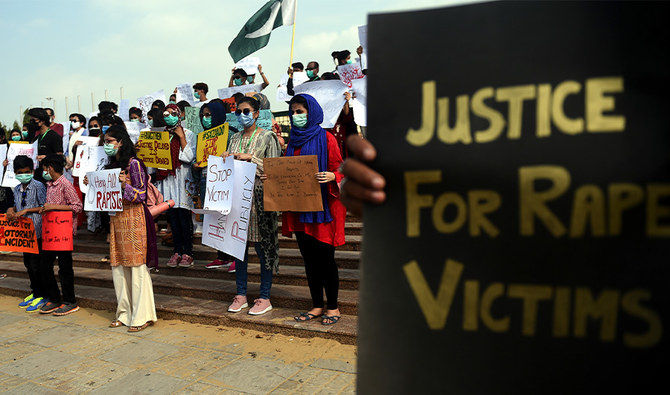
The court ruling and presidential ordinance have followed a series of headline-grabbing rape cases across the country, including the gang-rape of a woman in front of her children along a major highway in September last year.
The case resulted in public outrage as rights activists and citizens asked the government to take necessary measures to stem sexual violence against women and ensure that the perpetrators of such crimes were held accountable.
Pakistani law specifies 10 to 25 years in prison for rape and life imprisonment or death for gang-rape. However, these punishments have rarely been implemented.
Maliha Zia Lari, one of the petitioners in the case and associate director of the Legal Aid Society, termed the ruling a “landmark judgment.”
“We now need to devise a proper monitoring and evaluation mechanism to ensure that the practice is abandoned practically in all rape cases,” she told Arab News. “We also need to tell the police and prosecution that the two-finger test is illegal and has no evidentiary value.”
Lari said the government should properly train medico-legal officials, police and prosecutors and give them the requisite equipment to collect forensic evidence, like DNA in rape cases, to boost conviction rates.
“It’s still a long journey to achieve the hundred percent,” she said, “but the good thing is that we have taken the first step in the right direction.”


