

Italy allows ship to bring migrants ashore

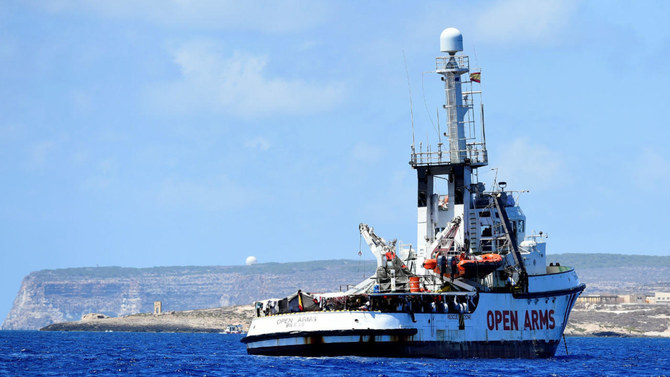
Spanish migrant rescue ship Open Arms with the Door to Europe monument in the background, Lampedusa, Italy, August 16, 2019. (Reuters)
Short Url
Updated 04 January 2021
Follow

Italy allows ship to bring migrants ashore

  • Spanish NGO’s Open Arms vessel rescued 169 people in the Mediterranean on Dec. 31 and 96 on Jan. 2
  • The migrants will be taken to a quarantine ship moored off Porto Empedocle

ROME: Italy has authorised a boat operated by the Spanish NGO Open Arms to disembark 265 migrants, including 63 minors, in Porto Empedocle, on the southern Sicilian coast.

The NGO’s vessel rescued 169 people in the Mediterranean on Dec. 31 and 96 on Jan. 2. They include at least fourteen women, one of them nine months pregnant, and 40 unaccompanied teenagers. The migrants will be taken to a quarantine ship moored off Porto Empedocle.

“Most of the migrants are Eritreans, but they also come from other countries such as Sudan, Bangladesh and Ethiopia. Those people are fleeing from Libyan detention centers, where they have been subjected to violence. All these men and women bear on their bodies the signs of the months, some of them even years, which they spent in those places, where they were held in inhumane conditions,” Monica Alfonsi, Open Arms representative in Italy told Arab News.

The rescued migrants had been waiting nearly four days on the Spanish humanitarian ship for a European country to authorise them to land, amid worsening sea conditions. Malta had refused permission for the migrants to disembark.

Most of the people aboard set off in dinghies from the Libyan city of Sabratha, about 60 kilometres west of Tripoli, on the morning of Dec. 30.

“They had a very difficult time because the weather conditions were very bad, with waves one and a half meters high and pouring rain,” Alfonsi said.

A total of 34,134 migrants arrived in Italy in 2020, almost three times as many as in the previous year, according to data published by the Italian Ministry of the Interior.

The Italian government has repeatedly asked the EU to launch a joint management plan for the migrants in the waters of the Central Mediterranean.

Italian Foreign Minister Luigi Di Maio yet again requested this week that the European Commission show courage to approve “a common response to the issue of immigration” and cease to be “immobile” while tens of thousands of people flee their home countries and try to reach Europe.

German school students rally against army recruitment drive

Updated 4 sec ago
Follow

German school students rally against army recruitment drive

BERLIN: Thousands of German teenagers skipped school Thursday to join protests against a stepped-up military recruitment drive that many fear may in future involve a form of conscription.
About 3,000 students gathered on Berlin’s Potsdamer Platz square, with smaller demonstrations held across Germany as part of a nationwide “school strike.”
“I don’t see why anyone should have to go to the front lines for politicians,” Alex Krzeszka, a 15-year-old student, told AFP at the Berlin rally.
“I don’t see it as morally right, and I think war should never be the solution. Problems should be solved diplomatically.”
Germany, like other European countries, has sought to build up its armed forces in response to Russia’s 2022 full-scale invasion of Ukraine and the threat of further aggression against NATO members.
Chancellor Friedrich Merz has vowed to turn the Bundeswehr into Europe’s largest conventional army, banking initially on a voluntary recruitment drive.
The government this year started requiring all 18-year-old men to fill out questionnaires about their interest and fitness for short-term military service.
Women are also being asked to fill out the forms, but cannot be compelled to do so under current German law.
Among the signs being waved by protesters in Berlin was a poster that read “We are not cannon fodder” while another demanded: “Send Friedrich Merz to the front line!” For now at least, German lawmakers have decided against bringing back mandatory conscription, which Germany suspended in 2011. But some politicians have expressed doubts about whether ambitious recruiting targets can be achieved without some from of conscription.

BACKGROUND

The government this year started requiring all 18-year-old men to fill out questionnaires about their interest and fitness for short-term military service.

Plans call for strengthening the Bundeswehr from about 185,000 active-duty troops now to 260,000 by 2030, while roughly quadrupling the size of the reserves to 200,000.
The Bundeswehr shrank dramatically after the end of the Cold War as countries across Europe slashed defense budgets.
In the 1980s, West Germany alone had fielded a military of nearly 500,000 troops.
“I think they should definitely advertise for the Bundeswehr, but it absolutely shouldn’t be compulsory,” Leander Martinez, a 16-year-old student from Berlin, told AFP.
“Reintroducing conscription is nothing other than rearmament,” Leon Reinemann, a student who helped organize the school strike in the western city of Koblenz, told broadcaster NTV.
He defended the fact students were skipping classes, saying that “a single day of absence from school is significantly less serious than six months in the barracks.”
Others took a more staunchly pacifist stance at the Berlin demonstration.
“I’m against conscription and against war propaganda,” Tillmann, a 19-year-old student who declined to give his last name, told AFP.
“And I think murdering someone is always wrong, even if the state says that someone should be murdered. There’s nothing more important than human life.”